

The United Nations Office at Geneva
Multimedia Newsroom
Four years of war in Ukraine: Childhood has ‘moved underground’, displacement continues – UN humanitarians
Civilian suffering shows no sign of letting up in Ukraine as the four-year-mark of Russia’s full-scale invasion nears amid attacks on energy infrastructure, blackouts and freezing temperatures, UN humanitarians warned on Tuesday.
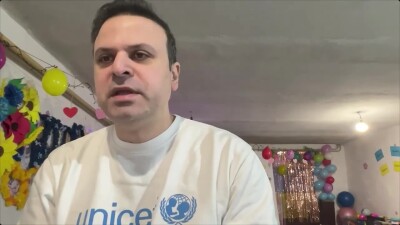
Speaking to reporters from a basement in Kherson, UN Children’s Fund (UNICEF) representative in Ukraine Munir Mammadzade said that the frontline city remains “under constant fire,” with daily attacks destroying homes and critical infrastructure, as well as the services that children and families rely on.
“I have been constantly hearing artillery shelling,” he said, speaking of yet another “massive, coordinated attack” which reportedly impacted civilian and energy infrastructure overnight.
The city’s children’s hospital was attacked eight times Tuesday morning, Mr. Mammadzade added.
With few places offering any sanctuary in Kherson, daily life is “a matter of survival” for children and families and the frontline area, the UNICEF representative said.
The region is “almost fully covered in anti-drone nets” and childhood has “literally moved underground,” he stressed.
Out of some 60,000 children who lived in Kherson prior to the start of Russia’s full-scale invasion on 24 February 2022, only about 5,000 are left, and have to “learn, play and sleep in basements just to stay safe.”
Mr. Mammadzade made his comments to journalists at a press briefing in Geneva, as negotiators from Ukraine and Russia gathered in the Swiss city on Tuesday for two days of US-brokered talks.
Speaking of the basement turned into a child protection hub managed by UNICEF from which he was connecting, Mr. Mammadzade said that there are “kids in the neighbouring room playing and engaging with psychologists, which is something precious to witness in places like Kherson because you hardly see people outside.”
Humanitarians working with the children “all speak about levels of exhaustion that families are enduring from living 24 hours a day in a hyper-alert state,” he said.
The UNICEF official stressed that attacks impacting civilian areas continue across the country, “including in the areas that we don't necessarily talk about,” such as western Ukraine and the capital Kyiv.
“Constant fear of attacks, sheltering in basements and isolation with limited social connection have left children struggling with circumstances of this war, with their mental and physical health directly impacted,” he concluded.
Arthur Erken, the International Organization for Migration (IOM) regional director for Europe, told reporters that due to attacks on civilian energy infrastructure “power cuts now structure daily life when families cook, when children study, when hospitals schedule procedures.”
“With temperatures down to -20 degrees Celsius, communities face severe shortages of heating, electricity and household repairs,” he added – with displaced people and recent returnees being particularly affected.
Ukraine remains Europe's largest displacement crisis, Mr. Erken said. Out of the 9.6 million people who have had to flee their homes, 3.7 million are internally displaced.
“In one of every three displaced households, someone is living with a disability, and in more than half, someone actually manages a chronic illness,” he said. “These aren't just statistics, but the daily realities that shape every decision, from medical care to putting food on the table.”
The IOM representative stressed that even after four years of full-scale war, Ukrainians continue to flee in search of safety and basic services.
“In the last year, more than 450,000 people were displaced from their homes, many for the second or even the third time,” he said.
Mr. Erken warned that 325,000 Ukrainian returnees could be displaced again in the coming months, with more than a third of those considering moving abroad again.
“Intentions to leave the country reflect the cumulative strain of insecurity, damaged housing and limited access to electricity and heating,” he said.
“After four years of war, resilience alone cannot sustain families through yet another winter of blackouts and freezing temperatures,” the IOM official insisted.
“Safe housing, reliable energy and essential services are not luxuries. They are fundamental to people's survival, safety and dignity,” he concluded.
-Ends-
STORY Ukraine approaches 4 years of war – UNICEF, IOM
TRT: 4:23”
SOURCE: UNTV CH
RESTRICTIONS: NONE
LANGUAGE: ENGLISH/NATS
ASPECT RATIO: 16:9
DATELINE: 17 FEBRUARY 2026 GENEVA, SWITZERLAND
1. Exterior wide shot: Palais des Nations, Flag Alley.
2. Medium-wide reverse shot: Speakers at the podium of the press conference; speaker on screens; journalists in the Press room.
3. SOUNDBITE (English) – Munir Mammadzade, Country Representative in Ukraine, UN Children’s Fund (UNICEF): “I'm in Kherson, which remains under constant fire, and daily attacks destroying homes and critical infrastructure, impacting the services that children and families rely on. Just two kilometres away from the frontline, actually, I have been hearing constantly artillery shelling and as you know, Ukraine was under another massive coordinated attack last night that have also reportedly impacted civilian and energy infrastructure.”
4. Wide shot: Speaker on screens; journalists in the Press room.
5. SOUNDBITE (English) – Munir Mammadzade, Country Representative in Ukraine, UN Children’s Fund (UNICEF): “Few places actually offer any sanctuary. In Kherson city and the region where again I'm here right now, the daily life is a matter of survival for children and families. And the frontline area, as I was with my colleagues driven through the region, is almost fully covered in anti-drone nets and childhood has actually literally moved underground where I am actually connecting [with] you right now.”
6. Wide shot: Speaker on screens, journalists in the Press room.
7. SOUNDBITE (English) – Munir Mammadzade, Country Representative in Ukraine, UN Children’s Fund (UNICEF): “There are about 5,000 children left only out of 60,000 who once lived peacefully with their families and friends until their childhood [was] actually upended forever on 24 February 2022. So today children learn, play and sleep in basements just to stay safe and we as UNICEF support many facilities like the one I'm right now in. It's a child protection hub.”
8. Medium over-the-shoulder reverse shot: Speakers at the podium of the press conference, speaker on screens.
9. SOUNDBITE (English) – Munir Mammadzade, Country Representative in Ukraine, UN Children’s Fund (UNICEF): “There are actually kids even in the neighbouring room playing and engaging with psychologists, which is something precious to witness in places like Kherson because you hardly see people outside. So in this hub we have case managers and they all speak about levels of exhaustion that families are enduring from living 24 hours a day in hyper-alert state. So constant basically fear of attacks, sheltering in basements and isolation with limited social connection have left children struggling with circumstances of this war, with their mental and physical health directly impacted.”
10. Wide reverse shot: Speakers at the podium of the press conference, speaker on screens, journalists in the Press room.
11. SOUNDBITE (English) – Arthur Erken, Regional Director for Europe, International Organization for Migration (IOM): “Missile and drone attacks on civilian energy infrastructure coupled with brutal winter conditions have made darkness and cold a daily reality for Ukrainians across the country. Power cuts now structure daily life when families cook, when children study, when hospitals schedule procedures. With temperatures down to -20 degrees Celsius, communities face severe shortages of heating, electricity and household repairs.”
12. Wide shot: Speaker on screens; journalists in the Press room.
13. SOUNDBITE (English) – Arthur Erken, Regional Director for Europe, International Organization for Migration (IOM): “In one of every three displaced households, someone is living with a disability, and in more than half, someone actually manages a chronic illness. These aren't just statistics, but the daily realities that shape every decision, from medical care to putting food on the table.”
14. Medium shot: Journalists in the Press room.
15. SOUNDBITE (English) – Arthur Erken, Regional Director for Europe, International Organization for Migration (IOM): “325,000 Ukrainian returnees could be displaced again in the coming months, with more than a third of those considering moving abroad again. Intentions to leave the country reflects the cumulative strain of insecurity, damaged housing and limited access to electricity and heating.”
16. Various shots of journalists in the Press room.
Similar Stories

1
1
1
Edited News | UNICEF
A little over one year since a ceasefire agreement was announced between Hamas fighters and Israel, more than 340 children have been reported killed and hundreds more injured, the UN Children’s Fund, UNICEF, said on Friday.

1
1
1
Edited News | UNICEF , IFRC
Six weeks after Nepal’s deadly flooding disaster, communities are still struggling to rebuild their lives, but they will need sustained help as global warming increases the risk of another Himalayan catastrophe, the UN Children’s Fund (UNICEF) said on Friday.

1
1
1
Edited News | WHO
In suspected Russia plague death, testing and monitoring underway – WHO
The death of a lab worker in Russia’s Siberia region has sparked concerns about plague being the cause, the UN World Health Organization (WHO) said on Tuesday, adding that it was following the situation closely.

1
1
Edited News | OHCHR , UNOG
UN Human Rights Chief Volker Türk on Friday provided and oral update to the 63rd session of the Human rights Council on Ukraine.

1
1
1
Edited News | OHCHR , UNOG
UN Human Rights Chief Volker Türk on Friday provided and oral update to the 63rd session of the Human rights Council on the human rights situation in Haiti.

1
1
1
Edited News | WHO
Repeated delays in bringing lifesaving medicines, prosthetics and more from Israel into Gaza risk having devastating consequences on Palestinians who urgently need them in the wartorn enclave, the UN World Health Organization (WHO) said on Friday. “A truck full of non-priority supplies or the right supplies arriving too late, doesn't save lives. That's the question that actually matters," said Dr Reinhilde Van De Weerdt, WHO Representative in the OPT.

1
1
1
Edited News | WHO
DRC: Early access to care and oxygen decisive for Ebola patients’ survival – WHO
In the Democratic Republic of the Congo (DRC), health workers fighting the country’s largest-ever Ebola outbreak are struggling to overcome critical challenges to patient care, the UN World Health Organization (WHO) warned on Tuesday.

1
1
1
Edited News | OCHA , UN
Civilians in Iran are continuing to feel the consequences of months of conflict and military escalation, the UN’s top official in the country has said, as loss of life, damage to civilian infrastructure and mounting economic pressures leave many facing continued uncertainty.
1
1
1
Edited News | WHO , UNICEF
Aid agencies in Yemen highlighted the growing hunger emergency sparked by renewed fighting between Houthi opposition forces and Government troops, after mobile health clinics reported that hundreds of children displaced by the violence are suffering from the most deadly form of malnutrition.
1
1
1
Edited News | UNHCR
Displacement on the rise in Yemen as fighting continues - UNHCR
As hostilities worsen in Yemen, more people have been fleeing their homes, further intensifying the humanitarian crisis within the region, the UN Refugee Agency (UNHCR) warned on Tuesday.
1
1
1
Edited News | IOM , OHCHR , UNFPA , UNOG , UNHCR , WHO
Yemen’s humanitarian crisis growing by the hour amid spike in displacement
Yemenis displaced by renewed fighting have described fleeing for their lives amid shelling and gunfire, aid agencies reported on Friday, while highlighting the dramatic increase in humanitarian needs in the country and in Djibouti, where thousands have sought shelter.
1
1
1
Edited News | OHCHR , UNOG
The UN Human Rights Office issued on Friday a report documenting a shocking pattern of sexual violence amid Russia’s full-scale armed attack on Ukraine.