

The United Nations Office at Geneva
Multimedia Newsroom
In Lebanon, the same fears and dangers persist despite ceasefire: UNHCR
Death and destruction have continued unabated in Lebanon while communities are still unable to return to their homes despite a ceasefire that began on 17 April, humanitarians said on Tuesday.
“Civilians in the south of Lebanon and parts of the Bekaa [Valley] are really living with the same fear for their lives as before the ceasefire and more are being forced to flee…many of the displaced are not even allowed to return by the Israeli army in areas it controls in the south,” said Karolina Lindholm Billing, UN refugee agency (UNHCR) Representative in Lebanon.
Since 17 April, at least 380 people have been killed despite a ceasefire between Lebanon and Israel, the agency said.
In addition, homes and public services have suffered “widespread destruction” across large parts of the country, affecting hundreds of thousands of people, the UNHCR official reported.
She described meeting families who had tried to return to their homes in Nabatieh and Tyre after the ceasefire, only to find twisted masonry and chaos.
“They were even more devastated than before after seeing their homes completely destroyed,” Ms. Lindholm Billing explained. “One man, he showed me a photo on his phone of his demolished house. And he’s now back inside a sleeping on the floor in a classroom that serves as a collective shelter with nothing to return to and a very uncertain future.”
Civilians and emergency workers are protected under international humanitarian law, but that hasn’t prevented the targeting of non-combatants who live in fear of being killed every day.
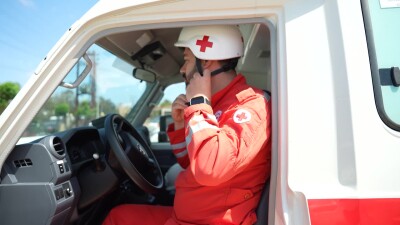
“I want to share one clear message from Lebanese Red Cross volunteers: they are asking for protection,” said Tommaso Della Longa, spokesperson for UN partner, the International Federation of Red Cross and Red Crescent Societies (IFRC). While visiting volunteer paramedics in Lebanon last week he said that “every time they go on an ambulance mission, they hug each other and say goodbye to one another, unsure if they will return safely.”
In the last two months, two IFRC Lebanon paramedics have been killed or died from injuries sustained while responding to callouts in southern Lebanon: Youssef Assaf and Hassan Badawi.
“In a normal world, Red Cross volunteers would not need flak jackets or helmets in ambulances, the emblem should protect them,” said Mr. Della Longa. “But this is not a normal world. In Lebanon, Youssef and Hassan were killed while saving lives. The emblem did not protect them, nor their protective equipment.”
Across Lebanon today, around 1.8 million people have been uprooted by the war between Hezbollah fighters and Israel, which erupted on 2 March when the Israeli military responded to Hezbollah rocket fire, three days after Israel and the US began bombing Iran.
“Families forced from their homes speak not only of loss but of their dignity being taken away,” stressed Mr. Della Longa. He explained that restoring people’s dignity “is central to the response”. Delivering aid is important, but so too is “listening, involving people and enabling them to support one another”, he said, adding that the ceasefire “has not restored norms or livelihoods, nor does it guarantee basic needs such as water, food or healthcare”.
ends
Lebanon emergency update – UNHCR, IFRC
TRT: 3 min 30s
SOURCE: UNTV CH
RESTRICTIONS: NONE
LANGUAGE: ENGLISH / NATS
ASPECT RATIO: 16:9
DATELINE: 5 MAY 2026 GENEVA, SWITZERLAND & Broll from UNHCR in LEBANON taken 30 April 2026 and from IFRC in LEBANON taken 1 May 2026; please consider crediting the relevant organization.
Speakers:
- Karolina Lindholm Billing, Representative in Lebanon, UN Refugee Agency (UNHCR) from Beirut
- Tommaso Della Longa, spokesperson, International Federation of Red Cross and Red Crescent Societies (IFRC) in Geneva
SHOTLIST
- Exterior wide, UN Geneva flag alley.
- SOUNDBITE (English) – Karolina Lindholm Billing, Representative in Lebanon, UN Refugee Agency (UNHCR): “Civilians in the south of Lebanon and parts of the Bekaa are really living with the same fear for their lives as before the ceasefire and more are being forced to flee. Just to recall that since 17 April, at least 380 people have been killed despite the ceasefire and widespread destruction continues across large parts of the country.”
- Wide, podium.
- SOUNDBITE (English) – Karolina Lindholm Billing, Representative in Lebanon, UN Refugee Agency (UNHCR): “Insecurity continues to shape people's decisions about whether to return to their home villages or to stay put in relative safety, for now. And many of the displaced are not even allowed to return by the Israeli army in areas it controls in the south.”
- Medium, journalist.
- SOUNDBITE (English) – Karolina Lindholm Billing, Representative in Lebanon, UN Refugee Agency (UNHCR): “Many of those who return and have tried to go back since the ceasefire, have witnessed widespread destruction of their homes, of infrastructure, no electricity or water, damaged or non-functional health care facilities and schools, and ongoing risks from unexploded ordinance.”
- Wide, video journalists.
- SOUNDBITE (English) – Karolina Lindholm Billing, Representative in Lebanon, UN Refugee Agency (UNHCR): “One man, he showed me a photo on his phone of his demolished house, and he's now back inside a sleeping on the floor in Saida in a classroom that serves as a collective shelter with nothing to return to and a very uncertain future.”
- Wide, podium speakers, journalists.
- SOUNDBITE (English) – Tommaso Della Longa, spokesperson, International Federation of Red Cross and Red Crescent Societies (IFRC): “I want to share one clear message from Lebanese Red Cross volunteers: they are asking for protection. Every time they go on an ambulance mission, they hug each other and say goodbye to one another, unsure if they will return safely.”
- Medium, podium speakers.
- SOUNDBITE (English) – Tommaso Della Longa, spokesperson, International Federation of Red Cross and Red Crescent Societies (IFRC): “In a normal world, Red Cross volunteers would not need flak jackets or helmets in ambulances. The emblem should protect them. But this is not a normal world. In Lebanon, Youssef and Hassan were killed while saving lives. The emblem did not protect them, nor their protective equipment.”
- Medium, ambulance worker preparing to head out in ambulance; IFRC footage taken 1 May 2026 in Lebanon.
- Wide, ambulance workers on steps of medical facility, IFRC footage taken 1 May 2026 in Lebanon.
- Wide, ambulance worker walking to IFRC vehicle, IFRC footage taken 1 May 2026 in Lebanon.
- Wide, Lebanon makeshift shelter, UNHCR footage taken 30 April 2026 in Lebanon.
- Wide, Lebanon makeshift shelter, UNHCR footage taken 30 April 2026 in Lebanon.
- Wide tents on roadside, UNHCR footage taken 30 April 2026 in Lebanon.
- Wide children in wasteland by makeshift shelters, UNHCR footage taken 30 April 2026 in Lebanon.
- Wide, school shelter and bed, UNHCR footage taken 30 April 2026 in Lebanon.
- Medium, school shelter and bed, UNHCR footage taken 30 April 2026 in Lebanon.
- Medium, tent and tarpaulin, UNHCR footage taken 30 April 2026 in Lebanon.
- Wide, tents on roadside under palm trees, UNHCR footage taken 30 April 2026 in Lebanon.
Similar Stories

2
17
1
2
Edited News , Press Conferences | OCHA , WMO
Two UN agencies teamed up on Wednesday to issue an appeal for immediate assistance to help communities already being impacted by the strongest El Niño on record.

3
16
2
2
B-roll , Conferences , Edited News | UNITED NATIONS , UNOG
Sixth Consultative Meeting on Enhancing Coordination of Peace Initiatives and Efforts for Sudan

1
1
1
Edited News | UNICEF , WHO , UNHCR
Yemen war continues to force families from homes amid hunger and disease
More than 250,000 people have now fled renewed fighting in Yemen, the UN said on Tuesday, citing particular concern for those sheltering in the southwestern city of Taiz and the wider governorate, where access is “essentially blocked”.

1
1
1
Edited News | UNICEF
A little over one year since a ceasefire agreement was announced between Hamas fighters and Israel, more than 340 children have been reported killed and hundreds more injured, the UN Children’s Fund, UNICEF, said on Friday.

1
1
1
Edited News | UNICEF , IFRC
Six weeks after Nepal’s deadly flooding disaster, communities are still struggling to rebuild their lives, but they will need sustained help as global warming increases the risk of another Himalayan catastrophe, the UN Children’s Fund (UNICEF) said on Friday.

1
1
1
Edited News | WHO
In suspected Russia plague death, testing and monitoring underway – WHO
The death of a lab worker in Russia’s Siberia region has sparked concerns about plague being the cause, the UN World Health Organization (WHO) said on Tuesday, adding that it was following the situation closely.

1
1
Edited News | OHCHR , UNOG
UN Human Rights Chief Volker Türk on Friday provided and oral update to the 63rd session of the Human rights Council on Ukraine.

1
1
1
Edited News | OHCHR , UNOG
UN Human Rights Chief Volker Türk on Friday provided and oral update to the 63rd session of the Human rights Council on the human rights situation in Haiti.

1
1
1
Edited News | WHO
Repeated delays in bringing lifesaving medicines, prosthetics and more from Israel into Gaza risk having devastating consequences on Palestinians who urgently need them in the wartorn enclave, the UN World Health Organization (WHO) said on Friday. “A truck full of non-priority supplies or the right supplies arriving too late, doesn't save lives. That's the question that actually matters," said Dr Reinhilde Van De Weerdt, WHO Representative in the OPT.

1
1
1
Edited News | WHO
DRC: Early access to care and oxygen decisive for Ebola patients’ survival – WHO
In the Democratic Republic of the Congo (DRC), health workers fighting the country’s largest-ever Ebola outbreak are struggling to overcome critical challenges to patient care, the UN World Health Organization (WHO) warned on Tuesday.

1
1
1
Edited News | OCHA , UN
Civilians in Iran are continuing to feel the consequences of months of conflict and military escalation, the UN’s top official in the country has said, as loss of life, damage to civilian infrastructure and mounting economic pressures leave many facing continued uncertainty.
1
1
1
Edited News | WHO , UNICEF
Aid agencies in Yemen highlighted the growing hunger emergency sparked by renewed fighting between Houthi opposition forces and Government troops, after mobile health clinics reported that hundreds of children displaced by the violence are suffering from the most deadly form of malnutrition.