

The United Nations Office at Geneva
Multimedia Newsroom
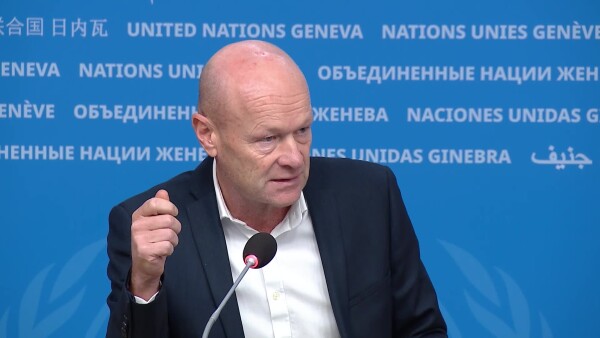
DR Congo Ebola outbreak spreading exponentially, UN responders warn
As the deadliest Ebola outbreak in DR Congo’s history continued spreading on Friday, UN responders renewed their urgent appeal for immediate international support, with existing funding for lifesaving work critically low.
“We're only covered for the next weeks, and very soon funding will run out,” said Julien Harneis, UN Senior Ebola Coordinator. “Every delay in funding and implementation makes this epidemic more deadly, more difficult to stop and more expensive. So, we need that international support immediately.”
Since the outbreak was declared on 15 May, 5,290 people have been infected 2,516 have died, according to latest health authority data published on Friday.
Of the total confirmed number of cases, 1,152 people have recovered and nearly 840 people remain in isolation or hospitalized. The fatality rate is 47.6 per cent and contact follow-up is 82.9 per cent.
Briefing journalists from the Ebola epicentre in Bunia, Ituri province, Mr. Harneis warned that the disease is “growing exponentially”, with half of all deaths occurring in just the last 20 days.
“The epidemic is spreading to an area that is bigger than France. And the outbreak is growing faster and wider than the Ebola response,” he stressed, as “brutal” operating conditions continue to impede the progress of frontline workers.
Three months into the outbreak, 160 healthcare workers have contracted Ebola and 43 of them have died. “And then when we do respond, apart from the threat from the virus, healthcare workers and frontline workers have been attacked by youths, ambulances have been burned and stoned and the healthcare facilities have been attacked,” Mr. Harneis explained.
“Conditions on the ground are extremely difficult, but we will continue deploying all the humanitarian and medical assistance needed until the job is done,” the veteran aid official said.
“Last week, I was trying to get into an Ebola hotspot, and it took three hours to drive 60 kilometres,” he added.
Another key obstacle to the response is the lack of basic social services in the six eastern, provinces where the virus is spreading (Ituri, North Kivu, South Kivu, Haut-Uélé, Tshopo, and Bas-Uélé), a direct result of decades of violence in the resource-rich area.
Gaps in government-run, coordinated healthcare services and a limited number of banks have created further problems.
“In this area, the banking system barely functions,” Mr. Harneis explained. “We're unable to bring in the amount of money that is required to pay the workers, which has led to great unhappiness amongst frontline workers.”
And although the United States has contributed $80 million to the DRC Government to boost bed capacity and safe burial practices, among other support, cuts to aid work - especially in the last two years - have reduced the capacity of humanitarian organizations by more than 30 per cent, he added.
Despite these challenges, multiple specialist UN agencies continue to work alongside the DRC authorities to push back Ebola. They include the World Health Organization, the World Food Programme, the UN Children’s Fund (UNICEF), the UN migration agency (IOM) and partners including Médecins Sans Frontières.
“It's a disease, it's an invisible threat which comes into your community and suddenly people start falling sick around you and your loved ones die,” Mr. Harneis said. “And that generates a lot of fear in any community.”
ends
DR Congo Ebola outbreak - OCHA
TRT: 3’11”
SOURCE: UNTV CH
RESTRICTIONS: NONE
LANGUAGE: ENGLISH / FRENCH / NATS
ASPECT RATIO: 16:9
DATELINE: 21 AUGUST 2026 GENEVA, SWITZERLAND & JULY and AUGUST 2026 BUNIA, DR CONGO; please credit OCHA.
Speakers:
- Julien Harneis, UN Senior Ebola Coordinator (from Bunia, DR Congo)
SHOTLIST
- Exterior wide, UN Geneva flag alley.
- Wide, UN Geneva Press Room, podium speakers, external speaker shown on TV screens.
- SOUNDBITE (English) – Julien Harneis, UN Senior Ebola Coordinator: “The Ebola outbreak is growing exponentially. In the last three months, 2,500 people have died and half of those in the last 20 days. And the epidemic is spreading widely; it's now covering an area that is bigger than France.”
- Medium-wide, podium speakers, external speaker on TV screen.
- SOUNDBITE (English) – Julien Harneis, UN Senior Ebola Coordinator: “Why is it so difficult to respond? Well, the operating conditions are brutal; 160 healthcare workers have fallen ill with Ebola and 43 of them have died. And then when we do respond, apart from the threat from the virus, healthcare workers and frontline workers have been attacked by youths. Ambulances have been burned and stoned and the healthcare facilities have been attacked.”
- Wide, Press Room, TV screens showing external speaker.
- SOUNDBITE (French) – Julien Harneis, UN Senior Ebola Coordinator: “Je regarde les collègues du Gouvernement ; ils sont sur le terrain en permanence et ils ne relâchent pas. Oui, c'est vrai que des ambulances ont été cassés, mais nous continuons le travail. C'est vrai que les conditions de la route, des conditions sur le terrain sont extrêmement difficiles, mais nous continuons à déployer toute l'assistance humanitaire et médicale qui est nécessaire, et nous continuons jusqu'à c’est terminé.”
- Wide, podium speakers, TV screen showing external speaker.
- SOUNDBITE (English) – Julien Harneis, UN Senior Ebola Coordinator: “Just getting around is difficult. Last week, I was trying to get into an Ebola hotspot, and it took three hours to drive 60 kilometres.”
- Wide, Press Room.
- SOUNDBITE (English) – Julien Harneis, UN Senior Ebola Coordinator: “In this area, the banking system barely functions. We're unable to bring in the amount of money that is required to pay the workers, which has led to great unhappiness amongst frontline workers. And then aid cuts over the years, particularly the last two years, have reduced the capacity of humanitarian organisations by more than 30 per cent.”
- Wide, Press Room.
- SOUNDBITE (English) – Julien Harneis, UN Senior Ebola Coordinator: “We're only covered for the next weeks, and very soon funding will run out. So, we need to scale up, we need to have far greater investment, far greater support from the international community. And every delay in funding and implementation makes this epidemic more deadly, more difficult to stop and more expensive. So, we need that international support immediately.”
- Medium-wide, Press Room.
- Medium, journalist.
- Medium, participants, journalist.
- Wide, a health centre in Bunia, Ituri province. Please credit OCHA.
- Medium-wide, Julien Harneis speaking to a motorbike rider. Please credit OCHA.
- Medium-wide, a community health care worker talking to a mother and children. Please credit OCHA.
- Medium-wide, a community health care worker talking to a mother and children. Please credit OCHA.

Similar Stories
1
1
1
Edited News | OCHA , UNICEF , WFP
Aid agencies warned on Friday of the fast-developing humanitarian emergency inside Taiz City in Yemen, which has been encircled by de facto Houthi forces fighting government troops along the country’s west coast.

2
17
1
2
Edited News , Press Conferences , Images | OCHA , WMO
Two UN agencies teamed up on Wednesday to issue an appeal for immediate assistance to help communities already being impacted by the strongest El Niño on record.

3
16
2
2
Edited News , B-roll , Conferences , Images | UNITED NATIONS , UNOG
Sixth Consultative Meeting on Enhancing Coordination of Peace Initiatives and Efforts for Sudan

1
1
1
Edited News | UNICEF , WHO , UNHCR
Yemen war continues to force families from homes amid hunger and disease
More than 250,000 people have now fled renewed fighting in Yemen, the UN said on Tuesday, citing particular concern for those sheltering in the southwestern city of Taiz and the wider governorate, where access is “essentially blocked”.

1
1
1
Edited News | UNICEF
A little over one year since a ceasefire agreement was announced between Hamas fighters and Israel, more than 340 children have been reported killed and hundreds more injured, the UN Children’s Fund, UNICEF, said on Friday.

1
1
1
Edited News | UNICEF , IFRC
Six weeks after Nepal’s deadly flooding disaster, communities are still struggling to rebuild their lives, but they will need sustained help as global warming increases the risk of another Himalayan catastrophe, the UN Children’s Fund (UNICEF) said on Friday.

1
1
1
Edited News | WHO
In suspected Russia plague death, testing and monitoring underway – WHO
The death of a lab worker in Russia’s Siberia region has sparked concerns about plague being the cause, the UN World Health Organization (WHO) said on Tuesday, adding that it was following the situation closely.

1
1
Edited News | OHCHR , UNOG
UN Human Rights Chief Volker Türk on Friday provided and oral update to the 63rd session of the Human rights Council on Ukraine.

1
1
1
Edited News | OHCHR , UNOG
UN Human Rights Chief Volker Türk on Friday provided and oral update to the 63rd session of the Human rights Council on the human rights situation in Haiti.

1
1
1
Edited News | WHO
Repeated delays in bringing lifesaving medicines, prosthetics and more from Israel into Gaza risk having devastating consequences on Palestinians who urgently need them in the wartorn enclave, the UN World Health Organization (WHO) said on Friday. “A truck full of non-priority supplies or the right supplies arriving too late, doesn't save lives. That's the question that actually matters," said Dr Reinhilde Van De Weerdt, WHO Representative in the OPT.

1
1
1
Edited News | WHO
DRC: Early access to care and oxygen decisive for Ebola patients’ survival – WHO
In the Democratic Republic of the Congo (DRC), health workers fighting the country’s largest-ever Ebola outbreak are struggling to overcome critical challenges to patient care, the UN World Health Organization (WHO) warned on Tuesday.

1
1
1
Edited News | OCHA , UN
Civilians in Iran are continuing to feel the consequences of months of conflict and military escalation, the UN’s top official in the country has said, as loss of life, damage to civilian infrastructure and mounting economic pressures leave many facing continued uncertainty.