

The United Nations Office at Geneva
Multimedia Newsroom
Children shot, stabbed and pepper-sprayed in occupied West Bank; scores of Gaza amputees denied prosthetics, aid teams warn
Israeli military operations and surging settler attacks in the occupied West Bank are killing and maiming Palestinian children, while in Gaza tens of thousands with life-changing injuries lack access to treatment and rehabilitation, UN agencies warned on Tuesday.
UN Children’s Fund (UNICEF) spokesperson James Elder told reporters in Geneva that children in the occupied West Bank, including East Jerusalem, are “paying an intolerable price” for the ongoing violence. Some 70 children have been killed since January 2025 – at least one on average every week – and a further 850 injured, mostly by live ammunition.
“All this comes amid historic levels of settler attacks,” he said, explaining that March 2026 saw the highest number of Palestinians injured by settler attacks in the last 20 years.
“We're seeing attacks become increasingly coordinated,” Mr. Elder added, citing data from the UN humanitarian affairs coordination office (OCHA). “Documented incidents include children shot, stabbed, children beaten, and children pepper-sprayed.”
Recalling his recent West Bank visit, the UNICEF spokesperson described meeting an eight-year-old who had been beaten with a piece of wood in a settler attack and hospitalized for head injuries.
The boy’s mother “had both her arms broken when she reached across to protect her four-month-old baby, putting therefore her arms between her baby and the attacker's club”.
Mr. Elder also highlighted the prevalence of education-related attacks, including the killing, injury and detention of students, as well as the demolition of schools.
“Schools, which should be places of safety and stability, are increasingly becoming places of panic,” he stressed.
“I walked with schoolchildren through the West Bank so as to try and help them avoid any attacks,” the UNICEF spokesperson recounted. “It's interesting to watch them walk...They don't walk in a straight line because they're constantly looking over their shoulder.”
“This is a walk to school. It's become a walk through fear,” he insisted.
Mr. Elder also reported on a “sharp rise” in the arrest and the detention of Palestinian children from the occupied territory, saying that 347 of them are being held in Israeli military detention “for alleged security-related offences” – the highest number in eight years.
“Alarmingly, more than half of these children, 180, are held under administrative detention and without the procedural safeguards, including detention without regular access to legal counsel and the right to challenge detention,” he said.
Meanwhile in Gaza, Mr. Elder said that since the October 2025 ceasefire, the UN has documented at least 229 children killed and 260 injured.
Dr Reinhilde Van de Weerdt, the UN World Health Organization (WHO)’s representative in the Occupied Palestinian Territories, told reporters that some 10,000 children in the devastated Strip live with life-changing injuries.
Overall, an estimated 43,000 of the 172,000 people injured in Gaza since October 2023 have sustained such trauma, affecting limbs, the spinal cord or brain. Almost 2,500 people have been injured since the October 2025 ceasefire.
“Of the 2,277 people that have had a limb amputated, less than 25 per cent have been fitted with permanent prosthetics,” Dr Van de Weerdt said, due to a severe shortage of prosthetics in Gaza.
Speaking from Jerusalem, the WHO representative explained that no less than 18 shipments of rehabilitation-related supplies such as wheelchairs or prosthetic limbs are pending clearance to enter Gaza, with waiting times ranging from 130 days to more than a year.
In total, more than 50,000 conflict-related injuries require long-term rehabilitation; no rehabilitation facilities are functional in the enclave.
“Every day that rehabilitation services in Gaza remain under-resourced is a day that preventable disability risks become permanent,” she concluded.
-Ends-
STORY Occupied West Bank, Gaza update – UNICEF, WHO
TRT: 3:14’’
SOURCE: UNTV CH
RESTRICTIONS: NONE
LANGUAGE: ENGLISH/NATS
ASPECT RATIO: 16:9
DATELINE: 12 MAY 2026 GENEVA, SWITZERLAND
1. Exterior wide shot: Palais des Nations, Flag Alley.
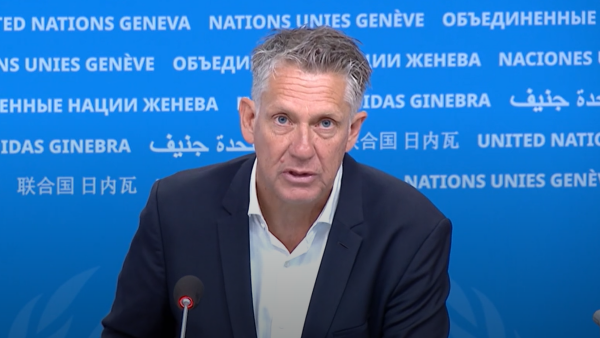
2. Wide reverse shot: Speakers at the podium of the press conference; speaker on screens; journalists in the Press room.
3. SOUNDBITE (English) – James Elder, spokesperson, UN Children’s Fund (UNICEF): “Between January 2025 and today, at least one Palestinian child has been killed on average every single week in the occupied West Bank, including East Jerusalem. So that's 70 Palestinian children killed in this timeframe. Now, 93 per cent of those were killed by Israeli forces, and a further 850 Palestinian children were injured. Most of those killed or wounded were done by live ammunition.”
4. Medium reverse shot: Speakers at the podium of the press conference; speaker on screen.
5. SOUNDBITE (English) – James Elder, spokesperson, UN Children’s Fund (UNICEF): “March 2026 saw the highest number of Palestinians injured by settler attacks in the last 20 years. And we're seeing attacks become increasingly coordinated. So, documented incidents include children shot, stabbed, children beaten, and children pepper-sprayed.”
6. Medium shot: Journalist in the Press room.
7. SOUNDBITE (English) – James Elder, spokesperson, UN Children’s Fund (UNICEF): “Little eight-year-old Ezzaldin was beaten with a piece of wood and hospitalized for head injuries. His mother had both her arms broken when she reached across to protect her four-month-old baby, putting therefore her arms between her baby and the attacker's club.”
8. Wide shot: Journalists in the Press room; speaker on screens.
9. SOUNDBITE (English) – James Elder, spokesperson, UN Children’s Fund (UNICEF): “I walked with school children through the West Bank so as to try and help them avoid any attacks. And it's interesting to watch them walk. They don't walk in a straight line because they're constantly looking over their shoulder. This is a walk to school. It's become a walk through fear.”
10. Medium shot: Journalists in the Press room.
11. SOUNDBITE (English) – James Elder, spokesperson, UN Children’s Fund (UNICEF): “347 Palestinian children from the West Bank are being held in Israeli military detention for alleged security-related offences. This is the highest number in eight years. Alarmingly, more than half of these children, 180, are held under administrative detention and without the procedural safeguards, including detention without regular access to legal counsel and the right to challenge detention.”
12. Wide reverse shot: Speakers at the podium of the press conference; speaker on screens; journalists in the Press room.
13. SOUNDBITE (English) – Dr Reinhilde Van de Weerdt, Representative in the Occupied Palestinian Territories, World Health Organization (WHO): “Since the last report in September [20]25, almost 5,000 additional injuries have been recorded, and nearly half of these 5,000 additional injuries occurred after the ceasefire announced in October of [20]25.”
14. Medium shot: Journalists in the Press room.
15. SOUNDBITE (English) – Dr Reinhilde Van de Weerdt, Representative in the Occupied Palestinian Territories, World Health Organization (WHO): “At the same time, of the 2,277 people that have had a limb amputated, less than 25 per cent have been fitted with permanent prosthetics. This [is] due to severe shortage of prosthetics in Gaza.”
16. Wide shot: Journalists in the Press room.
17. SOUNDBITE (English) – Dr Reinhilde Van de Weerdt, Representative in the Occupied Palestinian Territories, World Health Organization (WHO): “18 shipments of rehabilitation related supplies are pending clearance to enter Gaza, with waiting times ranging from 130 days to more than a year. Pending items include things such as wheelchairs, prosthetic limbs, and basic rehabilitation equipment such as stationary bicycles. And every day that rehabilitation services in Gaza remain under-resourced is a day that preventable disability risks become permanent.”
18. Various shots of journalists in the Press room.
Similar Stories

2
17
1
2
Edited News , Press Conferences | OCHA , WMO
Two UN agencies teamed up on Wednesday to issue an appeal for immediate assistance to help communities already being impacted by the strongest El Niño on record.

3
16
2
2
B-roll , Conferences , Edited News | UNITED NATIONS , UNOG
Sixth Consultative Meeting on Enhancing Coordination of Peace Initiatives and Efforts for Sudan

1
1
1
Edited News | UNICEF , WHO , UNHCR
Yemen war continues to force families from homes amid hunger and disease
More than 250,000 people have now fled renewed fighting in Yemen, the UN said on Tuesday, citing particular concern for those sheltering in the southwestern city of Taiz and the wider governorate, where access is “essentially blocked”.

1
1
1
Edited News | UNICEF
A little over one year since a ceasefire agreement was announced between Hamas fighters and Israel, more than 340 children have been reported killed and hundreds more injured, the UN Children’s Fund, UNICEF, said on Friday.

1
1
1
Edited News | UNICEF , IFRC
Six weeks after Nepal’s deadly flooding disaster, communities are still struggling to rebuild their lives, but they will need sustained help as global warming increases the risk of another Himalayan catastrophe, the UN Children’s Fund (UNICEF) said on Friday.

1
1
1
Edited News | WHO
In suspected Russia plague death, testing and monitoring underway – WHO
The death of a lab worker in Russia’s Siberia region has sparked concerns about plague being the cause, the UN World Health Organization (WHO) said on Tuesday, adding that it was following the situation closely.

1
1
Edited News | OHCHR , UNOG
UN Human Rights Chief Volker Türk on Friday provided and oral update to the 63rd session of the Human rights Council on Ukraine.

1
1
1
Edited News | OHCHR , UNOG
UN Human Rights Chief Volker Türk on Friday provided and oral update to the 63rd session of the Human rights Council on the human rights situation in Haiti.

1
1
1
Edited News | WHO
Repeated delays in bringing lifesaving medicines, prosthetics and more from Israel into Gaza risk having devastating consequences on Palestinians who urgently need them in the wartorn enclave, the UN World Health Organization (WHO) said on Friday. “A truck full of non-priority supplies or the right supplies arriving too late, doesn't save lives. That's the question that actually matters," said Dr Reinhilde Van De Weerdt, WHO Representative in the OPT.

1
1
1
Edited News | WHO
DRC: Early access to care and oxygen decisive for Ebola patients’ survival – WHO
In the Democratic Republic of the Congo (DRC), health workers fighting the country’s largest-ever Ebola outbreak are struggling to overcome critical challenges to patient care, the UN World Health Organization (WHO) warned on Tuesday.

1
1
1
Edited News | OCHA , UN
Civilians in Iran are continuing to feel the consequences of months of conflict and military escalation, the UN’s top official in the country has said, as loss of life, damage to civilian infrastructure and mounting economic pressures leave many facing continued uncertainty.
1
1
1
Edited News | WHO , UNICEF
Aid agencies in Yemen highlighted the growing hunger emergency sparked by renewed fighting between Houthi opposition forces and Government troops, after mobile health clinics reported that hundreds of children displaced by the violence are suffering from the most deadly form of malnutrition.