

The United Nations Office at Geneva
Multimedia Newsroom
Rising tensions along the Blue Line
Monday’s hastily-convened meeting of the UN Security Council at the request of France in response to escalating violence in Lebanon between Israel and Hezbollah has underlined deepening international concern as the conflict intensifies, despite ongoing US-mediation efforts.
Once gathered in the famous horseshoe-shaped chamber, Member States urged de-escalation by both sides and reiterated the obligation to protect civilians and respect the UN peacekeeping mission in Lebanon, UNIFIL.
Although the force’s mandate is scheduled to end on 31 December, UN Secretary-General António Guterres insisted that peacekeepers would be needed in Lebanon beyond that date.
He presented three possible scenarios involving between some 2,000 and more than 5,500 UN personnel who could monitor the ceasefire and support the Lebanese army.
To better understand the situation on the ground, UN News spoke with UNIFIL spokesperson Tilak Pokharel.
Escalation still a reality in southern Lebanon
UNIFIL’s Mr. Pokharel noted an uptick in violence between last weekend and today. “We have seen more trajectories, being fired from both sides. For example, yesterday marked the highest, number of trajectories fired by the Israeli side, IDF, and the day before also was the same level, almost.” Non-state armed groups also continue to fire into Israeli targets from Lebanon, he added.
Large-scale destruction along the Blue Line
The UNIFIL spokesperson noted that the IDF had advanced deeper inside Lebanon, while in the south they have carried out large-scale destruction of houses and other civil infrastructure. “So that forced the people living here from their homes and they have not been able to come back, of course…now, much of the area that our positions are is under IDF control.”
UNIFIL’s support to the local communities
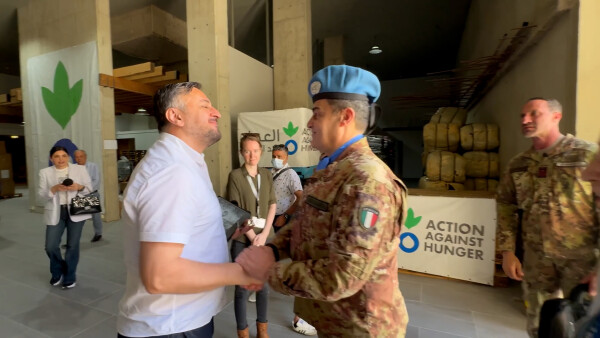
UNIFIL is trying to help people who have decided to stay by supporting access for humanitarian organizations, and by escorting aid relief missions.
Mr. Pokharel added that “on a few occasions, we have also provided small-scale donations to address the immediate needs, not only within the area of UNIFIL’s operations, but also outside, where people from our area, were forced and evacuated, or forced to flee, and are living outside collective shelters, mostly.”
Road blocks and mines creating extraordinary conditions for peacekeepers
Mr. Pokharel explained that in the areas close to the Blue Line, most of the buildings and other infrastructure have been demolished and destroyed: “many of the bridges were targeted, along the Litani River, and peacekeepers encounter a lot of roadblocks as well as mines being planted on the roads…it is an extraordinary situation where we're operating in.”
Confined to bunkers
“Peacekeepers coming from faraway countries, who are far away from their homes, families, friends, spending time here faced challenging times in the south of Lebanon have had to stay in bunkers for days, if not weeks,” the UNIFIL spokesperson said.
“In the aftermath of the latest escalation, there was a situation in which they could not resupply their positions, some were left without food, or fresh food or water, for days…we have been through all of this, and then, of course six of our peacekeepers died doing their duty in south Lebanon for peace and stability” since 2 March, when hostilities began between Hezbollah fighters and Israel.
ends
STORY: Rising tensions along the Blue Line
TRT: 04:35”
SOURCE: UNTV CH
RESTRICTIONS: FOR BROLL PLEASE CREDIT UNIFIL (26 May 2026).
LANGUAGE: ENGLISH / NATS
ASPECT RATIO: 16:9
DATELINE: 02 JUNE 2026 GENEVA, SWITZERLAND
- Exterior wide shot flag alley, Geneva.
- SOUNDBITE (English) – Tilak Pokharel Spokesperson UN Interim Force in Lebanon (UNIFIL): “Over the last weekend until now, we have seen an uptick in violence. We have seen more trajectories being fired from both sides. For example, yesterday marked the highest, number of trajectories fired by the Israeli side, IDF and also the day before also was the same level almost. So, from the Lebanese side, non-state armed groups, they have also continued to fire.”
- Various shots of aid distribution. UNIFIL donated 750 food parcels to the Union of Al Qalaa Municipalities, covering 13 municipalities, to support displaced families living outside of shelter centres. Location: Chwayfat - Beirut, 26 May 2026. Please credit UNIFIL.
- SOUNDBITE (English) – Tilak Pokharel Spokesperson UN Interim Force in Lebanon (UNIFIL): “Since the IDF actually advanced deeper inside Lebanon, in the south, you know, they conducted, carried out large-scale destruction of houses and other civil infrastructure. So that actually forced the people living here from their homes, and they have not been able to come back. Of course, it's now much of the area that where we are now is under IDF control.”
- Various shots of aid distribution. UNIFIL donated 750 food parcels to the Union of Al Qalaa Municipalities, covering 13 municipalities, to support displaced families living outside of shelter centres. Location: Chwayfat - Beirut, 26 May 2026. Please credit UNIFIL.
- SOUNDBITE (English) – Tilak Pokharel Spokesperson UN Interim Force in Lebanon (UNIFIL): “The areas close to the Blue Line, much of the area, most of the buildings and other infrastructure have been demolished or destroyed. Many of the bridges were targeted along the, you know, the Litani River. And also, like, we encounter a lot of roadblocks. And, we also have encountered mines being planted on the roads. I mean, all of this put together actually has restricted our own mobility. This is not business, as usual. It's not a normal situation. So, it is an extraordinary situation where we're operating in.”
- Various shots of aid distribution. UNIFIL donated 750 food parcels to the Union of Al Qalaa Municipalities, covering 13 municipalities, to support displaced families living outside of shelter centres. Location: Chwayfat - Beirut, 26 May 2026. Please credit UNIFIL.
- SOUNDBITE (English) – Tilak Pokharel Spokesperson UN Interim Force in Lebanon (UNIFIL): “In the wake of the latest escalation, there was a situation in which we were not able to resupply our positions, part away, isolated positions. Some positions left without food, or fresh food or water, for days. So, we have been through all of this, and then, of course, six of our peacekeepers died doing their duty in South Lebanon for peace and stability.”
- Various shots of aid distribution. UNIFIL donated 750 food parcels to the Union of Al Qalaa Municipalities, covering 13 municipalities, to support displaced families living outside of shelter centres. Location: Chwayfat - Beirut, 26 May 2026. Please credit UNIFIL.
- SOUNDBITE (English) – Tilak Pokharel Spokesperson UN Interim Force in Lebanon (UNIFIL): “There are times when in some of the positions, peacekeepers have stayed in the bunkers for days, if not weeks. So, this is not a normal situation, and then, these people coming from faraway countries, far away from their homes, families, friends, spending time here, and coming here with some enthusiasm, frankly. When actually they come, I feel the energy, I see the energy, and facing what they have been facing is not something that I would like to see.”
- Various shots of aid distribution. UNIFIL donated 750 food parcels to the Union of Al Qalaa Municipalities, covering 13 municipalities, to support displaced families living outside of shelter centres. Location: Chwayfat - Beirut, 26 May 2026. Please credit UNIFIL.
- SOUNDBITE (English) – Tilak Pokharel Spokesperson UN Interim Force in Lebanon (UNIFIL): “We are supporting access of humanitarian organization to these people and also, you know, by escorting humanitarian missions. And on a few occasions, we have also provided small-scale donations to address the immediate needs.”
- Various shots of aid distribution. UNIFIL donated 750 food parcels to the Union of Al Qalaa Municipalities, covering 13 municipalities, to support displaced families living outside of shelter centres. Location: Chwayfat - Beirut, 26 May 2026. Please credit UNIFIL.
Similar Stories

1
1
1
Edited News | OCHA , UNICEF , WFP
Aid agencies warned on Friday of the fast-developing humanitarian emergency inside Taiz City in Yemen, which has been encircled by de facto Houthi forces fighting government troops along the country’s west coast.

2
17
1
2
Edited News , Press Conferences , Images | OCHA , WMO
Two UN agencies teamed up on Wednesday to issue an appeal for immediate assistance to help communities already being impacted by the strongest El Niño on record.

3
16
2
2
Edited News , B-roll , Conferences , Images | UNITED NATIONS , UNOG
Sixth Consultative Meeting on Enhancing Coordination of Peace Initiatives and Efforts for Sudan

1
1
1
Edited News | UNICEF , WHO , UNHCR
Yemen war continues to force families from homes amid hunger and disease
More than 250,000 people have now fled renewed fighting in Yemen, the UN said on Tuesday, citing particular concern for those sheltering in the southwestern city of Taiz and the wider governorate, where access is “essentially blocked”.

1
1
1
Edited News | UNICEF
A little over one year since a ceasefire agreement was announced between Hamas fighters and Israel, more than 340 children have been reported killed and hundreds more injured, the UN Children’s Fund, UNICEF, said on Friday.

1
1
1
Edited News | UNICEF , IFRC
Six weeks after Nepal’s deadly flooding disaster, communities are still struggling to rebuild their lives, but they will need sustained help as global warming increases the risk of another Himalayan catastrophe, the UN Children’s Fund (UNICEF) said on Friday.

1
1
1
Edited News | WHO
In suspected Russia plague death, testing and monitoring underway – WHO
The death of a lab worker in Russia’s Siberia region has sparked concerns about plague being the cause, the UN World Health Organization (WHO) said on Tuesday, adding that it was following the situation closely.

1
1
Edited News | OHCHR , UNOG
UN Human Rights Chief Volker Türk on Friday provided and oral update to the 63rd session of the Human rights Council on Ukraine.

1
1
1
Edited News | OHCHR , UNOG
UN Human Rights Chief Volker Türk on Friday provided and oral update to the 63rd session of the Human rights Council on the human rights situation in Haiti.

1
1
1
Edited News | WHO
Repeated delays in bringing lifesaving medicines, prosthetics and more from Israel into Gaza risk having devastating consequences on Palestinians who urgently need them in the wartorn enclave, the UN World Health Organization (WHO) said on Friday. “A truck full of non-priority supplies or the right supplies arriving too late, doesn't save lives. That's the question that actually matters," said Dr Reinhilde Van De Weerdt, WHO Representative in the OPT.

1
1
1
Edited News | WHO
DRC: Early access to care and oxygen decisive for Ebola patients’ survival – WHO
In the Democratic Republic of the Congo (DRC), health workers fighting the country’s largest-ever Ebola outbreak are struggling to overcome critical challenges to patient care, the UN World Health Organization (WHO) warned on Tuesday.

1
1
1
Edited News | OCHA , UN
Civilians in Iran are continuing to feel the consequences of months of conflict and military escalation, the UN’s top official in the country has said, as loss of life, damage to civilian infrastructure and mounting economic pressures leave many facing continued uncertainty.