

The United Nations Office at Geneva
Multimedia Newsroom
Sudan emergency: One million now displaced in ongoing conflict
As heavy fighting continues, UN humanitarians warned on Friday that more than one million people have now been forced to flee for their lives.
A wave of deadly attacks reportedly targeted West Darfur’s capital, El-Geneina, in recent days, while the UN World Health Organization (WHO) said that more than 700 people had been killed and nearly 5,300 injured nationwide, after five weeks of clashes.
“Over one million people have now been recorded as displaced within Sudan or to neighboring countries,” said UNHCR spokesperson Matthew Saltmarsh, as he issued an urgent appeal to respect the safety of civilians and to allow humanitarian aid to move freely, in line with an agreement reached by the warring parties in Jeddah on 11 May.
Under that accord between the national army and rival RSF militia, both sides agreed to allow trapped civilians to leave combat zones and allow humanitarian aid to enter.
Civilians will continue to suffer unless this deal is implemented, the UNHCR spokesperson insisted, echoing UN humanitarian chief Martin Griffiths’s condemnation of “flagrant violations” of the humanitarian agreement: “Unfortunately, what we've seen in the last couple of days is continued horrendous fighting on the ground, shelling, bombing and it's extremely important that what was committed to in Jeddah is enacted on the ground so that much needed aid can come in”.
Confirming that health facilities and health professionals have continued to be targeted since fighting broke out on 15 April, WHO spokesperson Carla Drysdale told journalists in Geneva that there have been 34 verified attacks, eight deaths and 18 injuries.
Sudan’s neighboring countries continue to be affected by the conflict, especially South Sudan, Chad, and particularly Egypt, which currently hosts the largest number of Sudanese, with 5,000 arriving every day. “That makes a total of almost 110,000 Sudanese who have entered the country, according to the Government,” said Mr. Saltmarsh.
In South Sudan, the numbers of refugees remain high, with around 1,500 arriving per day. Those fleeing the violence use via the Renk crossing in Upper Nile State, although "the transit facility near the border is becoming perilously crowded and resources are extremely stretched”, the UNHCR official noted.
In Chad, essential relief items such as safe drinking water and blankets have been delivered to almost 10,000 families, but UN humanitarians have warned that new arrivals are stuck in remote transit sites near the border with very limited supplies.
-ends-
STORY: Sudan Update - UNHCR - WHO
TRT: 3 min 6s
SOURCE: UNTV CH
RESTRICTIONS: NONE
LANGUAGE: ENGLISH / NATS
ASPECT RATIO: 16:9
PUBLISHED: 19 MAY 2023
DATELINE: GENEVA, SWITZERLAND
- Wide shot, UN Geneva flag alley.
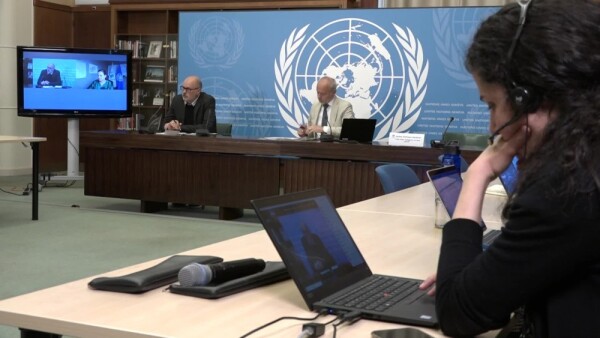
- Wide shot, press room with spokespersons and journalists.
- SOUNDBITE (ENGLISH) – Matthew Saltmarsh, UNHCR Spokesperson: “Over a month since the fighting have started, we're making an urgent appeal for the safety of civilians and to allow humanitarian aid to move into Sudan as we continue to scale up our response for the over one million people who have now been recorded as displaced within Sudan or to neighboring countries.”
- Medium shot of speaker.
- SOUNDBITE (ENGLISH) – Matthew Saltmarsh, UNHCR Spokesperson: “Around 88,000 refugees hosted by Sudan have fled Khartoum for safety in White Nile, Gedaref, Kassala Madani and Port Sudan. In those locations, UNHCR is delivering critical assistance, including, of course, shelters, household items, clean water and sanitation, health care and education support for refugees and other people who are displaced in White Nile.”
- Wide shot of speakers in the room.
- SOUNDBITE (ENGLISH) – Carla Drysdale WHO Spokesperson: “Overall 5,287 injuries, 705 deaths, in Khartoum state 3,254 injuries and 203 deaths.”
- Close-up shots of people in the room.
- SOUNDBITE (ENGLISH) – Carla Drysdale WHO Spokesperson: “Since 15 of April, WHO has verified 34 attacks on health leading to eight deaths and 18 injuries. 21 of these incidents impacted health facilities while 10 impacted health personnel.”
- Close-up shot of journalists in the room.
- SOUNDBITE (ENGLISH) – Matthew Saltmarsh, UNHCR Spokesperson: “Over 843,000 people have been internally displaced within the country, according to the IOM, with neighboring governments and UNHCR having recorded almost a quarter of a million crossing borders to date.”
- Close-up shot of a journalist typing.
- SOUNDBITE (ENGLISH) – Matthew Saltmarsh, UNHCR Spokesperson: “The numbers of those fleeing to Egypt, which is the largest host, are rapidly increasing and with partners we estimate that the numbers currently are around 5,000 everyday arrivals, that makes a total of almost 110,000 Sudanese who have entered the country, according to the government.”
- Close-up shot hands typing.
- SOUNDBITE (ENGLISH) – Matthew Saltmarsh, UNHCR Spokesperson: “In South Sudan arrival rates remain high, at around 1,500 a day and of the 63,000 who have arrived, many were South Sudanese refugees in Sudan. Most arrive via the Renk crossing in Upper Nile State. The transit facility near the border is becoming perilously crowded and resources are extremely stretched”.
- Close-up shot of journalists in the room.
- SOUNDBITE (ENGLISH) – Matthew Saltmarsh, UNHCR Spokesperson: “In Chad, we have delivered relief items to almost 10,000 families and we have stepped up our monitoring to address the most pressing protection concerns. Most new arrivals are still in remote transit sites near the border with very limited resources.”
- Wide shots of speakers on the podium.
- Medium shot of speaker.
Similar Stories

1
1
1
Edited News | UNICEF
A little over one year since a ceasefire agreement was announced between Hamas fighters and Israel, more than 340 children have been reported killed and hundreds more injured, the UN Children’s Fund, UNICEF, said on Friday.

1
1
1
Edited News | UNICEF , IFRC
Six weeks after Nepal’s deadly flooding disaster, communities are still struggling to rebuild their lives, but they will need sustained help as global warming increases the risk of another Himalayan catastrophe, the UN Children’s Fund (UNICEF) said on Friday.

1
1
1
Edited News | WHO
In suspected Russia plague death, testing and monitoring underway – WHO
The death of a lab worker in Russia’s Siberia region has sparked concerns about plague being the cause, the UN World Health Organization (WHO) said on Tuesday, adding that it was following the situation closely.

1
1
Edited News | OHCHR , UNOG
UN Human Rights Chief Volker Türk on Friday provided and oral update to the 63rd session of the Human rights Council on Ukraine.

1
1
1
Edited News | OHCHR , UNOG
UN Human Rights Chief Volker Türk on Friday provided and oral update to the 63rd session of the Human rights Council on the human rights situation in Haiti.

1
1
1
Edited News | WHO
Repeated delays in bringing lifesaving medicines, prosthetics and more from Israel into Gaza risk having devastating consequences on Palestinians who urgently need them in the wartorn enclave, the UN World Health Organization (WHO) said on Friday. “A truck full of non-priority supplies or the right supplies arriving too late, doesn't save lives. That's the question that actually matters," said Dr Reinhilde Van De Weerdt, WHO Representative in the OPT.

1
1
1
Edited News | WHO
DRC: Early access to care and oxygen decisive for Ebola patients’ survival – WHO
In the Democratic Republic of the Congo (DRC), health workers fighting the country’s largest-ever Ebola outbreak are struggling to overcome critical challenges to patient care, the UN World Health Organization (WHO) warned on Tuesday.

1
1
1
Edited News | OCHA , UN
Civilians in Iran are continuing to feel the consequences of months of conflict and military escalation, the UN’s top official in the country has said, as loss of life, damage to civilian infrastructure and mounting economic pressures leave many facing continued uncertainty.
1
1
1
Edited News | WHO , UNICEF
Aid agencies in Yemen highlighted the growing hunger emergency sparked by renewed fighting between Houthi opposition forces and Government troops, after mobile health clinics reported that hundreds of children displaced by the violence are suffering from the most deadly form of malnutrition.
1
1
1
Edited News | UNHCR
Displacement on the rise in Yemen as fighting continues - UNHCR
As hostilities worsen in Yemen, more people have been fleeing their homes, further intensifying the humanitarian crisis within the region, the UN Refugee Agency (UNHCR) warned on Tuesday.
1
1
1
Edited News | IOM , OHCHR , UNFPA , UNOG , UNHCR , WHO
Yemen’s humanitarian crisis growing by the hour amid spike in displacement
Yemenis displaced by renewed fighting have described fleeing for their lives amid shelling and gunfire, aid agencies reported on Friday, while highlighting the dramatic increase in humanitarian needs in the country and in Djibouti, where thousands have sought shelter.
1
1
1
Edited News | OHCHR , UNOG
The UN Human Rights Office issued on Friday a report documenting a shocking pattern of sexual violence amid Russia’s full-scale armed attack on Ukraine.