

The United Nations Office at Geneva
Multimedia Newsroom
UN’s top rights forum passes resolutions on Belarus, Myanmar
The UN’s top rights forum passed resolutions condemning abuses of fundamental freedoms in Belarus and Myanmar on Wednesday, in response to ongoing concerns over the human rights situation in both countries.
Ahead of the adoption of the Belarus resolution without a vote by the 47-member Human Rights Council in Geneva, the European Union - the main sponsor of both texts – highlighted reported ongoing violations in the east European State.
Speaking on behalf of the EU, Permanent Representative of Portugal to the United Nations Office in Geneva, Rui Macieira, echoed UN condemnation of the use of force against peaceful protesters in mass demonstrations across the country, after the re-election of President Alexander Lukashenko last August.
“(At the) last (Human Rights Council) session, we requested an urgent debate on Belarus and presented a resolution of the same title, because we were deeply concerned about serious human rights violations that occurred in the run-up to the 2020 Presidential election and in its aftermath. Since then, we have witnessed a continued massive crackdown on human rights and fundamental freedoms, such as freedom of peaceful assembly and association, freedom of expression and opinion and freedom of the media in Belarus.”
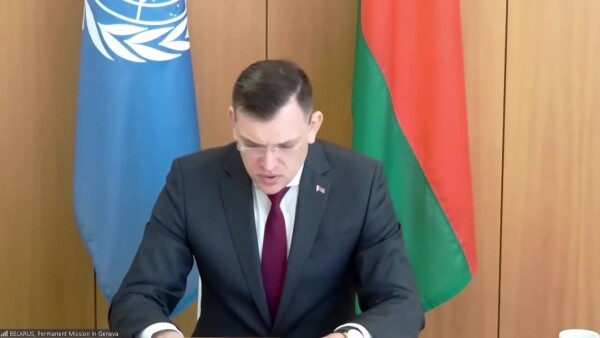
Rejecting the resolution – which passed with 20 votes for, 7 against and 20 abstentions - Belarus’s Ambassador Yury Ambrazevic said that the country regarded it “as yet another attempt to interfere in the domestic affairs of our State and we reject it. Our Government is not in agreement with subjective assessment and unfounded accusations that are contained in the resolution.”
“We understand that there were upheavals in some Belarusian cities with the purpose to counter and fight against the legally elected government and this was supported by some European Governments. This leads to the undermining of democratic processes and it is clear that this is done and this reflects an absolute minority of the population.”
The development comes after UN Special Rapporteur on the situation of Human Rights Defenders Mary Lawlor spoke out against “an increasing crackdown against human rights defenders in Belarus”.
In an alert on Friday 19 March, the independent rights expert who reports to the Human Rights Council, cited two cases of suspected reprisals against individuals who had helped the United Nations in promoting and protecting the rights of people with disabilities.
During the Council’s current session, which ended on Wednesday, UN High Commissioner for Human Rights Michelle Bachelet described the post-election situation in Belarus as a “human rights crisis of unprecedented dimension”.
Addressing the forum on 25 February, Ms. Bachelet pointed to “numerous and widespread violations committed in the context of the election” including mass arbitrary arrests and detentions of people who organized or participated in largely peaceful protests…hundreds of allegations of torture and ill-treatment” and “harassment and intimidation targeting opposition members, journalists, human rights defenders and citizens in general”.
Echoing those concerns, EU and Portugal representative Ambassador Rui Macieira insisted that “documented cases of arbitrary arrests and detentions of opposition members, journalists and media workers, human rights defenders, as well as prison sentences handed down to media workers have become daily realities in Belarus. To prevent further escalation of human rights crisis, we believe that it is imperative for the international community, and for the Human Rights Council in particular, not just to maintain attention to and scrutiny of the human rights violations in Belarus, but also to take all necessary steps to ensure that perpetrators of human rights violations do not remain unpunished.”
Introducing the resolution on Myanmar, which followed a call last Friday by UN Secretary-General António Guterres for “a firm, unified international response” to “end violations of fundamental human rights and return to the path of democracy” after the 1 February military coup, Ambassador Macieira maintained that the country’s de-facto rulers had “increased (their) brutal repression and must be held to account”.
He added: “They must stop the use of force and allow the population to exercise their rights. The EU calls on the military authorities to end the state of emergency and martial law and to restore the elected civilian Government. We call for the release of President Win Myint, State Counsellor Aung San Suu Kyi and those arbitrarily detained.”
According to the resolution, which was adopted without a vote, the Council reaffirms its “strong commitment to the sovereignty, political independence, territorial integrity and unity of Myanmar”.
The 11-page document also promises continuing support for the Independent Investigative Mechanism for Myanmar – previously established by the Human Rights Council – “to collect, consolidate, preserve and analyse evidence of the most serious international crimes and violations of international law committed in Myanmar since 2011, in particular in Chin, Kachin, Kayin, Rakhine and Shan States”, with a view to a future prosecution.
“We would like to reiterate support to the mandate of the Independent Investigative Mechanism for Myanmar, including the request for recipients of illegal orders to contact the Mechanism,” Ambassador Macieira told the Council.
Dismissing the resolution and a possible future prosecution by the International Criminal Court, Deputy Minister, Ministry of Foreign Affairs, Myanmar, Kyaw Myo Htut said that his Government strongly rejected “any measure which could lead Myanmar to international judicial system and any judgement that could erode the ongoing domestic judicial mechanisms”.
“Our position is utterly clear relating to ICC as it shall not exercise the jurisdiction over Myanmar, a non-State Party to Rome Statute.”
The 47th regular session of the Human Rights Council is scheduled from 21 June 2021 to 9 July 2021.
ends
STORY: Human Rights Council Belarus and Myanmar
TRT: 04 min 06
SOURCE: UNTV CH
RESTRICTIONS: NONE
LANGUAGE: ENGLISH / RUSSIAN
ASPECT RATIO: 16:9
DATELINE: 24 MARCH 2021 GENEVA, SWITZERLAND
SHOTLIST
- Exterior wide shot, Palais des Nations flag alley, nations’ flags flying, a sunny day.
- Wide shot, Assembly Hall, Palais des Nations.
- SOUNDBITE (English/Russian) — Permanent Representative of the Republic of Belarus to the United Nations Office in Geneva, Yury Ambrazevic: “Belarus regards the consideration of a resolution on our country as yet another attempt to interfere in the domestic affairs of our State and we reject it. Our Government is not in agreement with subjective assessment and unfounded accusations that are contained in the resolution.”
- Medium shot, podium with speakers, Assembly Hall, Palais des Nations.
- SOUNDBITE (English/Russian) — Permanent Representative of the Republic of Belarus to the United Nations Office in Geneva, Yury Ambrazevic: “We understand that there were upheavals in some Belarusian cities with the purpose to counter and fight against the legally elected government and this was supported by some European Governments. This leads to the undermining of democratic processes and it is clear that this is done and this reflects an absolute minority of the population.”
- Medium-wide shot, podium with speakers, Assembly Hall, Palais des Nations.
- SOUNDBITE (English) — Permanent Representative of Portugal to the United Nations Office in Geneva, Rui Macieira (on behalf of the EU): “Last session we requested an urgent debate on Belarus and presented a resolution of the same title, because we were deeply concerned about serious human rights violations that occurred in the run-up to the 2020 Presidential election and in its aftermath. Since then, we have witnessed a continued massive crackdown on human rights and fundamental freedoms, such as freedom of peaceful assembly and association, freedom of expression and opinion and freedom of the media in Belarus.”
- Medium-wide shot, podium with speakers, Assembly Hall, Palais des Nations.
- SOUNDBITE (English) — Permanent Representative of Portugal to the United Nations Office in Geneva, Rui Macieira: “The documented cases of arbitrary arrests and detentions of opposition members, journalists and media workers, human rights defenders, as well as prison sentences handed down to media workers have become daily realities in Belarus. To prevent further escalation of human rights crisis, we believe that it is imperative for the international community, and for the Human Rights Council in particular, not just to maintain attention to and scrutiny of the human rights violations in Belarus, but also to take all necessary steps to ensure that perpetrators of human rights violations do not remain unpunished.”
- Medium-wide shot, podium with speakers, Assembly Hall, Palais des Nations.
- SOUNDBITE (English) — President of Human Rights Council, Nazhat Shameem Khan: “The results of the recorded vote are as follows: 20 in favour, 7 against and 20 abstentions. Draft text L.19 is therefore adopted. The Council will now consider draft resolution L.21/Rev.1 entitled “The situation of human rights in Myanmar”.”
- SOUNDBITE (English) — Permanent Representative of Portugal to the United Nations Office in Geneva, Rui Macieira: “The military has increased its brutal repression and must be held to account. They must stop the use of force and allow the population to exercise their rights. The EU calls on the military authorities to end the state of emergency and martial law and to restore the elected civilian Government. We call for the release of President Win Myint, State Counsellor Aung San Suu Kyi and those arbitrarily detained.”
- Medium shot, podium with speakers, Assembly Hall, Palais des Nations.
- SOUNDBITE (English) — Permanent Representative of Portugal to the United Nations Office in Geneva, Rui Macieira: “We would like to reiterate support to the mandate of the Independent Investigative Mechanism for Myanmar, including the request for recipients of illegal orders to contact the Mechanism.”
- Medium-wide shot, podium with speakers, Assembly Hall, Palais des Nations.
- SOUNDBITE (English) — Deputy Minister, Ministry of Foreign Affairs, Myanmar, Kyaw Myo Htut: “We strongly reject any measure which could lead Myanmar to international judicial system and any judgement that could erode the ongoing domestic judicial mechanisms.”
- Medium-wide shot, podium with speakers, Assembly Hall, Palais des Nations.
- SOUNDBITE (English) — Deputy Minister, Ministry of Foreign Affairs, Myanmar, Kyaw Myo Htut: “Our position is utterly clear relating to ICC as it shall not exercise the jurisdiction over Myanmar, a non-State Party to Rome Statute.”
- Medium-wide shot, podium with speakers, Assembly Hall, Palais des Nations.
- SOUNDBITE (English) — President of Human Rights Council, Nazhat Shameem Khan: “May I take it that draft proposal L.21/Rev.1 as orally revised may be adopted without a vote? It is so decided.”
- Wide shot, Assembly Hall, Palais des Nations.
Similar Stories

1
1
1
Edited News | OCHA , UNICEF , WFP
Aid agencies warned on Friday of the fast-developing humanitarian emergency inside Taiz City in Yemen, which has been encircled by de facto Houthi forces fighting government troops along the country’s west coast.

2
17
1
2
Edited News , Press Conferences , Images | OCHA , WMO
Two UN agencies teamed up on Wednesday to issue an appeal for immediate assistance to help communities already being impacted by the strongest El Niño on record.

3
16
2
2
Edited News , B-roll , Conferences , Images | UNITED NATIONS , UNOG
Sixth Consultative Meeting on Enhancing Coordination of Peace Initiatives and Efforts for Sudan

1
1
1
Edited News | UNICEF , WHO , UNHCR
Yemen war continues to force families from homes amid hunger and disease
More than 250,000 people have now fled renewed fighting in Yemen, the UN said on Tuesday, citing particular concern for those sheltering in the southwestern city of Taiz and the wider governorate, where access is “essentially blocked”.

1
1
1
Edited News | UNICEF
A little over one year since a ceasefire agreement was announced between Hamas fighters and Israel, more than 340 children have been reported killed and hundreds more injured, the UN Children’s Fund, UNICEF, said on Friday.

1
1
1
Edited News | UNICEF , IFRC
Six weeks after Nepal’s deadly flooding disaster, communities are still struggling to rebuild their lives, but they will need sustained help as global warming increases the risk of another Himalayan catastrophe, the UN Children’s Fund (UNICEF) said on Friday.

1
1
1
Edited News | WHO
In suspected Russia plague death, testing and monitoring underway – WHO
The death of a lab worker in Russia’s Siberia region has sparked concerns about plague being the cause, the UN World Health Organization (WHO) said on Tuesday, adding that it was following the situation closely.

1
1
Edited News | OHCHR , UNOG
UN Human Rights Chief Volker Türk on Friday provided and oral update to the 63rd session of the Human rights Council on Ukraine.

1
1
1
Edited News | OHCHR , UNOG
UN Human Rights Chief Volker Türk on Friday provided and oral update to the 63rd session of the Human rights Council on the human rights situation in Haiti.

1
1
1
Edited News | WHO
Repeated delays in bringing lifesaving medicines, prosthetics and more from Israel into Gaza risk having devastating consequences on Palestinians who urgently need them in the wartorn enclave, the UN World Health Organization (WHO) said on Friday. “A truck full of non-priority supplies or the right supplies arriving too late, doesn't save lives. That's the question that actually matters," said Dr Reinhilde Van De Weerdt, WHO Representative in the OPT.

1
1
1
Edited News | WHO
DRC: Early access to care and oxygen decisive for Ebola patients’ survival – WHO
In the Democratic Republic of the Congo (DRC), health workers fighting the country’s largest-ever Ebola outbreak are struggling to overcome critical challenges to patient care, the UN World Health Organization (WHO) warned on Tuesday.

1
1
1
Edited News | OCHA , UN
Civilians in Iran are continuing to feel the consequences of months of conflict and military escalation, the UN’s top official in the country has said, as loss of life, damage to civilian infrastructure and mounting economic pressures leave many facing continued uncertainty.