

The United Nations Office at Geneva
Multimedia Newsroom
Northern hemisphere heatwave underscores value of early-warning alerts
The blistering early-summer heatwave that’s brought life-threatening temperatures across much of the northern hemisphere is a worrying sign of things to come, UN weather experts said on Tuesday.
Three days after Spain’s national weather service confirmed a record 46°C reading in the southern town of El Granado, there’s been little let-up in stifling day and night temperatures across the continent and beyond.
In Barcelona, a road sweeper reportedly died on Saturday after completing her shift, prompting an investigation and widespread public appeals to keep out of the sun wherever possible.
“Everybody is at risk,” insisted Clare Nullis, spokesperson for the World Meteorological Organization (WMO): “If you go out without water in the middle of the day, to do jogging, have a bike ride, you will probably have health problems or even die.”
If part of the reason for Europe’s heat misery is because it is in the grip of a strong high-pressure weather front trapping hot air from northern Africa, Ms. Nullis noted that “human-induced climate change” is the source of these acute weather events.
Another part of the climate puzzle is that sea surface temperatures in the Mediterranean are exceptionally high for this time of year. “It's the equivalent of a land heatwave”, the WMO spokesperson said.
“Extreme heat creeps up on you,” she added, while dangerously warm conditions are becoming “more frequent, more intense” because of global warming caused by burning fossil fuels.
“It’s something we have to learn to live with,” Ms. Nullis maintained, highlighting the importance of early warnings from national meteorological and hydrological services to prevent more deaths from extreme heat events – which are often “under-reflected” in official statistics.
According to the UN agency, night-time minimum temperatures and daytime maximum temperatures broke monthly station records for June in parts of Western and Southwestern Europe, partly explaining why the heatwave is so draining.
“The frequency and intensity of extreme heat events is increasing in Europe and by 2050 about half the European population may be exposed to high or very high risk of heat stress during summer,” Ms. Nullis explained.
“What is exceptional - and I would stress exceptional but not unprecedented - is the time of year. We are 1 July and we are seeing episodes of extreme heat which normally we would see later on.”
WMO insisted that warnings from national weather services and coordinated heat-health action plans are increasingly important to protect public safety and wellbeing.
The UN agency is promoting these efforts through its Early Warnings for All platform.
A key component is the WMO Coordination Mechanism (WCM) which supports crisis-prone and conflict-affected regions with advice. WMO curates authoritative weather, climate and water information from countries such as its WCM Global Hydromet Weekly Scan.
ends
STORY: Heatwave update – WMO
TRT: 1’48”
SOURCE: UNTV CH
RESTRICTIONS: NONE
LANGUAGE: ENGLISH/ NATS
ASPECT RATIO: 16:9
DATELINE: 1 JULY 2025 GENEVA, SWITZERLAND
Speakers
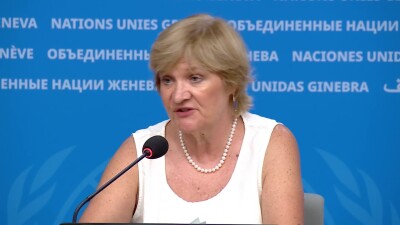
- Clare Nullis, WMO spokesperson
SHOTLIST
- Exterior wide shot: Palais des Nations, flag alley.
- Wide, Press room podium and speakers.
- SOUNDBITE (English) – Clare Nullis, Spokesperson, WMO: “We are currently under the influence of a strong high-pressure system; this is trapping hot air from northern Africa over the region. And as we can see, it's having a pretty big impact on the way we feel.”
- Wide, podium speakers, TV screens and Press room.
- SOUNDBITE (English) – Clare Nullis, Spokesperson, WMO: “Everybody is at risk; if you go out without water in the middle of the day, to do jogging, have a bike ride, you will probably have health problems or even die.”
- Medium, journalists.
- SOUNDBITE (English) – Clare Nullis, Spokesperson, WMO: “The frequency and intensity of extreme heat events is increasing in Europe and by 2050 about half the European population may be exposed to high or very high risk of heat stress during summer.”
- Medium, journalist.
- SOUNDBITE (English) – Clare Nullis, Spokesperson, WMO: “What is exceptional - and I would stress exceptional but not unprecedented - is the time of year. You know we are 1 July and we are seeing episodes of extreme heat which normally we would see later on.”
- Medium, participant.
- SOUNDBITE (English) – Clare Nullis, Spokesperson, WMO: “Why is it happening? Various reasons, one of them is that sea surface temperatures in the Mediterranean are exceptionally high for this time of year. It's the equivalent of a land heat wave.”
- Medium-wide, podium speakers, TV screen showing speaker.
- Medium, journalist.
Similar Stories

1
1
1
Edited News | UNICEF
A little over one year since a ceasefire agreement was announced between Hamas fighters and Israel, more than 340 children have been reported killed and hundreds more injured, the UN Children’s Fund, UNICEF, said on Friday.

1
1
1
Edited News | UNICEF , IFRC
Six weeks after Nepal’s deadly flooding disaster, communities are still struggling to rebuild their lives, but they will need sustained help as global warming increases the risk of another Himalayan catastrophe, the UN Children’s Fund (UNICEF) said on Friday.

1
1
1
Edited News | WHO
In suspected Russia plague death, testing and monitoring underway – WHO
The death of a lab worker in Russia’s Siberia region has sparked concerns about plague being the cause, the UN World Health Organization (WHO) said on Tuesday, adding that it was following the situation closely.

1
1
Edited News | OHCHR , UNOG
UN Human Rights Chief Volker Türk on Friday provided and oral update to the 63rd session of the Human rights Council on Ukraine.

1
1
1
Edited News | OHCHR , UNOG
UN Human Rights Chief Volker Türk on Friday provided and oral update to the 63rd session of the Human rights Council on the human rights situation in Haiti.

1
1
1
Edited News | WHO
Repeated delays in bringing lifesaving medicines, prosthetics and more from Israel into Gaza risk having devastating consequences on Palestinians who urgently need them in the wartorn enclave, the UN World Health Organization (WHO) said on Friday. “A truck full of non-priority supplies or the right supplies arriving too late, doesn't save lives. That's the question that actually matters," said Dr Reinhilde Van De Weerdt, WHO Representative in the OPT.

1
1
1
Edited News | WHO
DRC: Early access to care and oxygen decisive for Ebola patients’ survival – WHO
In the Democratic Republic of the Congo (DRC), health workers fighting the country’s largest-ever Ebola outbreak are struggling to overcome critical challenges to patient care, the UN World Health Organization (WHO) warned on Tuesday.

1
1
1
Edited News | OCHA , UN
Civilians in Iran are continuing to feel the consequences of months of conflict and military escalation, the UN’s top official in the country has said, as loss of life, damage to civilian infrastructure and mounting economic pressures leave many facing continued uncertainty.

1
1
1
Edited News | WHO , UNICEF
Aid agencies in Yemen highlighted the growing hunger emergency sparked by renewed fighting between Houthi opposition forces and Government troops, after mobile health clinics reported that hundreds of children displaced by the violence are suffering from the most deadly form of malnutrition.
1
1
1
Edited News | UNHCR
Displacement on the rise in Yemen as fighting continues - UNHCR
As hostilities worsen in Yemen, more people have been fleeing their homes, further intensifying the humanitarian crisis within the region, the UN Refugee Agency (UNHCR) warned on Tuesday.
1
1
1
Edited News | IOM , OHCHR , UNFPA , UNOG , UNHCR , WHO
Yemen’s humanitarian crisis growing by the hour amid spike in displacement
Yemenis displaced by renewed fighting have described fleeing for their lives amid shelling and gunfire, aid agencies reported on Friday, while highlighting the dramatic increase in humanitarian needs in the country and in Djibouti, where thousands have sought shelter.
1
1
1
Edited News | OHCHR , UNOG
The UN Human Rights Office issued on Friday a report documenting a shocking pattern of sexual violence amid Russia’s full-scale armed attack on Ukraine.