

The United Nations Office at Geneva
Multimedia Newsroom
Northeast Syria: Arbitrary detention of children needs to stop, says top rights expert
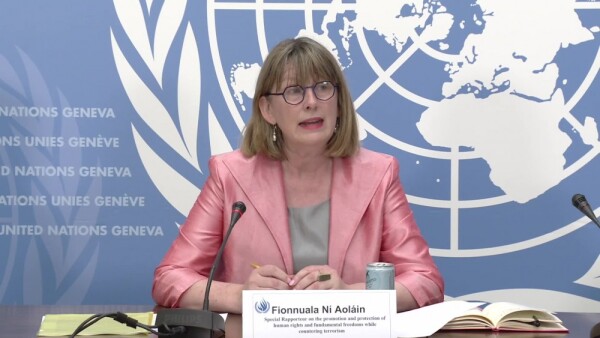
Mass arbitrary and indefinite detentions of children without legal process in northeast Syria need to cease immediately, the UN Special Rapporteur on the promotion and protection of human rights and fundamental freedoms while countering terrorism, Ms. Fionnuala Ní Aoláin, said on Friday.
Briefing journalists after returning from a six-day visit to the country, the independent UN-appointed expert said that she had witnessed “mass arbitrary detention of children, incommunicado detention, disappearances, structural and systematic discrimination for detained person on the basis of their nationality…Torture, cruel, inhuman and degrading treatment, as well as the deprivation of the fundamental capacity to live a dignified life in detention, including access to water, food and health care.”
Ms. Ní Aoláin said that she had been particularly appalled to witness “the mass, indefinite and arbitrary detention of children, particularly boys, in various types of facilities premised on the alleged threat that they pose to security based on their or their parent's alleged prior links with Da'esh…I want to make clear that not a single in many cases legal determination has been made for the vast majority of these children detained, whether they're detained in prisons, camps or centers.”
During her visit, Ms. Ni Aoláin met with Syrian government official and focused on detention and repatriation issues in the northeast.
The UN Special Rapporteur had access to several prisons and detention places, a first for an independent human rights expert. She also visited prisons and sites of detention in Qamishli, Gweirna, Al Hol districts and al-Malikya city.
According to the camp authorities, almost 50,000 people live in the Al Hol camp: 15,000 women, 3,000 men and more than 30,000 children.
Some “31,000 children, mass detention, arbitrary detention of children,” Ms. Ni Aoláin said. “It is, in my view, no doubt that this facility is a detention facility because no one can leave or enter without the permission of the detaining authority."
Conditions in Al Hol camp are dire, despite the efforts of under-funded humanitarian actors. The Special Rapporteur highlighted the major humanitarian challenges experienced by the population, particularly access to water and electricity. She emphasised the broader constrictions on health services affecting both the general population and those held in detention facilities as well as serious concerns about the situation of women in the Annex at Al Hol, given the lack of meaningful access by anyone other than security actors to that location.
“It is entirely unacceptable that we have 40,000 plus people held in a detention facility where 60 per cent of them are children under the age of 12. And we have absolutely no idea what's happening in that facility,” Ms. Ni Aoláin said. “I think to say that this is a breach of international law is perhaps the understatement of the day.“
The top rights expert recognized the intense political and security complexity of the situation on the ground, including the presence of a number of State and non-state actors exercising various forms of control and competences over parts of the population and institutions in this region, as well as the presence of UN Security Council-designated terrorist groups.
The Special Rapporteur observed the systematic practice of separating boys, in particular third country nationals, from their mothers in the camps upon reaching adolescence, causing irreparable harm which would inevitably work against any stated efforts at rehabilitation.
“Anyone seriously thinking about long-term security in this region who is not addressing the systematic and arbitrary detention of thousands of children is closing their eyes to the long-term security implications of what it means to hold children in these kinds of conditions of detention indefinitely.”
Ms. Ni Aoláin added that “they won't sleep at night because the separation is usually happening at night without notice, often violently. And we had consistent reports both from the detaining authorities and the mothers, that mothers are hiding their boys, so they won't be taken.”
Most of the camp inmates are Iraqi, Syrian and third country nationals. The Special Rapporteur appealed to all States whose nationals are detained in northeast Syria to live up to their fundamental human rights obligations and repatriate their nationals. She regretted that she was unable to access the annex in Al Hol where third country nations are detained.
“The other black hole is non-repatriation, which is the non-repatriation of men and the unwillingness to return men and again, as boys age into being men who are separated and kept in facilities”, she said. “What that means is that you're condemning the boy child in this facility to a life of imprisonment on no legal grounds, except for the fact that he was born there. He happens to be a boy and he's deemed to be associated with terrorism by virtue of where he was born and who he was born to.”
The Special Rapporteurs are independent experts and serve in their individual capacity who work on a voluntary basis. They are not UN staff and do not receive a salary for their work.
-ends-
- Exterior wide shot: UN flag alley UN Geneva
- Wide shot: speakers and mediator behind panel at the press conference
- SOUNDBITE (English) – Fionnuala Ní Aoláin, UN Special Rapporteur on the promotion and protection of human rights and fundamental freedoms while countering terrorism: “What I was able to witness firsthand, including mass arbitrary detention of children, incommunicado detention, disappearances, structural and systematic discrimination for detained persons on the basis of their nationality, torture, cruel, inhuman and degrading treatment, as well as the deprivation of the fundamental capacity to live a dignified life in detention, including access to water, food and health care.”
- Medium shot: speakers and mediator behind panel at the press conference
- SOUNDBITE (English) – Fionnuala Ní Aoláin, UN Special Rapporteur on the promotion and protection of human rights and fundamental freedoms while countering terrorism: “The mass, indefinite and arbitrary detention of children, particularly boys, in various types of facilities premised on the alleged threat that they pose to security based on their or their parent's alleged prior links with Daesh. I want to make clear that not a single in many cases legal determination has been made for the vast majority of these children detained, whether they're detained in prisons, camps or centers.”
- Medium shot: speakers and mediator behind panel at the press conference
- SOUNDBITE (English) – Fionnuala Ní Aoláin, UN Special Rapporteur on the promotion and protection of human rights and fundamental freedoms while countering terrorism: “31,000 children, mass detention, arbitrary detention of children. It is, in my view, no doubt that this facility is a detention facility because no one can leave or enter without the permission of the detaining authority.”
- Close shot: attendees typing at the press conference
- SOUNDBITE (English) – Fionnuala Ní Aoláin, UN Special Rapporteur on the promotion and protection of human rights and fundamental freedoms while countering terrorism: “It is entirely unacceptable that we have 40’000 plus people held in a detention facility, where 60% of them are children under the age of 12 and we have absolutely no idea what's happening in that facility. I think to say that this is a breach of international law is perhaps the understatement of the day.”
- Medium shot: speakers and mediator behind panel at the press conference
- SOUNDBITE (English) – Fionnuala Ní Aoláin, UN Special Rapporteur on the promotion and protection of human rights and fundamental freedoms while countering terrorism: “Anyone seriously thinking about long term security in this region, who is not addressing the systematic and arbitrary detention of thousands of children, is closing their eyes to the long-term security implications of what it means to hold children in these kinds of conditions of detention indefinitely.”
- Medium shot: attendee at the press conference
- SOUNDBITE (English) – Fionnuala Ní Aoláin, UN Special Rapporteur on the promotion and protection of human rights and fundamental freedoms while countering terrorism: “They won't sleep at night because the separation is usually happening at night without notice, often violently and we had consistent reports both from the detaining authorities and the mothers, that mothers are hiding their boys, so they won't be taken.”
- Wide shot: attendees at the press conference
- SOUNDBITE (English) – Fionnuala Ní Aoláin, UN Special Rapporteur on the promotion and protection of human rights and fundamental freedoms while countering terrorism: “The other black hole of non-repatriation, which is the non-repatriation of men and the unwillingness to return men. And again, as boys age into being men who are separated and kept in facilities, what that means is that you're condemning the boy child in this facility to a life of imprisonment on no legal grounds, except for the fact that he was born there. He happens to be a boy and he's deemed to be associated with terrorism by virtue of where he was born and who he was born to.”
- Close shot: attendee taking notes at the press conference
- Medium shot: attendees, speakers and mediator behind panel at the press conference
- Medium shot: attendees, speakers and mediator behind panel at the press conference
Similar Stories

2
17
1
2
Edited News , Press Conferences | OCHA , WMO
Two UN agencies teamed up on Wednesday to issue an appeal for immediate assistance to help communities already being impacted by the strongest El Niño on record.

3
16
2
2
B-roll , Conferences , Edited News | UNITED NATIONS , UNOG
Sixth Consultative Meeting on Enhancing Coordination of Peace Initiatives and Efforts for Sudan

1
1
1
Edited News | UNICEF , WHO , UNHCR
Yemen war continues to force families from homes amid hunger and disease
More than 250,000 people have now fled renewed fighting in Yemen, the UN said on Tuesday, citing particular concern for those sheltering in the southwestern city of Taiz and the wider governorate, where access is “essentially blocked”.

1
1
1
Edited News | UNICEF
A little over one year since a ceasefire agreement was announced between Hamas fighters and Israel, more than 340 children have been reported killed and hundreds more injured, the UN Children’s Fund, UNICEF, said on Friday.

1
1
1
Edited News | UNICEF , IFRC
Six weeks after Nepal’s deadly flooding disaster, communities are still struggling to rebuild their lives, but they will need sustained help as global warming increases the risk of another Himalayan catastrophe, the UN Children’s Fund (UNICEF) said on Friday.

1
1
1
Edited News | WHO
In suspected Russia plague death, testing and monitoring underway – WHO
The death of a lab worker in Russia’s Siberia region has sparked concerns about plague being the cause, the UN World Health Organization (WHO) said on Tuesday, adding that it was following the situation closely.

1
1
Edited News | OHCHR , UNOG
UN Human Rights Chief Volker Türk on Friday provided and oral update to the 63rd session of the Human rights Council on Ukraine.

1
1
1
Edited News | OHCHR , UNOG
UN Human Rights Chief Volker Türk on Friday provided and oral update to the 63rd session of the Human rights Council on the human rights situation in Haiti.

1
1
1
Edited News | WHO
Repeated delays in bringing lifesaving medicines, prosthetics and more from Israel into Gaza risk having devastating consequences on Palestinians who urgently need them in the wartorn enclave, the UN World Health Organization (WHO) said on Friday. “A truck full of non-priority supplies or the right supplies arriving too late, doesn't save lives. That's the question that actually matters," said Dr Reinhilde Van De Weerdt, WHO Representative in the OPT.

1
1
1
Edited News | WHO
DRC: Early access to care and oxygen decisive for Ebola patients’ survival – WHO
In the Democratic Republic of the Congo (DRC), health workers fighting the country’s largest-ever Ebola outbreak are struggling to overcome critical challenges to patient care, the UN World Health Organization (WHO) warned on Tuesday.

1
1
1
Edited News | OCHA , UN
Civilians in Iran are continuing to feel the consequences of months of conflict and military escalation, the UN’s top official in the country has said, as loss of life, damage to civilian infrastructure and mounting economic pressures leave many facing continued uncertainty.
1
1
1
Edited News | WHO , UNICEF
Aid agencies in Yemen highlighted the growing hunger emergency sparked by renewed fighting between Houthi opposition forces and Government troops, after mobile health clinics reported that hundreds of children displaced by the violence are suffering from the most deadly form of malnutrition.