

The United Nations Office at Geneva
Multimedia Newsroom
Gaza’s sick and injured face new attacks on health care, lethal evacuation delays – UN humanitarians
Amid reports of a new Israeli military raid on a Gaza hospital on Friday morning - and ongoing hostilities hindering polio vaccination in the north of the Strip - UN humanitarians pleaded again for the protection of health facilities and urgent medical evacuation of critically ill patients.
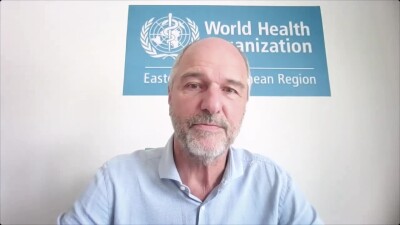
Dr. Rik Peeperkorn, the UN World Health Organization (WHO’s) representative for the Occupied Palestinian Territory, just back in central Gaza from a “complex mission” to the embattled Kamal Adwan hospital in the north, provided journalists in Geneva with an eyewitness account of what he had seen.
At a checkpoint close to Kamal Adwan, he said, there were “thousands of women and children, leaving the area, walking, limping, with a few belongings, towards Salah al-Din and… Gaza City."
The UN health agency official said that on Thursday, WHO and partners managed “amid ongoing hostilities” to reach Kamal Adwan hospital, which Dr. Peeperkorn described as “minimally functional,” and succeeded in transferring 23 patients and their caregivers to Al Shifa hospital in Gaza City, also delivering supplies and medicines.
At Kamal Adwan hospital “we saw mayhem and chaos,” he said, adding that during his last visit there, the facility had 75 to 100 patients.
“Now, there were probably more than 200 patients. The emergency ward was overflowing, and we saw numerous patients being brought in… horrific trauma patients.”
Dr. Peeperkorn stressed that the staff of the hospital were “overwhelmed” and underequipped to deal with the inflow of heavily injured patients.
“We also saw hundreds of people in every corner of the hospital seeking shelter,” he said. “And we want to stress again, this hospital, it needs to be protected.”
The WHO official also addressed “very concerning” reports received on Friday morning, hours after he and his colleagues had left Kamal Adwan, about Israeli military presence in the vicinity of the hospital and orders for the displaced to “come out”. The information needed to be confirmed, he said, insisting that people who shelter there have “nowhere to go.”
In a post on X on Friday afternoon, WHO chief Tedros Adhanom Ghebreyesus wrote that “since this morning’s reports of a raid of Kamal Adwan hospital… we have lost touch with the personnel there,” calling the development “deeply disturbing.”
Turning to the UN-run polio vaccination campaign in the war-torn enclave, Dr. Peeperkorn recalled that on Wednesday the health authorities and agencies involved in the campaign announced the postponement of its third and final phase aiming to vaccinate 119,279 children under 10 in the north of the Strip.
This was due to “escalating violence, intense bombardment, mass displacement orders, and lack of humanitarian pauses” across most of northern Gaza.
According to WHO “ongoing attacks on civilian infrastructure” were making it “impossible for families to safely bring their children for vaccination, and health workers to operate”.
Children across northern Gaza were to be vaccinated with a second dose of the novel oral polio vaccine type 2, following a first round conducted across the Strip last month. According to WHO, to interrupt poliovirus transmission “at least 90 per cent of all children in every community and neighbourhood must be vaccinated”.
“We want to cover these 119,000 children in the north as well, as we did in the first round,” Dr. Peeperkorn said, stressing the need for “access to all children, wherever they are, to make sure that you get to this 90 per cent coverage”.
“And we are almost there,” he insisted, adding that he still had “good hopes” regarding the feasibility of the final stretch of the campaign to protect children from the paralysis-inducing virus.
Time and time again, humanitarians have underscored the horrific suffering that children in the Strip have endured since Israel launched its offensive in Gaza following the Hamas attacks in southern Israel on 7 October last year.
UN Children’s Fund (UNICEF) spokesperson James Elder gave evidence of how the plight of Gazan children is being compounded by a drastic drop off in medical evacuations, leaving youngsters with “head trauma, amputations, burns, cancer, severe malnutrition,” and waiting for the slimmest chance to leave the Strip for treatment.
From the beginning of the year until the closing of the Rafah border crossing with Egypt in early May (due to Israel’s military offensive there), there had been a monthly average of 296 children medically evacuated out of the enclave, he said. But since then, that number “has collapsed to 22 per month.”
At this pace, it would take more than seven years to evacuate the 2,500 children needing urgent medical care, Mr. Elder warned, adding that COGAT, the Israeli entity responsible for humanitarian affairs in the occupied Gaza Strip, “does not provide reasons for refusals.”
“It is not known how many child patients have been rejected for medical evacuation,” the UNICEF spokesperson said. “Only a list of approved patients is provided by Israel’s COGAT, which controls Gaza’s entry and exit points. The status of others is not shared.”
When a patient is denied evacuation, “there is nothing that can be done,” Mr. Elder stressed. “Trapped in the grip of an indifferent bureaucracy, children’s pain is brutally compounded.”
The UNICEF spokesperson insisted that children “are being denied medical care that is a basic human right, and those who barely survive the ruthless bombardments are then condemned to die from their injuries”. Far from being a logistical or capacity problem, “it is simply a problem that is being completely disregarded,” he deplored.
Meanwhile in Lebanon, where a massive displacement crisis continues to unfold, the UN refugee agency (UNHCR) reported that Israeli airstrikes hit two border crossings with Syria on Friday.
UNHCR Senior Communications Advisor Rula Amin told journalists that the “Joussieh border crossing in the northern part of Al Masnaa border crossing” was hit, “and this happened less than 500 metres away from the immigration office”.
“You can see the crater and UNHCR rubb halls [tents] that we had established for people to be able to stay there in the shade while they are being processed.”
There was another airstrike at Al Masnaa border crossing, the main crossing point between Lebanon and Syria, she said, stressing that the airstrikes put at risk a “lifeline” for those fleeing their homes: for many, this is the only available escape route out of the country.
Over 430,000 people have crossed from Lebanon to Syria so far, Ms. Amin said, 70 per cent of them Syrians who had fled the conflict in their own country.
She pointed to “another emergency and humanitarian catastrophe” unfolding at the places to which people were fleeing, highlighting that in Syria 13 years of conflict had destroyed infrastructure and left a large part of the population in need of humanitarian assistance.
-ends-
STORY: Middle East update WHO – UNICEF – UNHCR
TRT: 3:55”
SOURCE: UNTV CH
RESTRICTIONS: NONE
LANGUAGE: ENGLISH / NATS
ASPECT RATIO: 16:9
DATELINE: 25 OCTOBER 2024 GENEVA, SWITZERLAND
1. Exterior wide shot: Palais des Nations, Flag Alley.
2. Wide shot: Speakers at the podium of the press conference; speaker on screens; journalists in the Press room.
3. SOUNDBITE (English) – Dr. Rik Peeperkorn, Representative for the Occupied Palestinian Territory, UN World Health Organization (WHO): “At a checkpoint - another checkpoint, there is number of checkpoints close to Kamal Adwan – WHO and partners, we witnessed actually a stream of what we estimated initially we thought about hundreds, but then they were passing us and there were actually thousands of women and children, leaving the area, walking, limping, with a few belongings, towards Salah al-Din and actually towards Gaza City.”
4. Wide lateral shot: Speakers at the podium of the press conference from rear; speaker on screens; journalists in the Press room.
5. SOUNDBITE (English) – Dr. Rik Peeperkorn, Representative for the Occupied Palestinian Territory, UN World Health Organization (WHO): “We saw mayhem and chaos. And just having been there a couple of days ago, as well, on 20 and 21 October, when the hospital had 75 patients, 75 to 100 patients and 15 on intensive care - now, there were probably more than 200 patients. The emergency ward was overflowing, and we saw numerous patients being brought in, and horrific trauma patients.”
6. Wide lateral shot: Journalists in the Press room; speaker on screens.
7. SOUNDBITE (English) – Dr. Rik Peeperkorn, Representative for the Occupied Palestinian Territory, UN World Health Organization (WHO): “We also saw hundreds of people in every corner of the hospital seeking shelter. And we want to stress again, this hospital, it needs to be protected.”
8. Medium shot: Press briefing participants in the Press room.
9. SOUNDBITE (English) – Dr. Rik Peeperkorn, Representative for the Occupied Palestinian Territory, UN World Health Organization (WHO): “We want to cover these 119,000 children in the north as well, as we did in the first round. But the current conditions – first of all, you need access. You need access to all children, wherever they are, to make sure that you get to this 90 per cent coverage. And we are almost there.”
10. Wide lateral shot: Speakers at the podium of the press conference from rear; speaker on screens; journalists in the Press room.
11. SOUNDBITE (English) – James Elder, spokesperson, UN Children’s Fund (UNICEF): “From 1 January to 7 May, there was an average, a monthly average of 296 children medically evacuated. However, since the Rafah crossing closed due to the ground offensive there, the number of children medically evacuated has collapsed to 22 per month.”
12. Wide lateral shot: Journalists in the Press room; speaker on screens.
13. SOUNDBITE (English) – James Elder, spokesperson, UN Children’s Fund (UNICEF): “It is not known how many child patients have been rejected for medical evacuation. Only a list of approved patients is provided by Israel’s COGAT, which controls Gaza’s entry and exit points. The status of others is not shared. When a patient is denied, there is nothing that can be done. Trapped in the grip of an indifferent bureaucracy, children’s pain is brutally compounded.”
14. Wide lateral shot: Journalists in the Press room; speaker on screens.
15. SOUNDBITE (English) – James Elder, spokesperson, UN Children’s Fund (UNICEF): “Children are thus being denied medical care that is a basic human right. And those who barely survive the ruthless bombardments are then condemned to die from their injuries. It is not a logistical problem. We have the ability to safely transport these children out of Gaza. It is not a capacity problem. Indeed, we were evacuating children at much higher numbers just a few months ago. It is simply a problem that is being completely disregarded.”
16. Wide lateral shot: Speaker on screens; journalists in the Press room.
17. SOUNDBITE (English) – Rula Amin, Senior Communications Advisor, UN Refugee Agency (UNHCR): “We have seen two Israeli airstrikes early this morning on Joussieh border crossing in the northern part of Al Masnaa border crossing. And this happened less than 500 metres away from the immigration office. You can see the crater and UNHCR rubb halls that we had established for people to be able to stay there in the shade while they are being processed. There was another airstrike at Al Masnaa border crossing, and that is the main border crossing between Syria and Lebanon.”
18. Various shots of journalists in the Press room.
Similar Stories

1
1
1
Edited News | UNICEF
A little over one year since a ceasefire agreement was announced between Hamas fighters and Israel, more than 340 children have been reported killed and hundreds more injured, the UN Children’s Fund, UNICEF, said on Friday.

1
1
1
Edited News | UNICEF , IFRC
Six weeks after Nepal’s deadly flooding disaster, communities are still struggling to rebuild their lives, but they will need sustained help as global warming increases the risk of another Himalayan catastrophe, the UN Children’s Fund (UNICEF) said on Friday.

1
1
1
Edited News | WHO
In suspected Russia plague death, testing and monitoring underway – WHO
The death of a lab worker in Russia’s Siberia region has sparked concerns about plague being the cause, the UN World Health Organization (WHO) said on Tuesday, adding that it was following the situation closely.

1
1
Edited News | OHCHR , UNOG
UN Human Rights Chief Volker Türk on Friday provided and oral update to the 63rd session of the Human rights Council on Ukraine.

1
1
1
Edited News | OHCHR , UNOG
UN Human Rights Chief Volker Türk on Friday provided and oral update to the 63rd session of the Human rights Council on the human rights situation in Haiti.

1
1
1
Edited News | WHO
Repeated delays in bringing lifesaving medicines, prosthetics and more from Israel into Gaza risk having devastating consequences on Palestinians who urgently need them in the wartorn enclave, the UN World Health Organization (WHO) said on Friday. “A truck full of non-priority supplies or the right supplies arriving too late, doesn't save lives. That's the question that actually matters," said Dr Reinhilde Van De Weerdt, WHO Representative in the OPT.

1
1
1
Edited News | WHO
DRC: Early access to care and oxygen decisive for Ebola patients’ survival – WHO
In the Democratic Republic of the Congo (DRC), health workers fighting the country’s largest-ever Ebola outbreak are struggling to overcome critical challenges to patient care, the UN World Health Organization (WHO) warned on Tuesday.

1
1
1
Edited News | OCHA , UN
Civilians in Iran are continuing to feel the consequences of months of conflict and military escalation, the UN’s top official in the country has said, as loss of life, damage to civilian infrastructure and mounting economic pressures leave many facing continued uncertainty.

1
1
1
Edited News | WHO , UNICEF
Aid agencies in Yemen highlighted the growing hunger emergency sparked by renewed fighting between Houthi opposition forces and Government troops, after mobile health clinics reported that hundreds of children displaced by the violence are suffering from the most deadly form of malnutrition.
1
1
1
Edited News | UNHCR
Displacement on the rise in Yemen as fighting continues - UNHCR
As hostilities worsen in Yemen, more people have been fleeing their homes, further intensifying the humanitarian crisis within the region, the UN Refugee Agency (UNHCR) warned on Tuesday.
1
1
1
Edited News | IOM , OHCHR , UNFPA , UNOG , UNHCR , WHO
Yemen’s humanitarian crisis growing by the hour amid spike in displacement
Yemenis displaced by renewed fighting have described fleeing for their lives amid shelling and gunfire, aid agencies reported on Friday, while highlighting the dramatic increase in humanitarian needs in the country and in Djibouti, where thousands have sought shelter.
1
1
1
Edited News | OHCHR , UNOG
The UN Human Rights Office issued on Friday a report documenting a shocking pattern of sexual violence amid Russia’s full-scale armed attack on Ukraine.