

The United Nations Office at Geneva
Multimedia Newsroom
Gaza medics struggling in face of ‘overwhelming disaster’ as vital supplies run low: WHO
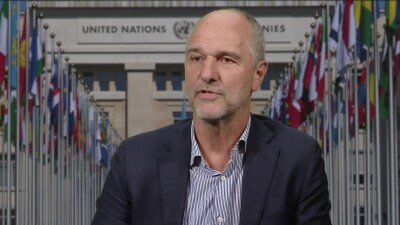
Vital medical supplies are fast running out in Gaza’s remaining hospitals, the UN health agency warned on Wednesday, amid reports of continuing Israeli bombing and hostilities in the enclave. “We have distributed an enormous amount of essential medical supplies, but it's not enough. I mean, this is such an overwhelming disaster, it’s not enough,” said Dr Rik Peeperkorn, UN World Health Organization (WHO) Representative in Palestine.
Speaking in Geneva on the sidelines of the World Health Assembly, the senior WHO official echoed widespread international condemnation of the Israeli airstrike at a camp for displaced people at Tal as-Sultan northwest of Rafah, that left scores dead on Sunday.
“WHO actually deplores this attack, this attack on displaced people. And it demonstrates that there is no safe place in Gaza at all,” he told UN News, as video from the field hospital treating victims distributed by the UN aid office, OCHA, showed an injured father weeping as he described the moment his children died.
“When the strike hit, I was thinking of my children,” said Mohammad Al Ghouf. “I promised them to get to the supermarket and do some shopping and to hug them. But unfortunately, I am here, and they are in a different place.”
From the same OCHA footage taken on Monday, the Medical Director of the International Medical Corps (IMC) field hospital described the grim task of preparing lifeless victims for burial: “I saw the dead body of a father who was basically holding his child, perhaps around three years of age. They were burned and charred. We couldn't separate them. So, we had to put both of them together in a body bag. It was very, very hard.”
Burns care lacking
Some 75 patients received treatment at the IMC field hospital. “Out of those 75, 25 were very critical,” the IMC official added, fuelling deep concerns that the specialist burns and trauma care and medicines they need are out of reach in Gaza, since the Israeli military seized the main aid crossing point at Rafah earlier this month.
“You can only do so much in Gaza. And when it comes to really extensive burns, et cetera, there's no place currently in Gaza where that can be treated.” Dr Peeperkorn said. “Since the closing of the Rafah crossing, we only have had three trucks into Rafah. They came through Kerem Shalom and that's the only supply. We fortunately still have some supplies, but they are quickly running out.”
The perilous lack of lifesaving aid supplies could be reversed if lorries carrying humanitarian aid are allowed back into the enclave in significant numbers, the WHO official insisted.
Aid obstacles remain
“There are 60 WHO trucks standing in Al Arish ready to get into Gaza. So again, this plea: the Rafah crossing needs to be opened not just for medical supplies, but for all other humanitarian supplies.”
“We have distributed an enormous amount of essential emergency medical supplies, but it's not enough. I mean, like, this is such an overwhelming disaster, it's not enough. Now, when there would be a sustained ceasefire and there would be entry routes into Gaza which are properly managed, when there is a deconfliction mechanism which actually facilitates and supports, much more is possible.”
The UN health agency has previously warned that more Gazans will die unless desperately needed medical evacuations for seriously sick or injured Gazans are allowed outside the enclave. Some “10,000-plus” people are believed to require urgent transport outside Gaza for treatment but since the Rafah closure on 6 May, “there's no medical evacuation outside Gaza - and it was already a huge problem before”, Dr Peeperkorn said.
According to the UN agency for Palestinian refugees (UNRWA) and OCHA, the intensification of hostilities and issuance of evacuation orders have displaced more than 940,000 people from Rafah in the past three weeks, alongside 100,000 who have been displaced in northern Gaza.
“Attacks on Rafah have continued unabated and civilians displaced by hostilities lack shelter, food, water and other supplies and services essential to their survival,” OCHA said in an update on Tuesday.
The same update reported that Gazan health facilities continue to face dire shortages of fuel and medical supplies “while having to cope with a rising influx of casualties due to injuries and burns”. The Nasser Medical Complex also appealed for people to donate blood, OCHA noted.
The humanitarian update echoed longstanding concerns over the lack of aid reaching Gaza and stressed that although the Kerem Shalom crossing “remains open in principle, it is extremely difficult for aid organizations to access from the Gaza side due to hostilities, challenging logistical conditions, and complex coordination procedures…access constraints continue to hamper the delivery of life-saving humanitarian aid inside Gaza”.
Between 1 May and 26 May, OCHA reported that only 137 humanitarian aid missions were facilitated by the Israeli authorities to areas that require coordination across Gaza; 86 were “impeded after getting a green light or denied access to begin with, and 43 were cancelled by the organizers”.
Healing imperative
Amid the ongoing destruction caused by nearly eight months of war in Gaza that began in response to Hamas-led terror attacks in southern Israel that killed some 1,250 people and saw 250 taken hostage, the WHO official stressed the need to support the future reconstruction of Gaza’s largely destroyed health system, to help the region to recover and support a sustainable peace.
“When you start thinking about the healing process and early recovery and reconstruction, we need to think completely different about getting the supplies into Gaza including, of course, specific medical and medical equipment and supplies,” Dr Peeperkorn insisted, before underscoring the historic difficulties associated with bringing in standard medical equipment:
“It took us almost two years to get three mobile X-rays. Every referral hospital everywhere around the world have a number of these mobile X-rays; they are in the referrals almost everywhere. So, it absolutely doesn't make sense and I just want to make this point, we all hope there will be a sustained ceasefire very soon.”
He added: “We have to look also at the future, we have to push for a sustained ceasefire and then…early recovery, a rehabilitation process (should) start as soon as possible. There should be a Palestinian solution,” the WHO official continued, noting that Gaza still has “a lot of very capable health professionals” – many working as volunteers – who “should be the focus and the centre” of the reconstruction and rehabilitation process.
ends
STORY: Gaza health update - WHO
TRT: 3’50”
SOURCE: UNTV CH
RESTRICTIONS: PLEASE CREDIT OCHA FOOTAGE ON SCREEN
LANGUAGE: ENGLISH / NATS
ASPECT RATIO: 16:9
DATELINE: 29 MAY 2024 GENEVA, SWITZERLAND (WHO speaker); 27 MAY 2024 Al Mawasi (OCHA cutaways)
1. Wide of the field hospital – the International Medical Corps Hospital (IMC) - in southern Gaza’s Al Mawasi.
2. SOUNDBITE (English) – Dr Rik Peeperkorn, WHO Representative in Palestine: “WHO actually deplores this attack, this attack on displaced people. And it demonstrates that there is no safe place in Gaza at all.”
3. Wide of patient on stretcher at International Medical Corps Hospital (IMC).
4. SOUNDBITE (English) – Dr Rik Peeperkorn, WHO Representative in Palestine: “Let's be clear, a lot of those essential medicines are temperature-sensitive, et cetera. So, we need to monitor that properly. So since the closing of the Rafah crossing, we only have had three trucks into Rafah. They came through Kerem Shalom and that's the only supply. We fortunately still have some supplies but they are quickly running out.”
5. Medium, injured patients sitting outside field hospital.
6. SOUNDBITE (English) – Dr Rik Peeperkorn, WHO Representative in Palestine: “Currently there are 60 - 60 - WHO trucks standing in Al Arish ready to get into Gaza. So again, this plea, the Rafah crossing needs to be opened not just for medical supplies, but for all other humanitarian supplies.”
7. Medium wide, patients at field hospital, panning to other tents.
8. SOUNDBITE (English) – Dr Rik Peeperkorn, WHO Representative in Palestine: “You can only do so much in Gaza. And when it comes to really extensive burns, et cetera, there's no place currently in Gaza where that can be treated.”
9. Medium: injured youngster with one bandaged hand, the other hand shows burn wounds.
10. SOUNDBITE (English) – Dr Rik Peeperkorn, WHO Representative in Palestine: “Since the Rafah closure on 6 May, no one has been - actually there's no medical evacuation outside Gaza - and it was already a huge problem before.”
11. Medium close, man’s hand and forearm showing burn wounds.
12. SOUNDBITE (English) – Dr Rik Peeperkorn, WHO Representative in Palestine: “And then when you start thinking about the healing process and early recovery and reconstruction, we need to think completely different about getting the supplies into Gaza including, of course, specific medical and medical equipment and supplies.”
13. Medium close, child’s leg bandaged, resting on adult’s lap.
14. SOUNDBITE (English) – Dr Rik Peeperkorn, WHO Representative in Palestine: “So it took us almost two years to get three mobile X-rays. Every referral hospital everywhere around the world have a number of these mobile X-rays; they are in the referrals almost everywhere. So, it absolutely doesn't make sense and I just want to make this point, we all hope there will be a sustained ceasefire very soon.”
15. Medium, child on crutches moving outside the field hospital.
16. SOUNDBITE (English) – Dr Rik Peeperkorn, WHO Representative in Palestine: “We have distributed an enormous amount of essential emergency medical supplies, but it's not enough. I mean, like, this is such an overwhelming disaster, it's not enough. Now, when there would be a sustained ceasefire and there would be entry routes into Gaza which are properly managed, when there is a deconfliction mechanism which actually facilitates and supports, much more is possible.”
17. Medium, amputee stands talking outside on the walkway to the field hospital.
18. Medium-close, child eats from a bowl which she’s holding with a heavily bandaged hand. Her face shows scarring from burns.
Similar Stories

1
1
1
Edited News | UNICEF
A little over one year since a ceasefire agreement was announced between Hamas fighters and Israel, more than 340 children have been reported killed and hundreds more injured, the UN Children’s Fund, UNICEF, said on Friday.

1
1
1
Edited News | UNICEF , IFRC
Six weeks after Nepal’s deadly flooding disaster, communities are still struggling to rebuild their lives, but they will need sustained help as global warming increases the risk of another Himalayan catastrophe, the UN Children’s Fund (UNICEF) said on Friday.

1
1
1
Edited News | WHO
In suspected Russia plague death, testing and monitoring underway – WHO
The death of a lab worker in Russia’s Siberia region has sparked concerns about plague being the cause, the UN World Health Organization (WHO) said on Tuesday, adding that it was following the situation closely.

1
1
Edited News | OHCHR , UNOG
UN Human Rights Chief Volker Türk on Friday provided and oral update to the 63rd session of the Human rights Council on Ukraine.

1
1
1
Edited News | OHCHR , UNOG
UN Human Rights Chief Volker Türk on Friday provided and oral update to the 63rd session of the Human rights Council on the human rights situation in Haiti.

1
1
1
Edited News | WHO
Repeated delays in bringing lifesaving medicines, prosthetics and more from Israel into Gaza risk having devastating consequences on Palestinians who urgently need them in the wartorn enclave, the UN World Health Organization (WHO) said on Friday. “A truck full of non-priority supplies or the right supplies arriving too late, doesn't save lives. That's the question that actually matters," said Dr Reinhilde Van De Weerdt, WHO Representative in the OPT.

1
1
1
Edited News | WHO
DRC: Early access to care and oxygen decisive for Ebola patients’ survival – WHO
In the Democratic Republic of the Congo (DRC), health workers fighting the country’s largest-ever Ebola outbreak are struggling to overcome critical challenges to patient care, the UN World Health Organization (WHO) warned on Tuesday.

1
1
1
Edited News | OCHA , UN
Civilians in Iran are continuing to feel the consequences of months of conflict and military escalation, the UN’s top official in the country has said, as loss of life, damage to civilian infrastructure and mounting economic pressures leave many facing continued uncertainty.

1
1
1
Edited News | WHO , UNICEF
Aid agencies in Yemen highlighted the growing hunger emergency sparked by renewed fighting between Houthi opposition forces and Government troops, after mobile health clinics reported that hundreds of children displaced by the violence are suffering from the most deadly form of malnutrition.
1
1
1
Edited News | UNHCR
Displacement on the rise in Yemen as fighting continues - UNHCR
As hostilities worsen in Yemen, more people have been fleeing their homes, further intensifying the humanitarian crisis within the region, the UN Refugee Agency (UNHCR) warned on Tuesday.
1
1
1
Edited News | IOM , OHCHR , UNFPA , UNOG , UNHCR , WHO
Yemen’s humanitarian crisis growing by the hour amid spike in displacement
Yemenis displaced by renewed fighting have described fleeing for their lives amid shelling and gunfire, aid agencies reported on Friday, while highlighting the dramatic increase in humanitarian needs in the country and in Djibouti, where thousands have sought shelter.
1
1
1
Edited News | OHCHR , UNOG
The UN Human Rights Office issued on Friday a report documenting a shocking pattern of sexual violence amid Russia’s full-scale armed attack on Ukraine.