

The United Nations Office at Geneva
Multimedia Newsroom
Deadly hantavirus outbreak is not a new COVID, insists UN health agency
The risk of hantavirus spreading to the general population is “absolutely low”, the UN World Health Organization (WHO) stressed on Friday.
“This is not COVID,” a WHO spokesperson told journalists at a briefing in Geneva, as the agency continues to coordinate the response to the deadly outbreak on a cruise liner moored in Cabo Verde.
Three people have died and several others have fallen ill aboard the Dutch-flagged ship the Hondius, prompting a major international public health response involving countries across Europe, Africa and Latin America.
“Let’s not forget from couples who were close…from a flight attendant who handled the sick woman who just shortly after died and was feeling extremely unwell, we get negative test results. That should convince nearly everybody now that this is a dangerous virus, but only to the person who is really infected. And it's the risk to the general population remains absolutely low,” said WHO spokesperson Christian Lindmeier.
Eight cases of infection have been reported so far, including five laboratory-confirmed infections and three suspected cases linked to the rare Andes strain of hantavirus, according to WHO.
“I need to stress again and again, even those who have been sharing cabins don't seem to be both infected in some cases…it’s not spreading anything close to how COVID was spreading,” Mr. Lindmeier said.
Beyond the Hantius cruise liner at the centre of the outbreak, contact tracing has continued of potentially infected individuals. The Dutch flight attendant who had been in brief contact with one of the ship’s passengers who later died has tested negative for hantavirus, the UN official added.
“It’s following up on everybody. It’s looking into seating lists of planes, of ships, maybe even more tracing somebody's steps, seeing where they would have been or might have been in close contact,” Mr. Lindmeier said.
The UN agency has stressed that the outbreak is very different from the 2020 coronavirus pandemic which killed millions worldwide.
According to WHO, transmission generally requires close and prolonged contact, particularly among household members, intimate partners or healthcare workers. Even so, the wife whose infected husband is being treated in a Swiss hospital “has not presented any symptoms and is self-isolating…So that shows you, again, luckily, apparently the virus is not that contagious, that it easily jumps from person to person, so that's good,” Mr. Lindmeier said.
The first known patient developed symptoms on 6 April and later died aboard the vessel. His wife also became ill and died after being evacuated to South Africa, where laboratory testing confirmed hantavirus infection.
Prior to boarding, the pair had travelled through Argentina, Chile and Uruguay on a birdwatching trip, including visits to sites where the rodent species known to carry the virus is present.
Another passenger died on 2 May and while one man remains in intensive care in South Africa, WHO said his condition is improving. Other patients have been transferred to hospitals in the Netherlands for treatment.
WHO said no passengers or crew currently remaining aboard the ship are showing symptoms.
Hantaviruses are zoonotic viruses carried by rodents and are usually transmitted to humans through contact with infected animals or their urine, saliva or droppings.
The Andes strain, found in parts of Latin America, is the only known hantavirus capable of limited human-to-human transmission.
The outbreak has triggered action under the International Health Regulations, the global framework designed to coordinate responses to cross-border health threats.
WHO said it is working closely with authorities in Cabo Verde, Spain, the Netherlands, South Africa, the United Kingdom and Argentina, alongside the European Centre for Disease Prevention and Control.
ends
Hantavirus update - WHO
TRT: 2 min 08s
SOURCE: UNTV CH
RESTRICTIONS: NONE
LANGUAGE: ENGLISH / NATS
ASPECT RATIO: 16:9
DATELINE: 8 MAY 2026 GENEVA, SWITZERLAND
Speaker:
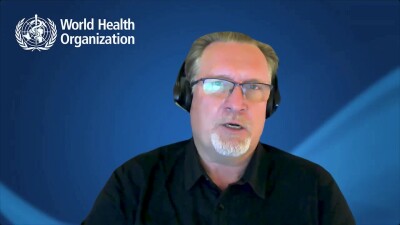
- Christian Lindmeier, spokesperson, WHO
SHOTLIST
- Exterior wide, UN Geneva flag alley.
- Wide, podium speakers, journalists.
- SOUNDBITE (English) – Christian Lindmeier, spokesperson, WHO: “This is not COVID. I know and we all know that we have COVID fresh in our minds still and that's the first connection everybody made, hence the international attention to these cases.”
- Cutaway, Press room, UN Geneva.
- SOUNDBITE (English) – Christian Lindmeier, spokesperson, WHO: “I need to stress again and again, even those who have been sharing cabins don't seem to be both infected in some cases. So, the risk remains absolutely low. This is not a new COVID.”
- Cutaway, Press room, UN Geneva.
- SOUNDBITE (English) – Christian Lindmeier, spokesperson, WHO: “My feeling is, people are getting less worried now because they realize it's not spreading anything close to how COVID was spreading.”
- Cutaway, Press room, UN Geneva.
- SOUNDBITE (English) – Christian Lindmeier, spokesperson, WHO: “Contact tracing is indeed a diligent detective work. It's following up on everybody. It's looking into seating lists of planes, of ships, maybe even more tracing somebody's steps, seeing where they would have been or might have been in close contact.”
- Cutaway, Press room, UN Geneva.
- SOUNDBITE (English) – Christian Lindmeier, spokesperson, WHO: “Let's not forget, from couples who were close, wore (inaudible) clothes, from a flight attendant who handled the sick woman who just shortly after died and was feeling extremely unwell, we get negative test results. That should convince nearly everybody now that this is a dangerous virus, but only to the person who is really infected. And its risk to the general population remains absolutely low.”
- Cutaway, Press room, UN Geneva.
- SOUNDBITE (English) – Christian Lindmeier, spokesperson, WHO: “The Dutch flight attendant of the flight which had reported symptoms and was tested has been tested negative for hantavirus that we received this morning from the Dutch IHR focal point for the International Health Regulations.”
- Cutaway, Press room, UN Geneva.
Similar Stories

2
17
1
2
Edited News , Press Conferences | OCHA , WMO
Two UN agencies teamed up on Wednesday to issue an appeal for immediate assistance to help communities already being impacted by the strongest El Niño on record.

3
16
2
2
B-roll , Conferences , Edited News | UNITED NATIONS , UNOG
Sixth Consultative Meeting on Enhancing Coordination of Peace Initiatives and Efforts for Sudan

1
1
1
Edited News | UNICEF , WHO , UNHCR
Yemen war continues to force families from homes amid hunger and disease
More than 250,000 people have now fled renewed fighting in Yemen, the UN said on Tuesday, citing particular concern for those sheltering in the southwestern city of Taiz and the wider governorate, where access is “essentially blocked”.

1
1
1
Edited News | UNICEF
A little over one year since a ceasefire agreement was announced between Hamas fighters and Israel, more than 340 children have been reported killed and hundreds more injured, the UN Children’s Fund, UNICEF, said on Friday.

1
1
1
Edited News | UNICEF , IFRC
Six weeks after Nepal’s deadly flooding disaster, communities are still struggling to rebuild their lives, but they will need sustained help as global warming increases the risk of another Himalayan catastrophe, the UN Children’s Fund (UNICEF) said on Friday.

1
1
1
Edited News | WHO
In suspected Russia plague death, testing and monitoring underway – WHO
The death of a lab worker in Russia’s Siberia region has sparked concerns about plague being the cause, the UN World Health Organization (WHO) said on Tuesday, adding that it was following the situation closely.

1
1
Edited News | OHCHR , UNOG
UN Human Rights Chief Volker Türk on Friday provided and oral update to the 63rd session of the Human rights Council on Ukraine.

1
1
1
Edited News | OHCHR , UNOG
UN Human Rights Chief Volker Türk on Friday provided and oral update to the 63rd session of the Human rights Council on the human rights situation in Haiti.

1
1
1
Edited News | WHO
Repeated delays in bringing lifesaving medicines, prosthetics and more from Israel into Gaza risk having devastating consequences on Palestinians who urgently need them in the wartorn enclave, the UN World Health Organization (WHO) said on Friday. “A truck full of non-priority supplies or the right supplies arriving too late, doesn't save lives. That's the question that actually matters," said Dr Reinhilde Van De Weerdt, WHO Representative in the OPT.

1
1
1
Edited News | WHO
DRC: Early access to care and oxygen decisive for Ebola patients’ survival – WHO
In the Democratic Republic of the Congo (DRC), health workers fighting the country’s largest-ever Ebola outbreak are struggling to overcome critical challenges to patient care, the UN World Health Organization (WHO) warned on Tuesday.

1
1
1
Edited News | OCHA , UN
Civilians in Iran are continuing to feel the consequences of months of conflict and military escalation, the UN’s top official in the country has said, as loss of life, damage to civilian infrastructure and mounting economic pressures leave many facing continued uncertainty.
1
1
1
Edited News | WHO , UNICEF
Aid agencies in Yemen highlighted the growing hunger emergency sparked by renewed fighting between Houthi opposition forces and Government troops, after mobile health clinics reported that hundreds of children displaced by the violence are suffering from the most deadly form of malnutrition.