

The United Nations Office at Geneva
Multimedia Newsroom
Two weeks since fighting erupted between the Rapid Support Forces (RSF) and the Sudanese Armed Forces (SAF), United Nation humanitarian aid agencies warned on Friday that the ongoing conflict is having a devastating impact on the civilian population, including refugees and internally displaced people across the country. Heavy fighting and insecurity have driven tens of thousands to flee in search of safety.
“The biggest challenge we will have is Darfur,” said Axel Bisschop, UNHCR Representative in Sudan. “Darfur has already faced the wrath of intercommunal conflict and displacement. Now with this added on crisis, the humanitarian situation will be very, very difficult.” Mr Bisschop added that “we also are concerned that the impact of communal violence is going to increase and that we might have some situations which will repeat in relation to what we had a couple of years ago”.
The UN refugee agency said that is extremely disturbing that desperately needed assistance - especially for newly displaced and vulnerable people like women and children - cannot be provided and that innocent civilians will continue to suffer.
“We are also very, very worried about the continued movement both internal displacement but also of refugees that now leave places like Khartoum but also Darfur to seek safety in other areas, and we have already seen that some of the camps especially in the White Nile have received new refugees,” said the UNHCR’s Sudan Representative.
UN agencies are temporarily relocating their staff to safer regions inside and outside Sudan. A leadership team has set up a hub in Port Sudan where staff will continue to monitor the situation while preparing to resume the humanitarian operations, when possible.
“We have all been forced to pause some of the programmes especially in Darfur, in Khartoum and also in the Kordofans, but we are still operating in the White Nile, Blue Nile, East Sudan, Gedaref and Kassala,” said Mr Bisschop. “This is where the main majority of the population of UNHCR’s concern is for the refugees.”
The UN World Food Programme (WFP) and other humanitarian actors have called on all parties to the conflict to take immediate steps to stop the fighting, restore calm and enable humanitarians to safety carry out their mandate.
“As the fighting rages on in parts of Sudan, our humanitarian operations in the country are actually impossible at a time when a third of the country is in desperate need of assistance,” said Brenda Kariuki, WFP’s Regional Communications Officer for East Africa. “We are hearing of acute shortages of food, water, fuel, medicines and access to healthcare.”
Because of the current crisis, millions more will need humanitarian assistance, WFP has warned. While a ceasefire meant a relative reprieve in the fighting, clashes continue to be reported in densely populated areas of Khartoum, Bahri, Omdurman and towns in Darfur and North Kordofan.
“WFP staff offices and vehicles and equipment and food stocks have come in the direct line of fire, and looting of our warehouses continues,” said Ms. Kariuki. “To date, we know up to 4,000 metric tonnes of food meant for vulnerable people has been looted from our warehouses, and at least ten vehicles and six trucks which transport food have been stolen”. She added that “this is unacceptable, and it is takes away much needed humanitarian aid meant for the most vulnerable Sudanese and refugees who desperately need this lifesaving assistance.”
With WFP’s air operations grounded, the entire humanitarian community’s movement is severely disrupted.
The UN human rights office (OHCHR) said on Friday that it is deeply alarming that inmates in Sudan have been released from, or escaped from, a number of prisons.
OHCHR’s spokesperson Ravina Shamdasani said that “when you see continued impunity for serious violations of international human rights law and international humanitarian law, it emboldens the perpetrators, and we are very concerned that prison releases or escapes have also led to potential war criminals having been released. This is of deep concern.”
According to OHCHR, the hostilities between the RSF and SAF have triggered intercommunal violence.
“This goes back also to perceived and real ethnic affiliations of the RSF and the SAF, the Sudanese Armed Forces,” Ms. Shamdasani said. “There have been sporadic clashes between Arab and Masalit communities. What we have seen since 24 April is that clashes between the communities are continuing, and we have estimates that some 96 people have already been killed.”
The World Health Organisation (WHO) also reported about 25 verified attacks on health facilities. Since 15 April, eight health care workers have been killed and 18 others injured following these attacks.
-ends-
STORY: Sudan Update: UNHCR - WFP - OHCHR
TRT: 03’49”
SOURCE: UNTV CH
LANGUAGE: ENGLISH/NATS
ASPECT RATIO: 16:9
RELEASE DATE: 28 April 2023
GENEVA, SWITZERLAND
SHOTLIST
- Exterior wide shot: UN flag alley UN Geneva.
- Wide shot of podium, conference room, Palais des Nations, Geneva
- SOUNDBITE (ENGLISH) Axel Bisschop, UNHCR Representative in Sudan: “The biggest challenge we will have is Darfur. Darfur has already faced the wrath of intercommunal conflict and displacement. Now with this added on crisis, the humanitarian situation will be very, very difficult. We also are concerned that the impact of communal violence is going to increase and that we might have some situations which will repeat in relation to what we had a couple of years ago.”
- Close up: journalists typing
- SOUNDBITE (ENGLISH) Axel Bisschop, UNHCR Representative in Sudan: “We are also very, very worried about the continued movement both internal displacement but also of refugees that now leave places like Khartoum but also Darfur to seek safety in other areas, and we have already seen that some of the camps especially in the White Nile have received new refugees.”
- Medium shot: journalists typing with monitor in the background
- SOUNDBITE (ENGLISH) Axel Bisschop, UNHCR Representative in Sudan: “We have all been forced to pause some of the programmes especially in Darfur, in Khartoum and also in the Kordofans, but we are still operating in the White Nile, Blue Nile, East Sudan, Gedaref and Kassala. This is where the main majority of the population of UNHCR’s concern is for the refugees.”
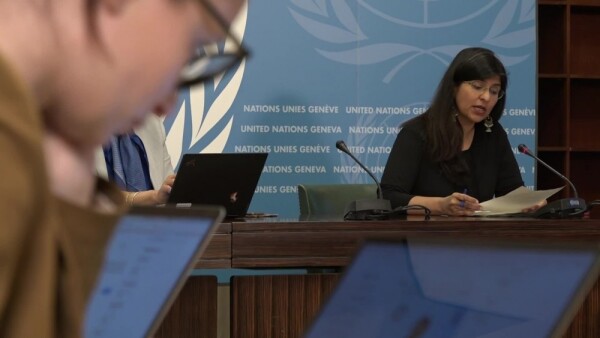
- Medium shot: journalist with speaker and moderator visible on the screen in the background.
- SOUNDBITE (ENGLISH): Brenda Kariuki, UN Food Programme (WFP)’s Regional Communications Officer for East Africa: “As the fighting rages on in parts of Sudan, our humanitarian operations in the country are actually impossible at a time when a third of the country is in desperate need of assistance. We are hearing of acute shortages of food, water, fuel, medicines and access to healthcare.”
- Medium shot: cameraperson
- SOUNDBITE (ENGLISH) Brenda Kariuki, UN Food Programme (WFP)’s Regional Communications Officer for East Africa: “WFP staff offices and vehicles and equipment and food stocks have come in the direct line of fire, and looting of our warehouses continues. To date, we know up to 4,000 metric tonnes of food meant for vulnerable people has been looted from our warehouses, and at least ten vehicles and six trucks which transport food have been stolen. This is unacceptable and it is takes away much needed humanitarian aid meant for the most vulnerable Sudanese and refugees who desperately need this lifesaving assistance.”
- Wide shot: journalists with laptops, with speakers at podium in the background
- SOUNDBITE (ENGLISH) Ravina Shamdasani, UN Human Rights Office (OHCHR): “When you see continued impunity for serious violations of International Human Rights Law and International Humanitarian Law, it emboldens the perpetrators, and we are very concerned that prison releases or escapes have also led to potential war criminals having been released. This is of deep concern.”
- Medium shot: technician on laptop, conference room
- SOUNDBITE (ENGLISH) Ravina Shamdasani, UN Human Rights Office (OHCHR): “This goes back also to perceived and real ethnic affiliations of the RSF and the SAF, the Sudanese Armed Forces. There have been sporadic clashes between Arab and Masalit communities. What we have seen since the 24th of April is that clashes between the communities are continuing, and we have estimates that some 96 people have already been killed.”
- Wide shot: speaker, podium
- Medium shot: journalist typing
- Cameraperson
Similar Stories

1
1
1
Edited News | OCHA , UNICEF , WFP
Aid agencies warned on Friday of the fast-developing humanitarian emergency inside Taiz City in Yemen, which has been encircled by de facto Houthi forces fighting government troops along the country’s west coast.

2
17
1
2
Edited News , Press Conferences , Images | OCHA , WMO
Two UN agencies teamed up on Wednesday to issue an appeal for immediate assistance to help communities already being impacted by the strongest El Niño on record.

3
16
2
2
Edited News , B-roll , Conferences , Images | UNITED NATIONS , UNOG
Sixth Consultative Meeting on Enhancing Coordination of Peace Initiatives and Efforts for Sudan

1
1
1
Edited News | UNICEF , WHO , UNHCR
Yemen war continues to force families from homes amid hunger and disease
More than 250,000 people have now fled renewed fighting in Yemen, the UN said on Tuesday, citing particular concern for those sheltering in the southwestern city of Taiz and the wider governorate, where access is “essentially blocked”.

1
1
1
Edited News | UNICEF
A little over one year since a ceasefire agreement was announced between Hamas fighters and Israel, more than 340 children have been reported killed and hundreds more injured, the UN Children’s Fund, UNICEF, said on Friday.

1
1
1
Edited News | UNICEF , IFRC
Six weeks after Nepal’s deadly flooding disaster, communities are still struggling to rebuild their lives, but they will need sustained help as global warming increases the risk of another Himalayan catastrophe, the UN Children’s Fund (UNICEF) said on Friday.

1
1
1
Edited News | WHO
In suspected Russia plague death, testing and monitoring underway – WHO
The death of a lab worker in Russia’s Siberia region has sparked concerns about plague being the cause, the UN World Health Organization (WHO) said on Tuesday, adding that it was following the situation closely.

1
1
Edited News | OHCHR , UNOG
UN Human Rights Chief Volker Türk on Friday provided and oral update to the 63rd session of the Human rights Council on Ukraine.

1
1
1
Edited News | OHCHR , UNOG
UN Human Rights Chief Volker Türk on Friday provided and oral update to the 63rd session of the Human rights Council on the human rights situation in Haiti.

1
1
1
Edited News | WHO
Repeated delays in bringing lifesaving medicines, prosthetics and more from Israel into Gaza risk having devastating consequences on Palestinians who urgently need them in the wartorn enclave, the UN World Health Organization (WHO) said on Friday. “A truck full of non-priority supplies or the right supplies arriving too late, doesn't save lives. That's the question that actually matters," said Dr Reinhilde Van De Weerdt, WHO Representative in the OPT.

1
1
1
Edited News | WHO
DRC: Early access to care and oxygen decisive for Ebola patients’ survival – WHO
In the Democratic Republic of the Congo (DRC), health workers fighting the country’s largest-ever Ebola outbreak are struggling to overcome critical challenges to patient care, the UN World Health Organization (WHO) warned on Tuesday.

1
1
1
Edited News | OCHA , UN
Civilians in Iran are continuing to feel the consequences of months of conflict and military escalation, the UN’s top official in the country has said, as loss of life, damage to civilian infrastructure and mounting economic pressures leave many facing continued uncertainty.