

The United Nations Office at Geneva
Multimedia Newsroom
STORY: Funding Sustainable Development - DSG Mohammed
TRT: 4’49”
SOURCE: UNTV CH
RESTRICTIONS: NONE
LANGUAGE: ENGLISH
ASPECT RATIO: 16:9
DATELINE: 29 November 2021, GENEVA, SWITZERLAND
SHOTLIST
- Exterior wide shot, United Nations flags flying.
- SOUNDBITE (English): Amina Mohammed, Deputy Secretary-General of the United Nations: “We need more ambition, more action, more scale, greater urgency in delivering the 2030 Agenda and the Paris Agreement – and we certainly need more fuel, more financial resources and more investments.”
- Close shot, inside the Auditorium Pictet (Maison de la Paix), participants, masked, attending the Summit.
- SOUNDBITE (English): Amina Mohammed, Deputy Secretary-General of the United Nations: “We need the private sector and its leadership to unlock resources for key transitions in sustainable energy and connectivity, food systems, health, education, social protection, digitalization. Innovative instruments including blended finance can all play an important role but we need to massively scale-up that delivery.”
- Medium shot, participants listening to the conference.
- SOUNDBITE (English): Amina Mohammed, Deputy Secretary-General of the United Nations: “The good news is that we already have a shared narrative or a linguistic bridge in the 2030 Agenda. But we still face a mismatch of metrics and languages between diplomacy and business; public and private actors.”
- Medium shot, Press Conference (Maison de la Paix), speakers and journalists.
- SOUNDBITE (English): Ueli Maurer, Federal Finance Minister, Swiss Confederation: “I think Building Bridges, we have to do it between the population and the Government, we have to explain what we have to do. Then we need bridges between the private sector and the Government and then I think we need bridges from Switzerland to the world.”
- Close shot Patrick Odier and Ueli Maurer on podium listening to journalists’ questions.
- SOUNDBITE (English): Patrick Odier, President of Building Bridges initiative and chair, Lombard Odier: “We are trying actually to bring capital closer to the whole array of the Sustainable Development Goals, i.e. to try to find not only bridges - but to be concrete - instruments, metrics, methodologies that allow capital not only to set targets in certain areas that are covered by the SDGs, but also to be measurable in terms of reaching all those targets that I have said. And this is where finance is at this very moment.”
- Wide shot, speakers and journalists at the Press Conference.
- SOUNDBITE (English): Patrick Odier, President of Building Bridges initiative and chair, Lombard Odier: “We all know that we have to deal with these issues of subsidies but finance itself is not at the helm of addressing this issue; what finance can do is basically ask the Government to play its role when it comes to trying to address the fossil industry and of course the emission problematic.”
- Medium shot, podium speakers.
- SOUNDBITE (English): Patrick Odier, President of Building Bridges initiative: “That’s what we want to do here, discuss what can we do directly or indirectly as a financial sector if you take this industry for example, this fossil industry, to make sure we accelerate the transition towards renewable, and perhaps we pick the low-hanging fruits of stopping perhaps financing certain types of damaging industries, that we can allow ourselves to stop without creating too big collateral damages in the short-term.”
- Wide shot, inside the Auditorium Pictet, audience following the conference.
- SOUNDBITE (English): Amina Mohammed, Deputy Secretary-General of the United Nations: “We do have the leadership, we have the expertise, and we have the tools. Never before have we been able to do so much. Yet, the truth is that the trust deficit is widening in our world. We have not been able to rise to the ask of solidarity in our global response for the pandemic.”
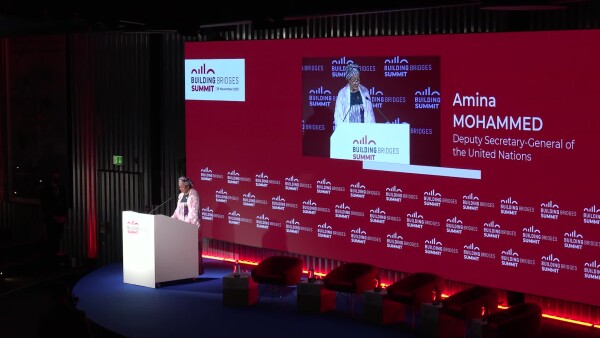
- Medium shot, Amina Mohammed delivering her speech at the Building Bridges Summit.
- SOUNDBITE (English): Amina Mohammed, Deputy Secretary-General of the United Nations: “Until everyone gets the vaccine, we will all be at risk, and we will not be able to take the SDGs to where they ought to be by 2030.”
- Close shot, the audience, masked, attending the Summit.
- SOUNDBITE (English): Amina Mohammed, Deputy Secretary-General of the United Nations: “For many, the health pandemic has been a tragedy, particularly in developed countries, but for developing countries it has a socio-economic impact that will take so much longer to recover from. And so, we need the urgency of the investments in climate action, which will have multiplier effects on the SDGs.”
- Medium shot, Mr. Maurer and Mr. Odier meeting Mrs. Tatiana Valovaya, United Nations Geneva Director-General.
- Medium-wide shot, Mrs. Mohammed arriving at the Maison de la Paix and meeting Mr. Odier and Mr. Maurer.
- Medium-wide shot, Mrs. Mohammed walking with Mr. Maurer at the Maison de la Paix, with Mr. Odier and Mrs. Valovaya behind.
- Medium-wide shot, Mrs. Mohammed, Mr. Maurer and Mr. Odier walking together outside at the Maison de la Paix.
Financing sustainable development needed more than ever, says UN deputy chief Mohammed
Securing the funding needed for sustainable development by involving as many actors from different sectors is more urgent than ever, amid a widening “trust deficit” between the haves and the have-nots, the UN Deputy Secretary-General said on Monday.
Speaking at the Building Bridges Summit for sustainable finance in Geneva, Amina Mohammed urged all those present from Government, the private sector, international organisations and civil society to do more to push ahead with a common investment framework to improve people’s lives everywhere.
“We need more ambition, more action, more scale, greater urgency in delivering the 2030 Agenda and the Paris Agreement – and we certainly need more fuel, more financial resources and more investments,” she said. “The good news is that we already have a shared narrative or a linguistic bridge in the 2030 Agenda. But we still face a mismatch of metrics and languages between diplomacy and business; public and private actors.”
Representing the Swiss federal government at the summit’s second iteration, Finance Minister Ueli Maurer highlighted its potential for concrete action, along with the need to be inclusive and transparent in the way that sustainable financing is handled.
“I think Building Bridges, we have to do it between the population and the Government, we have to explain what we have to do,” he said. “Then we need bridges between the private sector and the Government and then I think we need bridges from Switzerland to the world.”
According to the summit’s organisers, between 2019 and 2020, sustainable investment rose by 31 per cent in Switzerland, to over 1,500 billion francs.
In addition to highlighting opportunities for investors and fund managers, it is hoped that the summit will contribute to creating an ordered and common approach to “net zero” financing, said Patrick Odier, President of Building Bridges initiative and chair of Lombard Odier bank:
“We are trying actually to bring capital closer to the whole array of the Sustainable Development Goals, i.e. to try to find not only bridges - but to be concrete - instruments, metrics, methodologies that allow capital not only to set targets in certain areas that are covered by the SDGs, but also to be measurable in terms of reaching all those targets that I have said. And this is where finance is at this very moment.”
Mr. Odier also responded to the call to end subsidies for fossil fuel industries to create a level playing field for renewable energy investment: “We all know that we have to deal with these issues of subsidies, but finance itself is not at the helm of addressing this issue,” he said. “What finance can do is basically ask the Government to play its role when it comes to trying to address the fossil industry and of course the emission problematic.”
He added: “That’s what we want to do here, discuss what can we do directly or indirectly as a financial sector if you take this industry for example, this fossil industry, to make sure we accelerate the transition towards renewable, and perhaps we pick the low-hanging fruits of stopping perhaps financing certain types of damaging industries, that we can allow ourselves to stop without creating too big collateral damages in the short-term.”
Highlighting the convening ambition of the summit at Geneva’s Maison de la Paix, Deputy Secretary-General Mohammed listed the issues that she hoped the week-long summit might address: “We need the private sector and its leadership to unlock resources for key transitions in sustainable energy and connectivity, food systems, health, education, social protection, digitalization. Innovative instruments including blended finance can all play an important role, but we need to massively scale-up that delivery.”
Despite the fact that there was the “leadership”, “expertise” and “tools” to achieve so much, Ms. Mohammed warned that “the truth is that the trust deficit is widening in our world”.
And amid World Health Organization data showing that more than 80 per cent of COVID-19 vaccines have gone to G20 countries and low-income countries have received just 0.6 per cent, the UN deputy chief maintained in particular that “we have not been able to rise” to the global solidarity call.
“Until everyone gets the vaccine, we will all be at risk, and we will not be able to take the SDGs to where they ought to be by 2030, she said. “For many, the health pandemic has been a tragedy, particularly in developed countries, but for developing countries it has a socio-economic impact that will take so much longer to recover from. And so, we need the urgency of the investments in climate action, which will have multiplier effects on the SDGs.”
ends
Similar Stories
1
1
1
Edited News | OCHA , UNICEF , WFP
Aid agencies warned on Friday of the fast-developing humanitarian emergency inside Taiz City in Yemen, which has been encircled by de facto Houthi forces fighting government troops along the country’s west coast.

2
17
1
2
Edited News , Press Conferences , Images | OCHA , WMO
Two UN agencies teamed up on Wednesday to issue an appeal for immediate assistance to help communities already being impacted by the strongest El Niño on record.

3
16
2
2
Edited News , B-roll , Conferences , Images | UNITED NATIONS , UNOG
Sixth Consultative Meeting on Enhancing Coordination of Peace Initiatives and Efforts for Sudan

1
1
1
Edited News | UNICEF , WHO , UNHCR
Yemen war continues to force families from homes amid hunger and disease
More than 250,000 people have now fled renewed fighting in Yemen, the UN said on Tuesday, citing particular concern for those sheltering in the southwestern city of Taiz and the wider governorate, where access is “essentially blocked”.

1
1
1
Edited News | UNICEF
A little over one year since a ceasefire agreement was announced between Hamas fighters and Israel, more than 340 children have been reported killed and hundreds more injured, the UN Children’s Fund, UNICEF, said on Friday.

1
1
1
Edited News | UNICEF , IFRC
Six weeks after Nepal’s deadly flooding disaster, communities are still struggling to rebuild their lives, but they will need sustained help as global warming increases the risk of another Himalayan catastrophe, the UN Children’s Fund (UNICEF) said on Friday.

1
1
1
Edited News | WHO
In suspected Russia plague death, testing and monitoring underway – WHO
The death of a lab worker in Russia’s Siberia region has sparked concerns about plague being the cause, the UN World Health Organization (WHO) said on Tuesday, adding that it was following the situation closely.

1
1
Edited News | OHCHR , UNOG
UN Human Rights Chief Volker Türk on Friday provided and oral update to the 63rd session of the Human rights Council on Ukraine.

1
1
1
Edited News | OHCHR , UNOG
UN Human Rights Chief Volker Türk on Friday provided and oral update to the 63rd session of the Human rights Council on the human rights situation in Haiti.

1
1
1
Edited News | WHO
Repeated delays in bringing lifesaving medicines, prosthetics and more from Israel into Gaza risk having devastating consequences on Palestinians who urgently need them in the wartorn enclave, the UN World Health Organization (WHO) said on Friday. “A truck full of non-priority supplies or the right supplies arriving too late, doesn't save lives. That's the question that actually matters," said Dr Reinhilde Van De Weerdt, WHO Representative in the OPT.

1
1
1
Edited News | WHO
DRC: Early access to care and oxygen decisive for Ebola patients’ survival – WHO
In the Democratic Republic of the Congo (DRC), health workers fighting the country’s largest-ever Ebola outbreak are struggling to overcome critical challenges to patient care, the UN World Health Organization (WHO) warned on Tuesday.

1
1
1
Edited News | OCHA , UN
Civilians in Iran are continuing to feel the consequences of months of conflict and military escalation, the UN’s top official in the country has said, as loss of life, damage to civilian infrastructure and mounting economic pressures leave many facing continued uncertainty.