

The United Nations Office at Geneva
Multimedia Newsroom
“UN rights office warns any ground assault on Rafah would ‘heighten risk of further atrocity crimes’.”
The UN Human Rights Office (OHCHR) said on Friday that it fears that the already catastrophic situation in the Palestinian enclave “may slide deeper into the abyss” should Israel launch its threatened military offensive in Gaza’s border town of Rafah.
“Any ground assault on Rafah would incur massive loss of life and would heighten the risk of further atrocity crimes,” said Jeremy Laurence, OHCHR’s spokesperson when briefing reporters at the United Nations in Geneva. “This must not be allowed to happen.”
In Rafah, 1,5 million people have been displaced in deplorable, subhuman conditions, said Mr. Laurence. “We fear that this already catastrophic situation may slide deeper into the abyss, as many Palestinians mark the holy month of Ramadan, a period that is meant to honor peace and tolerance.”
OHCHR is also concerned about further Israeli restrictions to grant Palestinians access to East Jerusalem and Al Aqsa Mosque during Ramadan which commences on Sunday and which could further inflame tensions.
As the Gaza conflict enters on Friday its sixth month, Mr. Laurence stressed that “since the 7th of October, parties to this conflict have paid little heed to international law that protects human rights and governs the conduct of hostilities. This has been a stain on the collective conscience of humanity.”
The Human Rights Office repeated that there must be an immediate end to this conflict, the killing and destruction must stop. It also reminded that the hostages, who have now endured over 150 days of suffering and torment, must be released unconditionally, and returned to their families.
On Friday, the UN Human Rights Office published a report on the Israeli settlements in the occupied West Bank that detailed the drastic acceleration in settlement buildings as an exacerbating long-standing pattern of oppression, violence and discrimination against Palestinians.
“The report also highlights the dramatic increase in the intensity, severity and regularity of Israeli settler and state violence against Palestinians in the occupied West Bank, including East Jerusalem, particularly since 7th October 2023,” said Ajith Sunghay, head of OHCHR’s Office for the occupied Palestinian Territories (OPT). “This violence is accelerating Palestinians displacement from their land”.
The report finds that the current Israeli Government's policies “appear aligned, to an unprecedented extent, with the goals of the Israeli settler movement to expand long-term control over the West Bank, including East Jerusalem, and to steadily integrate this occupied territory into the State of Israel.”
The report which covers the period from 1 November 2022 to 31 October 2023 concluded that the size of existing Israeli settlements has expanded markedly. About 24,300 housing units within existing Israeli settlements in the West Bank were advanced during this period, the highest on record since monitoring began in 2017. This included approximately 9,670 units in East Jerusalem.
“We remind Israel that the transfer of population of an occupying power into occupied territory, or the forcible transfer of the population within or from occupied territory, or the annexation of territory by use of force are all strictly prohibited. Officials and others involved in such conduct risk individual criminal liability,” noted Ajith Sunghay.
According to reports, Israel plans to build a further 3,476 settler homes in the illegal settlements of Maale Adumim, Efrat and Kedar in further violation of international law.
-ends-
STORY: Gaza update and Israeli settlement report – OHCHR
TRT: 2:10”
SOURCE: UNTV CH
RESTRICTIONS: NONE
LANGUAGE: ENGLISH / NATS
ASPECT RATIO: 16:9
DATELINE: 8 March 2024 GENEVA, SWITZERLAND
SHOTLIST
- Exterior medium shot: UN flag alley at the United Nations Office in Geneva
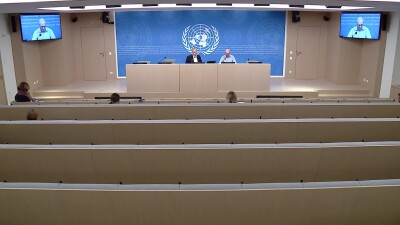
- Wide shot: Spokespersons at the podium and journalists in Press briefing room
- SOUNDBITE (English) – Jeremy Laurence, spokesperson for the UN Human Rights Office (OHCHR): “We fear that this already catastrophic situation may slide deeper into the abyss, as many Palestinians mark the holy month of Ramadan, a period that is meant to honor peace and tolerance.”
- Medium shot: Journalists in press room with speaker at podium
- SOUNDBITE (English) – Jeremy Laurence, spokesperson for the UN Human Rights Office (OHCHR): “Any ground assault on Rafah would incur massive loss of life and would heighten the risk of further atrocity crimes. This must not be allowed to happen.”
- Medium shot: UN staff working in press room booths
- SOUNDBITE (English) – Jeremy Laurence, spokesperson for the UN Human Rights Office (OHCHR): “Since the 7th of October, parties to this conflict have paid little heed to international law that protects human rights and governs the conduct of hostilities. This has been a stain on the collective conscience of humanity.”
- Wide shot: Journalists in press room with speaker on screen and spokesperson at the podium
- SOUNDBITE (English) – Ajith Sunghay, Head of OHCHR’s Office for the OPT (from East Jerusalem): “The report also highlights the dramatic increase in the intensity, severity and regularity of Israeli settler and state violence against Palestinians in the occupied West Bank, including East Jerusalem, particularly since 7th October 2023. This violence is accelerating Palestinians displacement from their land.”
- Medium shot: Spokespersons at the podium with speaker on screen
- SOUNDBITE (English) – Ajith Sunghay, Head of OHCHR’s Office for the OPT (from East Jerusalem): “We remind Israel that the transfer of population of an occupying power into occupied territory, or the forcible transfer of the population within or from occupied territory, or the annexation of territory by use of force are all strictly prohibited. Officials and others involved in such conduct risk individual criminal liability.”
- Close up: Camerawoman filming
- Close up: Journalist listening
- Wide shot: Journalists in press room
Similar Stories

1
1
1
Edited News | UNICEF
A little over one year since a ceasefire agreement was announced between Hamas fighters and Israel, more than 340 children have been reported killed and hundreds more injured, the UN Children’s Fund, UNICEF, said on Friday.

1
1
1
Edited News | UNICEF , IFRC
Six weeks after Nepal’s deadly flooding disaster, communities are still struggling to rebuild their lives, but they will need sustained help as global warming increases the risk of another Himalayan catastrophe, the UN Children’s Fund (UNICEF) said on Friday.

1
1
1
Edited News | WHO
In suspected Russia plague death, testing and monitoring underway – WHO
The death of a lab worker in Russia’s Siberia region has sparked concerns about plague being the cause, the UN World Health Organization (WHO) said on Tuesday, adding that it was following the situation closely.

1
1
Edited News | OHCHR , UNOG
UN Human Rights Chief Volker Türk on Friday provided and oral update to the 63rd session of the Human rights Council on Ukraine.

1
1
1
Edited News | OHCHR , UNOG
UN Human Rights Chief Volker Türk on Friday provided and oral update to the 63rd session of the Human rights Council on the human rights situation in Haiti.

1
1
1
Edited News | WHO
Repeated delays in bringing lifesaving medicines, prosthetics and more from Israel into Gaza risk having devastating consequences on Palestinians who urgently need them in the wartorn enclave, the UN World Health Organization (WHO) said on Friday. “A truck full of non-priority supplies or the right supplies arriving too late, doesn't save lives. That's the question that actually matters," said Dr Reinhilde Van De Weerdt, WHO Representative in the OPT.

1
1
1
Edited News | WHO
DRC: Early access to care and oxygen decisive for Ebola patients’ survival – WHO
In the Democratic Republic of the Congo (DRC), health workers fighting the country’s largest-ever Ebola outbreak are struggling to overcome critical challenges to patient care, the UN World Health Organization (WHO) warned on Tuesday.

1
1
1
Edited News | OCHA , UN
Civilians in Iran are continuing to feel the consequences of months of conflict and military escalation, the UN’s top official in the country has said, as loss of life, damage to civilian infrastructure and mounting economic pressures leave many facing continued uncertainty.
1
1
1
Edited News | WHO , UNICEF
Aid agencies in Yemen highlighted the growing hunger emergency sparked by renewed fighting between Houthi opposition forces and Government troops, after mobile health clinics reported that hundreds of children displaced by the violence are suffering from the most deadly form of malnutrition.
1
1
1
Edited News | UNHCR
Displacement on the rise in Yemen as fighting continues - UNHCR
As hostilities worsen in Yemen, more people have been fleeing their homes, further intensifying the humanitarian crisis within the region, the UN Refugee Agency (UNHCR) warned on Tuesday.
1
1
1
Edited News | IOM , OHCHR , UNFPA , UNOG , UNHCR , WHO
Yemen’s humanitarian crisis growing by the hour amid spike in displacement
Yemenis displaced by renewed fighting have described fleeing for their lives amid shelling and gunfire, aid agencies reported on Friday, while highlighting the dramatic increase in humanitarian needs in the country and in Djibouti, where thousands have sought shelter.
1
1
1
Edited News | OHCHR , UNOG
The UN Human Rights Office issued on Friday a report documenting a shocking pattern of sexual violence amid Russia’s full-scale armed attack on Ukraine.