

The United Nations Office at Geneva
Multimedia Newsroom
Edited News | OHCHR , UNOG
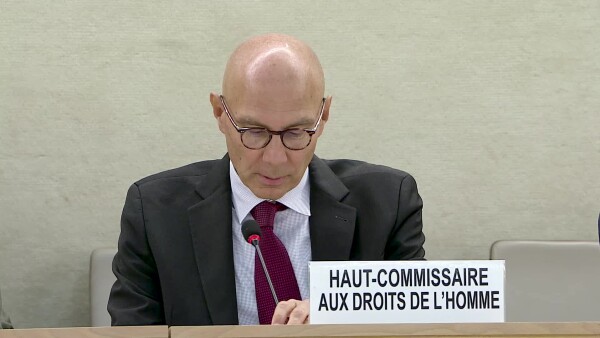
54th HRC-UN Human Rights Chief- People of Myanmar endure horrifying attacks 26 September 2023
The report before the Council today, which covers the period from 1 April 2022 and 31 July 2023, unveils how the military has further expanded its assault against the civilian population.
“We are faced here with a system of ruthless repression designed to coerce and subjugate its people and to erode a society so that the narrow interests of a kleptocratic elite are preserved. Senseless military attacks are exacerbating the human rights crisis with interconnected humanitarian, political, and economic impacts, imposing an unbearable toll on the people in Myanmar,” Türk said.
“Credible sources have verified as of yesterday a minimum of 1,108 deaths at the hands of the military and its affiliates. Three specific military tactics have been systematically directed against the civilian population: airstrikes, mass killings, and burning of villages. During the reporting period, the military undertook 687 airstrikes, more than double the number carried out in the 14 months following the coup,” said the High Commissioner.
“Ground operations have resulted in 22 documented incidents of mass killings of 10 or more individuals. Testimonies indicate that in many of these operations, soldiers entered villages, rounded up those who had not fled, and executed them. They used appalling methods to inflict unimaginable pain on their victims, including burning them alive, dismembering, raping, beheading, bludgeoning, and using abducted villagers to shield themselves against attacks and landmines. This is inhumanity in its vilest form,” he said.
The High Commissioner described the burning of entire villages and civilian infrastructure continues to terrorize the population, especially - but not only - in the central region of Sagaing. Over 75,000 structures, including homes, food storage facilities, seed banks and livestock have been destroyed, driving the ongoing displacement crisis, and dramatically increasing humanitarian and protection needs, including for those particularly at risk such as women, children, older people, and people with disabilities.
The restriction on humanitarian access following the destruction caused by Cyclone Mocha in May this year is a clear example of how the military is prioritizing its own political interests over the wellbeing of a population in dire need of life-saving assistance.
“Denial of humanitarian access throughout the whole country is having dramatic consequences on the right to food. Rice especially -- a staple for Myanmar people -- is becoming extremely limited in many regions. This denial of access has been acutely felt in Rakhine State where the human rights situation of the Rohingya community continues to be of the utmost concern, particularly for women, children and young people. Since Cyclone Mocha made landfall in May, the military has systematically prevented the provision of life-saving medical care, shelter materials, food and clean water. Rohingya families and members of other displaced communities have reported not being able to provide food to their children,” Türk said.
Despite this, since March, “the military has been proposing to carry out the return of thousands of Rohingya refugees from Bangladesh to Rakhine State by the end of the year, despite the clear absence of conditions for safe, dignified, and sustainable returns. Notably, no action has been taken to address the root causes of discrimination and other violations, to address the issue of citizenship, to ensure provision of services, or to guarantee free movement or other critical factors,” he said.
The High Commissioner called on all States and other actors with influence to support efforts to de-escalate this crisis and ensure that all vulnerable people in Myanmar can exercise their fundamental rights and receive all necessary assistance.
“Its clear that new thinking on Myanmar is needed - urgently - for this unspeakable tragedy to end,” Türk said.
“Given the continuing gravity of the situation and impunity on the ground, I reiterate my call for the UN Security Council to refer this situation to the International Criminal Court.
People in Myanmar have long suffered with insufficient attention being paid by the international community to their plight. That must change,” he said.
ENDS
The High Commissioner’s report, which covers the period between 1 April 2022 and 31 July 2023, is now online.
For more information and media requests, please contact:
In Geneva
Ravina Shamdasani - + 41 22 917 9169 / ravina.shamdasani@un.org or
Liz Throssell + 41 22 917 9296 / elizabeth.throssell@un.org or
Jeremy Laurence + +41 22 917 9383 / jeremy.laurence@un.org or
Marta Hurtado - + 41 22 917 9466 / marta.hurtadogomez@un.org
Tag and share
Twitter @UNHumanRights
Facebook unitednationshumanrights
Instagram @unitednationshumanrights
- Exterior shot: Palais des Nations, Geneva.
- Wide shot: wide shot room 20
- Soundbite (English)— Volker Türk, UN High Commissioner for Human Rights, (OHCHR): “Each day, the people of Myanmar are enduring horrifying attacks, flagrant human rights violations and the crumbling of their livelihoods and hopes.”
- Cut away: room 20
- Soundbite (English)— Volker Türk, UN High Commissioner for Human Rights, (OHCHR): “We are faced here with a system of ruthless repression designed to coerce and subjugate its people and to erode a society so that the narrow interests of a kleptocratic elite are preserved. Senseless military attacks are exacerbating the human rights crisis with interconnected humanitarian, political, and economic impacts, imposing an unbearable toll on the people in Myanmar.”
- Cut away: room 20.
- Soundbite (English)— Volker Türk, UN High Commissioner for Human Rights, (OHCHR):“Credible sources have verified as of yesterday a minimum of 1,108 deaths at the hands of the military and its affiliates. Three specific military tactics have been systematically directed against the civilian population: airstrikes, mass killings, and burning of villages. During the reporting period, the military undertook 687 airstrikes, more than double the number carried out in the 14 months following the coup.”
- Cut away: room 20.
- Soundbite (English)— Volker Türk, UN High Commissioner for Human Rights, (OHCHR): “Ground operations have resulted in 22 documented incidents of mass killings of 10 or more individuals. Testimonies indicate that in many of these operations, soldiers entered villages, rounded up those who had not fled, and executed them. They used appalling methods to inflict unimaginable pain on their victims, including burning them alive, dismembering, raping, beheading, bludgeoning, and using abducted villagers to shield themselves against attacks and landmines. This is inhumanity in its vilest form.”
- Cut away: room 20.
- Soundbite (English)— Volker Türk, UN High Commissioner for Human Rights, (OHCHR): “Denial of humanitarian access throughout the whole country is having dramatic consequences on the right to food. Rice especially -- a staple for Myanmar people -- is becoming extremely limited in many regions. This denial of access has been acutely felt in Rakhine State where the human rights situation of the Rohingya community continues to be of the utmost concern, particularly for women, children and young people. Since Cyclone Mocha made landfall in May, the military has systematically prevented the provision of life-saving medical care, shelter materials, food and clean water. Rohingya families and members of other displaced communities have reported not being able to provide food to their children.”
- Cut away: room 20.
- Soundbite (English)— Volker Türk, UN High Commissioner for Human Rights, (OHCHR): “…the military has been proposing to carry out the return of thousands of Rohingya refugees from Bangladesh to Rakhine State by the end of the year, despite the clear absence of conditions for safe, dignified, and sustainable returns. Notably, no action has been taken to address the root causes of discrimination and other violations, to address the issue of citizenship, to ensure provision of services, or to guarantee free movement or other critical factors.”
- Cut away: room 20.
- Soundbite (English)— Volker Türk, UN High Commissioner for Human Rights, (OHCHR): “It’s clear that new thinking on Myanmar is needed - urgently - for this unspeakable tragedy to end.”
- Cut away: room 20.
- Soundbite (English)— Volker Türk, UN High Commissioner for Human Rights, (OHCHR): “Given the continuing gravity of the situation and impunity on the ground, I reiterate my call for the UN Security Council to refer this situation to the International Criminal Court. People in Myanmar have long suffered with insufficient attention being paid by the international community to their plight. That must change.”
- Cut away: room 20.
- Extract of satellite pictures analysis from UN Human Rights report (online).
Similar Stories

1
1
1
Edited News | UNICEF
A little over one year since a ceasefire agreement was announced between Hamas fighters and Israel, more than 340 children have been reported killed and hundreds more injured, the UN Children’s Fund, UNICEF, said on Friday.

1
1
1
Edited News | UNICEF , IFRC
Six weeks after Nepal’s deadly flooding disaster, communities are still struggling to rebuild their lives, but they will need sustained help as global warming increases the risk of another Himalayan catastrophe, the UN Children’s Fund (UNICEF) said on Friday.

1
1
1
Edited News | WHO
In suspected Russia plague death, testing and monitoring underway – WHO
The death of a lab worker in Russia’s Siberia region has sparked concerns about plague being the cause, the UN World Health Organization (WHO) said on Tuesday, adding that it was following the situation closely.

1
1
Edited News | OHCHR , UNOG
UN Human Rights Chief Volker Türk on Friday provided and oral update to the 63rd session of the Human rights Council on Ukraine.

1
1
1
Edited News | OHCHR , UNOG
UN Human Rights Chief Volker Türk on Friday provided and oral update to the 63rd session of the Human rights Council on the human rights situation in Haiti.

1
1
1
Edited News | WHO
Repeated delays in bringing lifesaving medicines, prosthetics and more from Israel into Gaza risk having devastating consequences on Palestinians who urgently need them in the wartorn enclave, the UN World Health Organization (WHO) said on Friday. “A truck full of non-priority supplies or the right supplies arriving too late, doesn't save lives. That's the question that actually matters," said Dr Reinhilde Van De Weerdt, WHO Representative in the OPT.

1
1
1
Edited News | WHO
DRC: Early access to care and oxygen decisive for Ebola patients’ survival – WHO
In the Democratic Republic of the Congo (DRC), health workers fighting the country’s largest-ever Ebola outbreak are struggling to overcome critical challenges to patient care, the UN World Health Organization (WHO) warned on Tuesday.

1
1
1
Edited News | OCHA , UN
Civilians in Iran are continuing to feel the consequences of months of conflict and military escalation, the UN’s top official in the country has said, as loss of life, damage to civilian infrastructure and mounting economic pressures leave many facing continued uncertainty.
1
1
1
Edited News | WHO , UNICEF
Aid agencies in Yemen highlighted the growing hunger emergency sparked by renewed fighting between Houthi opposition forces and Government troops, after mobile health clinics reported that hundreds of children displaced by the violence are suffering from the most deadly form of malnutrition.
1
1
1
Edited News | UNHCR
Displacement on the rise in Yemen as fighting continues - UNHCR
As hostilities worsen in Yemen, more people have been fleeing their homes, further intensifying the humanitarian crisis within the region, the UN Refugee Agency (UNHCR) warned on Tuesday.
1
1
1
Edited News | IOM , OHCHR , UNFPA , UNOG , UNHCR , WHO
Yemen’s humanitarian crisis growing by the hour amid spike in displacement
Yemenis displaced by renewed fighting have described fleeing for their lives amid shelling and gunfire, aid agencies reported on Friday, while highlighting the dramatic increase in humanitarian needs in the country and in Djibouti, where thousands have sought shelter.
1
1
1
Edited News | OHCHR , UNOG
The UN Human Rights Office issued on Friday a report documenting a shocking pattern of sexual violence amid Russia’s full-scale armed attack on Ukraine.