

The United Nations Office at Geneva
Multimedia Newsroom
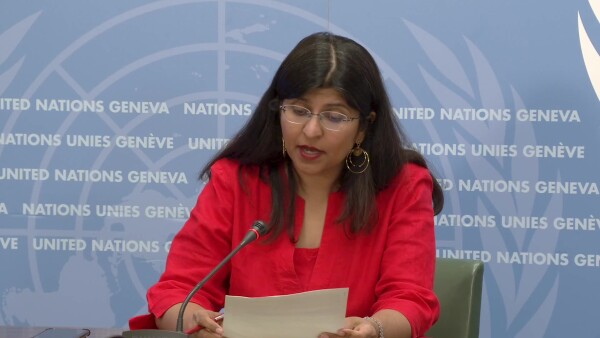
At the bi-weekly press briefing on Tuesday, Ravina Shamdasani, Spokesperson for the UN Human Rights Office, made the following comments on Myanmar, with James Rodehaver chief of the UN Human right office in Myanmar.
Myanmar’s military has created a perpetual human rights crisis through the continuous use of violence, including the killing, arbitrary arrest, torture and enforced disappearance of anti-coup opponents, a report published by the UN Human Rights Office said today.
“Two years after the military launched a coup, the generals have embarked on a scorched earth policy in an attempt to stamp out opposition,” Ravina Shamdasani, said.
“Tragically, regional and global efforts for peace and restraint have largely fallen on deaf ears. The military, emboldened by continuous and absolute impunity, has consistently shown disregard for international obligations and principles. Urgent, concrete action is needed to end this festering catastrophe,” she said.
The report echoed calls by the Security Council and ASEAN for, among other things, an immediate halt to the violence, the release of all those arbitrarily detained, accountability, and unhindered humanitarian access.
The report documents a litany of human rights abuses from 1 February 2022 to 31 January 2023, accompanied by a sharp rise in violence especially in the north-western and south-eastern parts of Myanmar.
It cites credible sources as having verified the deaths of at least 2,940, and 17,572 arrests by the military and its affiliates since the coup. Nearly 80 per cent of the country’s 330 townships have been impacted by armed clashes.
The military employs its so-called four-cuts approach - including through indiscriminate airstrikes and artillery shelling, razing villages to displace civilian populations, and denial of humanitarian access - to cut off non-State organized armed groups and other anti-military armed elements from access to food, finances, intelligence and recruits.
“Among the numerous incidents of airstrikes, on 16 September - in Let Yet Kone village, Tabayin Township, Sagaing - four helicopters opened fire on a school killing at least six children and injuring nine others. After some 60 soldiers deployed from helicopters to the ground, they reportedly raided the village, executing a school technician and five villagers before arresting wounded children and teachers,” Shamdasani said.
One of the most frequently used tactics by the military is the systematic and widespread burning of villages and dwellings. Consistent with their modus operandi documented over decades, including in Kachin in 2011 and Rakhine in 2017, UN reports indicated that nearly 39,000 houses nationwide have been burnt or destroyed in military operations since February 2022, representing a more than 1,000-fold increase compared to 2021.
Sagaing was the most affected region, accounting for over 25,500 homes. In an incident on 1 May 2022 in Ah Shey See, Kale Township, Sagaing, satellite images suggest the burning of almost the entire village with 621 structures destroyed. Satellite imagery coupled with interview reports suggest that between 16 and 28 September in Taze Township, Sagaing, the military destroyed 458 houses and damaged another 319 across eight villages during a series of raids and attacks.
The military’s mismanagement of the economy has provoked an economic crisis for much of the population, resulting in the doubling of poverty rates compared to March 2020. Rural populations are reported to be at risk of starvation as the military imposes further restrictions on access to areas affected by violence and conflict. Compounding the situation, main supply routes and waterways across the country have been blocked, preventing humanitarian actors from reaching 17.6 million people in need.
“The military has also adopted rules, including martial law, intended to target anti-coup opposition and severely restrict the civic space that had significantly contributed to Myanmar’s democratic transition,” Shamdasani said.
“Across Myanmar, people are continuously exposed to violations and crimes, including killings, enforced disappearances, displacement, torture, arbitrary arrests, and sexual violence. There are reasonable grounds to believe that the military and its affiliated militias continue to be responsible for most violations, some of which may constitute crimes against humanity and war crimes,” the spokesperson said.
James Rodehaver, chief of the UN Human Rights Office in Myanmar made the following comments. “They've weaponized the legal system. They have used the detention system, of course, as a means to both detain their political opponents and to torture those who have spoken out against them.”.”
There have been over 300 airstrikes in the last year, and OHCHR has been able to get satellite data on dozens of these areas.
“This is an ethnic Bamar area, actually. And you will see that one of the tried-and-true tactics of this ‘four cuts’ policy is to launch airstrikes and artillery barrages, that have if you can see closely, you can see several impact craters throughout the village area. And then, ground troops moved into this area shortly after the shelling stopped and the troops stayed overnight in the village and then burned it on their way out in the morning before they moved on to the next village.”
“There is also an image of Se Zin village in Kachin state. And here we see a very similar pattern where you had a succession of airstrikes against the village. And I would just say that in all the people we've spoken to, there were no military forces, no opposition armed groups present in this village when this airstrike was launched. There was no forewarning given. And you can see again, a series of impact craters and mixed with houses that have been burned. And of course, that indicates that after the airstrikes, the ground troops moved in and then structures were torched. Over 16 civilians were killed in this incident, and it resulted in and again over 200 houses being destroyed before they left the village.”
“The situation in Myanmar has grown and as I say, intense and you have a military making war against its own people and in pursuing they’re ‘four cuts’ policy, they have really created the crisis that's resulted in a loss, a regression in every human right.”
END
For more information and media requests, please contact:
In Geneva
Ravina Shamdasani - + 41 22 917 9169 / ravina.shamdasani@un.org or
Liz Throssell + 41 22 917 9296 / elizabeth.throssell@un.org or
Jeremy Laurence + +41 22 917 9383 / jeremy.laurence@un.org or
Marta Hurtado - + 41 22 917 9466 / marta.hurtadogomez@un.org
In Nairobi
Seif Magango - +254 788 343 897 / seif.magango@un.org
Tag and share
Twitter @UNHumanRights
Facebook unitednationshumanrights
Instagram @unitednationshumanrights
- Exterior shot: Wide shot entrance of Palais des Nations
- Wide Shot: Briefing room
- SOUNDBITE (English) – Ravina Shamdasani, Spokesperson for the UN Human Rights Office (OHCHR): “Two years after the military launched a coup, the generals have embarked on a scorched earth policy in an attempt to stamp out opposition.”
- Cut away: Briefing room
- SOUNDBITE (English) – Ravina Shamdasani, Spokesperson for the UN Human Rights Office (OHCHR): “Tragically, regional and global efforts for peace and restraint have largely fallen on deaf ears. The military, emboldened by continuous and absolute impunity, has consistently shown disregard for international obligations and principles. Urgent, concrete action is needed to end this festering catastrophe.”
- Cut away: Briefing room
- SOUNDBITE (English) – Ravina Shamdasani, Spokesperson for the UN Human Rights Office (OHCHR): “Among the numerous incidents of airstrikes, on 16 September - in Let Yet Kone village, Tabayin Township, Sagaing - four helicopters opened fire on a school killing at least six children and injuring nine others. After some 60 soldiers deployed from helicopters to the ground, they reportedly raided the village, executing a school technician and five villagers before arresting wounded children and teachers.”
- Cut away: Briefing room
- SOUNDBITE (English) – Ravina Shamdasani, Spokesperson for the UN Human Rights Office (OHCHR): “The military has also adopted rules, including martial law, intended to target anti-coup opposition and severely restrict the civic space that had significantly contributed to Myanmar’s democratic transition.”
- Cut away: Briefing room
- SOUNDBITE (English) – Ravina Shamdasani, Spokesperson for the UN Human Rights Office (OHCHR): “Across Myanmar, people are continuously exposed to violations and crimes, including killings, enforced disappearances, displacement, torture, arbitrary arrests, and sexual violence. There are reasonable grounds to believe that the military and its affiliated militias continue to be responsible for most violations, some of which may constitute crimes against humanity and war crimes.”
- Cut away: Briefing room
- SOUNDBITE (English) – James Rodehaver chief of the UN Human Rights Office in Myanmar: “ They've weaponized the legal system. They have used the detention system, of course, as a means to both detain their political opponents and to torture those who have spoken out against them.”
- Cut away: Briefing room 21stCentury Aerospace Technology for the right side and Chang Guang Space Tech for the left image.
- SOUNDBITE (English) – James Rodehaver, chief of the UN Human Rights Office in Myanmar: “This is an ethnic Bamar area, actually. And you will see that one of the tried-and-true tactics of this ‘four cuts’ policy is to launch airstrikes and artillery barrages, that have if you can see closely, you can see several impact craters throughout the village area. And then, ground troops moved into this area shortly after the shelling stopped and the troops stayed overnight in the village and then burned it on their way out in the morning before they moved on to the next village.”
- Cut away: satellite imagery © 21stCentury Aerospace Technology for the right side and Chang Guang Space Tech for the left image.
- SOUNDBITE (English) – James Rodehaver, chief of the UN Human Rights Office in Myanmar: “There is also an image of Se Zin village in Kachin state. And here we see a very similar pattern where you had a succession of airstrikes against the village. And I would just say that in all the people we've spoken to, there were no military forces, no opposition armed groups present in this village when this airstrike was launched. There was no forewarning given. And you can see again, a series of impact craters and mixed with houses that have been burned. And of course, that indicates that after the airstrikes, the ground troops moved in and then structures were torched. Over 16 civilians were killed in this incident, and it resulted in and again over 200 houses being destroyed before they left the village.”
- Cut away: satellite imagery © 21stCentury Aerospace Technology for the right side and Chang Guang Space Tech for the left image.
- SOUNDBITE (English) – James Rodehaver, chief of the UN Human Rights Office in Myanmar: “The situation in Myanmar has grown and as I say, intense and you have a military making war against its own people and in pursuing they’re ‘four cuts’ policy, they have really created the crisis that's resulted in a loss, a regression in every human right.”
Similar Stories

1
1
1
Edited News | UNICEF , IFRC
Six weeks after Nepal’s deadly flooding disaster, communities are still struggling to rebuild their lives, but they will need sustained help as global warming increases the risk of another Himalayan catastrophe, the UN Children’s Fund (UNICEF) said on Friday.

1
1
1
Edited News | WHO
In suspected Russia plague death, testing and monitoring underway – WHO
The death of a lab worker in Russia’s Siberia region has sparked concerns about plague being the cause, the UN World Health Organization (WHO) said on Tuesday, adding that it was following the situation closely.

1
1
Edited News | OHCHR , UNOG
UN Human Rights Chief Volker Türk on Friday provided and oral update to the 63rd session of the Human rights Council on Ukraine.

1
1
1
Edited News | OHCHR , UNOG
UN Human Rights Chief Volker Türk on Friday provided and oral update to the 63rd session of the Human rights Council on the human rights situation in Haiti.

1
1
1
Edited News | WHO
Repeated delays in bringing lifesaving medicines, prosthetics and more from Israel into Gaza risk having devastating consequences on Palestinians who urgently need them in the wartorn enclave, the UN World Health Organization (WHO) said on Friday. “A truck full of non-priority supplies or the right supplies arriving too late, doesn't save lives. That's the question that actually matters," said Dr Reinhilde Van De Weerdt, WHO Representative in the OPT.

1
1
1
Edited News | WHO
DRC: Early access to care and oxygen decisive for Ebola patients’ survival – WHO
In the Democratic Republic of the Congo (DRC), health workers fighting the country’s largest-ever Ebola outbreak are struggling to overcome critical challenges to patient care, the UN World Health Organization (WHO) warned on Tuesday.

1
1
1
Edited News | OCHA , UN
Civilians in Iran are continuing to feel the consequences of months of conflict and military escalation, the UN’s top official in the country has said, as loss of life, damage to civilian infrastructure and mounting economic pressures leave many facing continued uncertainty.
1
1
1
Edited News | WHO , UNICEF
Aid agencies in Yemen highlighted the growing hunger emergency sparked by renewed fighting between Houthi opposition forces and Government troops, after mobile health clinics reported that hundreds of children displaced by the violence are suffering from the most deadly form of malnutrition.
1
1
1
Edited News | UNHCR
Displacement on the rise in Yemen as fighting continues - UNHCR
As hostilities worsen in Yemen, more people have been fleeing their homes, further intensifying the humanitarian crisis within the region, the UN Refugee Agency (UNHCR) warned on Tuesday.
1
1
1
Edited News | IOM , OHCHR , UNFPA , UNOG , UNHCR , WHO
Yemen’s humanitarian crisis growing by the hour amid spike in displacement
Yemenis displaced by renewed fighting have described fleeing for their lives amid shelling and gunfire, aid agencies reported on Friday, while highlighting the dramatic increase in humanitarian needs in the country and in Djibouti, where thousands have sought shelter.
1
1
1
Edited News | OHCHR , UNOG
The UN Human Rights Office issued on Friday a report documenting a shocking pattern of sexual violence amid Russia’s full-scale armed attack on Ukraine.
2
1
2
Edited News , Press Conferences | WMO
As world’s water reserves change, countries must prepare for a new reality: WMO
New data showing that rivers were at their lowest level for decades last year provides further evidence that the climate crisis is real and countries must act immediately to protect themselves from the increasing threat to communities and livelihoods, the UN World Meteorological Organization (WMO) said on Thursday.
The key findings from WMO’s State of Global Water Resources 2025 report covering the hydrological cycle and extreme events in the five-year period to last year:
- 2025 was one of driest years for river discharge in 35 years
- Past seven years have seen abnorfmal river flows
- Water storage on Earth’s land surface has decreased in past decade
- Widespread glacier loss across all regions for fourth consecutive year
- Asia and Africa are regions most affected by water-related disasters
- Water data availability has improved, but gaps remain in hard-hit areas
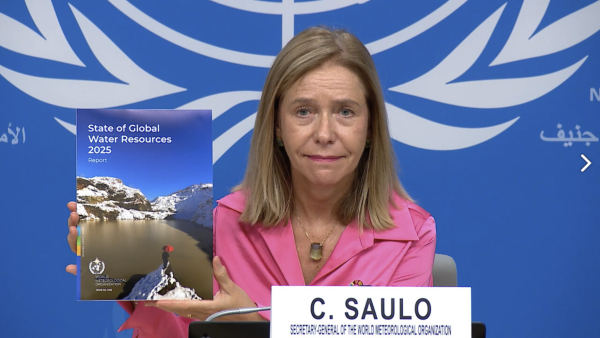
Highlighting the long-term decline in the Earth’s freshwater storage and glacier melt, WMO Secretary-General Celeste Saulo explained that the planet’s water reserves used to act as a planetary “savings account” that absorbed the occasional dry season, avoiding a water crisis. “One of the central stories of the 2025 report is what is happening to that savings account? And the simple answer is that we are depleting it,” she told journalists in Geneva.
Groundwater reserves are equally stretched and have been in decline since 2014, WMO’s report states, with nearly two-thirds of monitored wells worldwide showing levels lower than the historical norm and indicating a shift “further toward deficit…not recovery”.
“At the same time, we are seeing more water-related disasters,” Ms. Saulo said, while also stressing that the currently strengthening El Niño “will increase the risk of drought in some areas, and flooding in others”.
Glaciers disappearing
In 2025, for the fourth consecutive year, every major glaciated region on Earth lost ice mass, leading to short-term hazards including floods and long-term water insecurity, according to WMO.
Responding to a question about whether the changing global water cycle might have contributed to the deadly Nepal-China flooding disaster, Ms. Saulo explained that melting ice and rock was just one factor in the chain of events that ultimately sent a massive and deadly wall of water and debris downstream on 26 August, killing at least 1,367 people.
“You asked if it could happen again? Absolutely; the problem in this region is that there’s 63,700 glaciers at the last count,” she told a Press Conference in Geneva. “Even if you’re looking with remote sensing with satellites at these glaciers, you might see some faults, you might see some slight shifting, that does not mean necessarily catastrophic collapse. So, in order to plan for this, it’s very, very difficult. But the international community is looking very hard at ways in which we can bring people together to solve some of these monitoring issues.”
Data indicates that glaciers shrank between 2023 and 2025 with cumulative losses of 1,400 gigatonnes of water – or about one third of annual fresh water needs.
Every major glacier region on Earth lost ice for the fourth consecutive year.
“All 19 glacier regions around the globe lost ice; in Central Asia, Iceland, the Russian Arctic and western Canada and the United States, it was among the three worst years on record,” said Wayne Jenkinson, WMO’s Director of Hydrology and Cryosphere.
Some regions with smaller glaciers such as Central Europe, the Caucasus, the western Canada and the United States may already have reached “peak water”, Mr. Jenkinson warned.
“After this point, the glacier gives less meltwater each year simply because there is less ice left to melt. That matters for every community downstream that relies on water during hot, dry summers,” he explained.
Narelle van der Wel, WMO’s Head of Cryosphere Monitoring, Predictions and Services, stressed that while some further glacier loss is unavoidable, the eventual scale of the decline is not predetermined.
“Some glacier loss is inevitable, but total loss of glaciers is not yet inevitable,” she said, pointing to emissions reductions as central to limiting future losses.
Preparing for moving baselines
The report does not attribute every observed change to climate change alone. WMO says pressure on water resources and natural variability also contribute.
Mr. Jenkinson said governments need to prepare for “moving baselines” as historical patterns become less reliable.
“The situation 30 years ago is not where we are today,” he said. Countries, he added, need to prepare “for those changes that have really already arrived”.
ends