

The United Nations Office at Geneva
Multimedia Newsroom
UN humanitarians in Lebanon on Tuesday described the massive challenge of trying to reach some 1.2 million people who have fled heavy Israeli bombardment and evacuation orders, driven by the fear that what happened in Gaza may befall them, too.
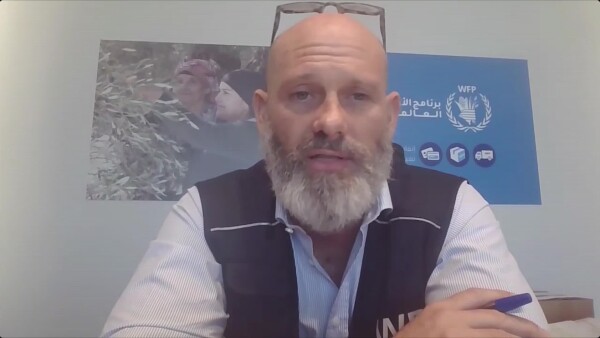
“It's impossible to meet the needs of more than a million people who have been suddenly uprooted, displaced and dispossessed without additional resources coming in,” said Matthew Hollingworth, WFP Country Director in Lebanon (From Beirut): “This was not a country that was well prepared because of all of the challenges that it's faced over the past years. So, it's going to be a struggle.”
One week since the UN launched a $426 million appeal to help those affected by the Lebanon crisis, contributions have reached just over 12 per cent, or $51.4 million.
Aid teams are committed to helping all those in need and particularly the most vulnerable, but Mr. Hollingworth warned that many of those uprooted by the rapid escalation in fighting had little choice but to leave their homes with nothing.
After COVID-19 and the devastating port explosion in Beirut in 2020, poverty levels have soared in the country that has struggled to host more than a million Syrian refugees, amid a long-running political crisis.
Uprooted in a moment
“[We’ve had] horrific cases of forced evacuation notices coming out with few hours for people to prepare and depart,” Mr. Hollingworth said.
Families displaced over the past year “who had prepared themselves…are far, far better off than the much greater majority today who have left in some cases with only hours to spare before their areas have come under bombardment.”
Amid intense Israeli bombardment of Beirut and southern Lebanon linked to the war in Gaza, the seven districts in frontline areas south of the country bordering Israel and Beirut’s southern suburbs have emptied of “hundreds of thousands of people”, the veteran aid worker reported. “Many of these towns, villages and suburbs [are] now nothing more than rubble.”
Paying the ultimate price
In a fresh appeal to halt the violence in Gaza, Lebanon and beyond, Jeremy Laurence from the UN human rights office, OHCHR, said that civilians continue to pay “the ultimate price, whether it be the hospitals being closed, a million people displaced, civilians killed, schools impacted; the devastation is beyond belief for all people in Lebanon as it is in Gaza. We can't let this happen again.”
Shelters ‘choc-a-block’
More than 200,000 people now live in the 973 formal shelters located inside Beirut and the north of country, according to WFP. Some 773 of these “are absolutely choc-a-block full”, Mr. Hollingworth said, adding that people in the south had decided to move not only because their land and homes had been destroyed, but because they had lost “family and friends and communities and they are extraordinarily fearful of what comes next”.
The aid agency update comes amid reported renewed rocket fire at the northern Israeli city of Haifa by Hezbollah on Tuesday. The armed group has been firing rockets at northern Israel since the outbreak of the war in Gaza, displacing tens of thousands of Israelis.
Healthcare under attack
According to the UN World Health Organization (WHO), 17 attacks on health care and healthcare workers since 16 September have left 65 dead and 42 injured.
More than 96 healthcare centres and health facilities have been forced to close in the south. Five hospitals are now not functioning “either due to physical or infrastructural damage”, said WHO’s Ian Clarke, Deputy Incident Manager for Lebanon.
Speaking via video from Beirut, he said that an additional four hospitals have been partially evacuated to maintain emergency services, with patients needing critical dialysis and cancer care referred to other hospitals.
UN humanitarians have insisted on the need to keep land, air and sea access open to Lebanon, which is dependent on imports for most of its needs.
A reported 1,900 hectares of agricultural land have been burned in the south of the country over the past year and “primarily in the last few weeks”, WFP’s Mr. Hollingworth said. In addition, 12,000 hectares of farmland in one of the most productive areas of the country have been abandoned and some 46,000 farmers have been impacted heavily by the crisis. “Olive harvests in the south will not happen, bananas, citrus harvests will not happen,” he noted.
Story: Lebanon crisis update – WFP, OHCHR
Speakers:
- Matthew Hollingworth, WFP Country Director in Lebanon (From Beirut);
- Jeremy Laurence, spokesperson, OHCHR.
TRT: 03’13”
SOURCE: UNTV CH
LANGUAGE: ENGLISH / NATS
ASPECT RATIO: 16:9
DATELINE: 8 October 2024 - GENEVA, SWITZERLAND
RESTRICTIONS: None
SHOTLIST
- Exterior medium shot: UN flag alley.
- Wide shot of the UN Geneva Press room.
- SOUNDBITE (English) Matthew Hollingworth, WFP Country Director in Lebanon (From Beirut): “We have upwards of 1.2 million people affected now by this crisis; hundreds of thousands of people displaced from the seven districts in the frontline areas of the south of this country bordering Israel and of course the southern suburbs of Beirut – emptied - many of these towns, villages and suburbs now nothing more than rubble.”
- Medium wide shot of Press room, podium and participants.
- SOUNDBITE (English) Matthew Hollingworth, WFP Country Director in Lebanon (From Beirut): “There’s now 973 formal shelters inside Beirut and the north of country with more than 200,000 living there registered; 773 of those shelters are absolutely choc-a-block full.”
- Medium-wide, Press room, journalists.
- SOUNDBITE (English) Matthew Hollingworth, WFP Country Director in Lebanon (From Beirut): “Many of the families that I’ve have met and I was in the south earlier last week talk about the fact that they are moving just because of fear of destruction of land and their homes and their neighbourhoods, but also because they have lost people, they’ve lots family and friends and communities and they are extraordinarily fearful of what comes next.”
- Medium-wide, Press room, TV screens showing external speakers.
- SOUNDBITE (English) Matthew Hollingworth, WFP Country Director in Lebanon (From Beirut): “It's impossible to meet the needs of more than a million people who have been suddenly uprooted, displaced and dispossessed without additional resources coming in. And this was not a country that was well prepared because of all of the challenges that it's faced over the past years. So, it's going to be a struggle.”
- Medium-wide, TV screens showing WFP speaker, journalist and control room.
- SOUNDBITE (English) Matthew Hollingworth, WFP Country Director in Lebanon (From Beirut): “Horrific cases of forced evacuation notices coming out with few hours for people to prepare and depart. So, many of families that were displaced over the past year who had prepared themselves and their family belongings are far, far better off than the much greater majority today who have left in some cases with only hours to spare before their areas have come under bombardment.”
- Medium-wide, Press room.
- SOUNDBITE (English) Jeremy Laurence, OHCHR: “We’re seeing civilians pay the ultimate price, whether it be the hospitals being closed, a million people displaced, civilians killed, schools impacted, the devastation is beyond belief for all people in in Lebanon as it is in Gaza. We can't let this happen again.”
- Medium, Press room, journalists, podium.
- Medium, journalist typing on laptop.
- Medium, journalists.
Similar Stories

1
1
1
Edited News | OCHA , UNICEF , WFP
Aid agencies warned on Friday of the fast-developing humanitarian emergency inside Taiz City in Yemen, which has been encircled by de facto Houthi forces fighting government troops along the country’s west coast.

2
17
1
2
Edited News , Press Conferences , Images | OCHA , WMO
Two UN agencies teamed up on Wednesday to issue an appeal for immediate assistance to help communities already being impacted by the strongest El Niño on record.

3
16
2
2
Edited News , B-roll , Conferences , Images | UNITED NATIONS , UNOG
Sixth Consultative Meeting on Enhancing Coordination of Peace Initiatives and Efforts for Sudan

1
1
1
Edited News | UNICEF , WHO , UNHCR
Yemen war continues to force families from homes amid hunger and disease
More than 250,000 people have now fled renewed fighting in Yemen, the UN said on Tuesday, citing particular concern for those sheltering in the southwestern city of Taiz and the wider governorate, where access is “essentially blocked”.

1
1
1
Edited News | UNICEF
A little over one year since a ceasefire agreement was announced between Hamas fighters and Israel, more than 340 children have been reported killed and hundreds more injured, the UN Children’s Fund, UNICEF, said on Friday.

1
1
1
Edited News | UNICEF , IFRC
Six weeks after Nepal’s deadly flooding disaster, communities are still struggling to rebuild their lives, but they will need sustained help as global warming increases the risk of another Himalayan catastrophe, the UN Children’s Fund (UNICEF) said on Friday.

1
1
1
Edited News | WHO
In suspected Russia plague death, testing and monitoring underway – WHO
The death of a lab worker in Russia’s Siberia region has sparked concerns about plague being the cause, the UN World Health Organization (WHO) said on Tuesday, adding that it was following the situation closely.

1
1
Edited News | OHCHR , UNOG
UN Human Rights Chief Volker Türk on Friday provided and oral update to the 63rd session of the Human rights Council on Ukraine.

1
1
1
Edited News | OHCHR , UNOG
UN Human Rights Chief Volker Türk on Friday provided and oral update to the 63rd session of the Human rights Council on the human rights situation in Haiti.

1
1
1
Edited News | WHO
Repeated delays in bringing lifesaving medicines, prosthetics and more from Israel into Gaza risk having devastating consequences on Palestinians who urgently need them in the wartorn enclave, the UN World Health Organization (WHO) said on Friday. “A truck full of non-priority supplies or the right supplies arriving too late, doesn't save lives. That's the question that actually matters," said Dr Reinhilde Van De Weerdt, WHO Representative in the OPT.

1
1
1
Edited News | WHO
DRC: Early access to care and oxygen decisive for Ebola patients’ survival – WHO
In the Democratic Republic of the Congo (DRC), health workers fighting the country’s largest-ever Ebola outbreak are struggling to overcome critical challenges to patient care, the UN World Health Organization (WHO) warned on Tuesday.

1
1
1
Edited News | OCHA , UN
Civilians in Iran are continuing to feel the consequences of months of conflict and military escalation, the UN’s top official in the country has said, as loss of life, damage to civilian infrastructure and mounting economic pressures leave many facing continued uncertainty.