

The United Nations Office at Geneva
Multimedia Newsroom
Edited News | UNICEF , UNOG , UNITED NATIONS
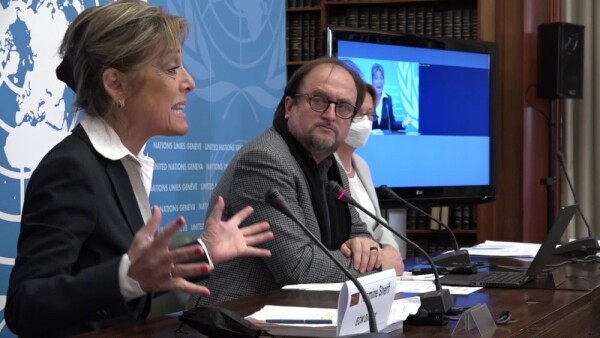
UNOG Bi-Weekly Press Briefing: 128 Million Children In Need Of Education - ECW
As the number of children and youth in desperate need of education skyrockets with the Covid-19 pandemic, ECW (Education Cannot Wait) welcomes significant new funding from Germany
The number of children who have lost access to education across the world has almost doubled since before the COVID-19 pandemic, according to the head of the global UN fund that deals with delivering education in emergency situations.
Yasmine Sherif, Director of Education Cannot Wait (ECW), said that as recently as 2016, the number of “children and youth who did not access education because of conflict and crisis and refuge were estimated at 75 million, of whom 39 million were girls. Today, as a result of Covid-19, we have reached a number of 128 million children and youth, half of them girls, who are not accessing education.”
Speaking at a press briefing at the UN in Geneva, Ms. Sherif thanked the people and government of Germany who announced yesterday, on International Day for Education, Monday 24 January, an additional contribution of 200 million Euro in funding for Education Cannot Wait (ECW), reaching a total of 318 Euro million in funding from Germany.
“Education is key to tackle the challenges of our time. Sustainable development, environmental transformation and social cohesion, just to name a few. However, Covid-19 has threatened all progress we have made. We experienced a huge backlash, and this is also true with education” said Katharina Stasch, the Ambassador of Germany to the UN in Geneva.
The new funding brings the ECW’s total Trust Fund to over USD 1.1 billion for crisis-affected children and youth – a seemingly large number but nowhere near what is still needed to address the problem on a global scale.
With over USD 1 billion leveraged through ECW in-country programmes, this makes ECW a more than 2-billion USD global fund in just a few short years since its establishment.
“Thanks to the German contribution, we broke that record yesterday,” Ms. Sherif said.
“We are making a difference to achieve the Sustainable Development Goals,” Ms. Sherif added, in an urgent plea for partners to step up and pledge an addition one billion USD to meet emergency education needs. “And we call on all member states in the U.N., host governments to cooperate with us, governments who are able to provide the funding, and many are private sectors, please help us reach the next funding target: USD 1 billion”, the ECW Director added.
Germany is currently the top contributor to ECW, followed by the United Kingdom and Denmark.
-ends-
- Exterior wide shot, United Nations Palace of Nations, Geneva. UN flags flying.
- Wide shot of press room UN Geneva.
- SOUNDBITE (English) Yasmine Sherif, Director of Education Cannot Wait (ECW): “Back then, the estimated children and youth who did not access education because of conflict and crisis and refuge were estimated at 75 million, of whom 39 million were girls. That was back in 2016. Today, as a result of COVID-19, we have reached a number of 128 million children and youth, half of them girls, who are not accessing education.”
- Cutaway, Wide Shot of press room
- SOUNDBITE (English) Ambassador Katharina Stasch, Germany's Permanent Representative to the UN in Geneva: “Education is key to tackle the challenges of our time. Sustainable development, environmental transformation and social cohesion, just to name a few. However, COVID-19 has threatened all progress we have made. We experienced a huge backlash, and this is also true with education.”
- Cutaway, Close shot of cameraman
- SOUNDBITE (English) Yasmine Sherif, Director of Education Cannot Wait (ECW): “Thanks to the German contribution, we broke that record yesterday. USD 1.1 billion in our Trust Fund and an additional excess of 1 billion in income through missions against our programs, making Education Cannot Wait (ECW) an over USD 2 billion fund in less than five years.“
- Cutaway, Medium lateral shot of speakers at podium
- SOUNDBITE (English) Yasmine Sherif, Director of Education Cannot Wait (ECW): “We are making a difference to achieve the Sustainable Development Goals. And we call on all member states in the U.N., host governments to cooperate with us, governments who are able to provide the funding, and many are private sector, please help us reach the next funding target: USD 1 billion.”
- Cutaway, Medium shot of participants
Similar Stories

2
17
1
2
Edited News , Press Conferences | OCHA , WMO
Two UN agencies teamed up on Wednesday to issue an appeal for immediate assistance to help communities already being impacted by the strongest El Niño on record.

3
16
2
2
B-roll , Conferences , Edited News | UNITED NATIONS , UNOG
Sixth Consultative Meeting on Enhancing Coordination of Peace Initiatives and Efforts for Sudan

1
1
1
Edited News | UNICEF , WHO , UNHCR
Yemen war continues to force families from homes amid hunger and disease
More than 250,000 people have now fled renewed fighting in Yemen, the UN said on Tuesday, citing particular concern for those sheltering in the southwestern city of Taiz and the wider governorate, where access is “essentially blocked”.

1
1
1
Edited News | UNICEF
A little over one year since a ceasefire agreement was announced between Hamas fighters and Israel, more than 340 children have been reported killed and hundreds more injured, the UN Children’s Fund, UNICEF, said on Friday.

1
1
1
Edited News | UNICEF , IFRC
Six weeks after Nepal’s deadly flooding disaster, communities are still struggling to rebuild their lives, but they will need sustained help as global warming increases the risk of another Himalayan catastrophe, the UN Children’s Fund (UNICEF) said on Friday.

1
1
1
Edited News | WHO
In suspected Russia plague death, testing and monitoring underway – WHO
The death of a lab worker in Russia’s Siberia region has sparked concerns about plague being the cause, the UN World Health Organization (WHO) said on Tuesday, adding that it was following the situation closely.

1
1
Edited News | OHCHR , UNOG
UN Human Rights Chief Volker Türk on Friday provided and oral update to the 63rd session of the Human rights Council on Ukraine.

1
1
1
Edited News | OHCHR , UNOG
UN Human Rights Chief Volker Türk on Friday provided and oral update to the 63rd session of the Human rights Council on the human rights situation in Haiti.

1
1
1
Edited News | WHO
Repeated delays in bringing lifesaving medicines, prosthetics and more from Israel into Gaza risk having devastating consequences on Palestinians who urgently need them in the wartorn enclave, the UN World Health Organization (WHO) said on Friday. “A truck full of non-priority supplies or the right supplies arriving too late, doesn't save lives. That's the question that actually matters," said Dr Reinhilde Van De Weerdt, WHO Representative in the OPT.

1
1
1
Edited News | WHO
DRC: Early access to care and oxygen decisive for Ebola patients’ survival – WHO
In the Democratic Republic of the Congo (DRC), health workers fighting the country’s largest-ever Ebola outbreak are struggling to overcome critical challenges to patient care, the UN World Health Organization (WHO) warned on Tuesday.

1
1
1
Edited News | OCHA , UN
Civilians in Iran are continuing to feel the consequences of months of conflict and military escalation, the UN’s top official in the country has said, as loss of life, damage to civilian infrastructure and mounting economic pressures leave many facing continued uncertainty.

1
1
1
Edited News | WHO , UNICEF
Aid agencies in Yemen highlighted the growing hunger emergency sparked by renewed fighting between Houthi opposition forces and Government troops, after mobile health clinics reported that hundreds of children displaced by the violence are suffering from the most deadly form of malnutrition.