

The United Nations Office at Geneva
Multimedia Newsroom
Gaza: a return to war must be avoided at all costs, insists UN chief
A return to war in Gaza must be avoided at all costs, UN Secretary-General António Guterres insisted on Tuesday, amid fears that the three-week old ceasefire agreement between Hamas fighters and Israel is about to end.
“We must avoid at all costs the resumption of hostilities in Gaza that would lead to an immense tragedy,” said the UN chief, in a statement relayed to journalists by UN Geneva spokesperson Rolando Gomez. “I appeal to Hamas to proceed with the planned liberation of hostages next Saturday. Both sides must fully abide by their commitments in the cease-fire agreement and resume serious negotiations in Doha for the second phase.”
The development comes amid reports that Hamas suspended the scheduled release of hostages from Gaza on Saturday, on the grounds that Palestinians continue to be killed in the war-torn enclave and that too little aid is entering the Strip.
The UN agency for Palestine refugees, UNRWA, said on Tuesday that its operations continue uninterrupted in Gaza and the occupied West Bank including
East Jerusalem.
“Our clinics across the occupied West Bank including East Jerusalem are open while the humanitarian operation in Gaza continues. We are committed to staying and delivering,” UNRWA said in an online post.
The UN aid coordination office, OCHA, meanwhile, highlighted that a significant aid boost into Gaza has been possible “under the conditions generated by this [ceasefire] deal” that began on 19 January.
Speaking in Geneva, OCHA spokesperson Jens Laerke said that the UN had delivered food, medical, shelter supplies and more in the last 21 days “which have enabled us to provide a range of critical services to people in need across Gaza and initiate repairs”. Responding to questions from journalists that UN aid teams had not been able to bring in certain materials which could help with the reconstruction of shattered medical centres and more, Mr. Laerke insisted that “the full visibility of the pipeline and the ceasefire deal and the compliance indicators, should be available to the guarantors of the ceasefire deal, which does not include the United Nations, but Egypt, Qatar and the US”.
According to the latest humanitarian update from OCHA, more than 1.5 million people in Gaza have received food parcels since the ceasefire began.
The World Food Programme (WFP) has distributed food parcels, hot meals and cash to more than 860,000 people in Gaza, OCHA said, and partners are providing more meals as community kitchens open in new areas.
Repair work continues on water wells across the enclave. However, widespread destruction of infrastructure and shortages of spare parts, generators and solar panels have impacted efforts to increase water production.
Today, nearly 60 health partners provide primary and secondary health services across the Gaza Strip, ensuring access to essential care.
The UN sexual and reproductive health agency UNFPA is distributing sexual and reproductive health supplies expected to benefit more than 65,000 people over the next three weeks.
UNFPA has also supported another health partner which has opened three temporary primary healthcare centres in Gaza and a temporary medical point in Jabalya in the north.
OCHA reported that recent winter storms destroyed at least five child-friendly spaces in Khan Younis and the Middle Area in Gaza.
“The needs are enormous,” Mr. Gomez told journalists. “The ceasefire is in place and of course that doesn't mean that there aren’t enormous needs and they remain so…This is where our priorities lie.”
ends
STORY: Gaza update - OCHA, UNOG
TRT: 01’57”
SOURCE: UNTV CH
RESTRICTIONS: NONE
LANGUAGE: ENGLISH / NATS
ASPECT RATIO: 16:9
DATELINE: 11 February 2025 GENEVA, SWITZERLAND
Speakers:
- Jens Laerke, spokesperson, OCHA
- Rolando Gomez, Chief of Communications & External Relations, UN Geneva
SHOTLIST
- Exterior wide shot: Palais des Nations, flag alley.
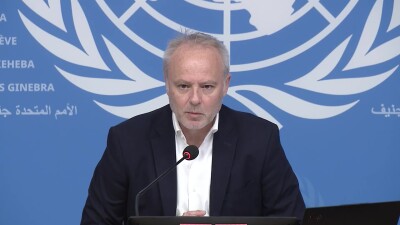
- Medium shot of the podium speakers showing Rolando Gomez and Jens Laerke.
- SOUNDBITE (English) - Jens Laerke, Deputy Spokesperson for the Office for the Coordination of Humanitarian Affairs (OCHA): “Under the conditions generated by this deal, the United Nations has been able to scale up humanitarian operations significantly in food, medical and shelter supplies, among others, which have enabled us to provide a range of critical services to people in need across Gaza and initiate repairs as well.”
- Wide shot of the Press room.
- SOUNDBITE (English) - Rolando Gomez, Chief of the Press and External Relations at UN Geneva (UNOG): “That prompts me to remind you of a statement that we shared with you a short while ago on behalf of the Secretary-General, on the situation in Gaza, through which he says, quote, ‘We must avoid at all costs the resumption of hostilities in Gaza that would lead to an immense tragedy. I appeal to Hamas to proceed with the planned liberation of hostages next Saturday, and both sides must fully abide by their commitments in the ceasefire agreement and resume serious negotiations in Doha for the second phase,’ end quote.”
- Medium shot of journalists listening to the press conference.
- SOUNDBITE (English) - Jens Laerke, OCHA: “The full visibility of the pipeline and the ceasefire deal and the compliance indicators, should be available to the guarantors of the ceasefire deal, which does not include the United Nations, but Egypt, Qatar and the US.”
- Medium shot of the speakers at the podium.
- SOUNDBITE (English) - Rolando Gomez, UNOG: “The needs are enormous. You know, the ceasefire is in place and of course that doesn't mean that there aren't enormous needs and they remain so, of course. This is where our priorities lie.”
- Close up of journalist taking notes.
- Close up of journalist listening.
- Medium shot of journalists listening.
Similar Stories

1
1
1
Edited News | OCHA , UNICEF , WFP
Aid agencies warned on Friday of the fast-developing humanitarian emergency inside Taiz City in Yemen, which has been encircled by de facto Houthi forces fighting government troops along the country’s west coast.

2
17
1
2
Edited News , Press Conferences , Images | OCHA , WMO
Two UN agencies teamed up on Wednesday to issue an appeal for immediate assistance to help communities already being impacted by the strongest El Niño on record.

3
16
2
2
Edited News , B-roll , Conferences , Images | UNITED NATIONS , UNOG
Sixth Consultative Meeting on Enhancing Coordination of Peace Initiatives and Efforts for Sudan

1
1
1
Edited News | UNICEF , WHO , UNHCR
Yemen war continues to force families from homes amid hunger and disease
More than 250,000 people have now fled renewed fighting in Yemen, the UN said on Tuesday, citing particular concern for those sheltering in the southwestern city of Taiz and the wider governorate, where access is “essentially blocked”.

1
1
1
Edited News | UNICEF
A little over one year since a ceasefire agreement was announced between Hamas fighters and Israel, more than 340 children have been reported killed and hundreds more injured, the UN Children’s Fund, UNICEF, said on Friday.

1
1
1
Edited News | UNICEF , IFRC
Six weeks after Nepal’s deadly flooding disaster, communities are still struggling to rebuild their lives, but they will need sustained help as global warming increases the risk of another Himalayan catastrophe, the UN Children’s Fund (UNICEF) said on Friday.

1
1
1
Edited News | WHO
In suspected Russia plague death, testing and monitoring underway – WHO
The death of a lab worker in Russia’s Siberia region has sparked concerns about plague being the cause, the UN World Health Organization (WHO) said on Tuesday, adding that it was following the situation closely.

1
1
Edited News | OHCHR , UNOG
UN Human Rights Chief Volker Türk on Friday provided and oral update to the 63rd session of the Human rights Council on Ukraine.

1
1
1
Edited News | OHCHR , UNOG
UN Human Rights Chief Volker Türk on Friday provided and oral update to the 63rd session of the Human rights Council on the human rights situation in Haiti.

1
1
1
Edited News | WHO
Repeated delays in bringing lifesaving medicines, prosthetics and more from Israel into Gaza risk having devastating consequences on Palestinians who urgently need them in the wartorn enclave, the UN World Health Organization (WHO) said on Friday. “A truck full of non-priority supplies or the right supplies arriving too late, doesn't save lives. That's the question that actually matters," said Dr Reinhilde Van De Weerdt, WHO Representative in the OPT.

1
1
1
Edited News | WHO
DRC: Early access to care and oxygen decisive for Ebola patients’ survival – WHO
In the Democratic Republic of the Congo (DRC), health workers fighting the country’s largest-ever Ebola outbreak are struggling to overcome critical challenges to patient care, the UN World Health Organization (WHO) warned on Tuesday.

1
1
1
Edited News | OCHA , UN
Civilians in Iran are continuing to feel the consequences of months of conflict and military escalation, the UN’s top official in the country has said, as loss of life, damage to civilian infrastructure and mounting economic pressures leave many facing continued uncertainty.