

The United Nations Office at Geneva
Multimedia Newsroom
Syria: Tragedy ‘at every step’ as millions of children face landmine threat – UNICEF
In Syria, landmines and other explosives left over from years of conflict present an ever more lethal threat to children, accounting for over 100 child deaths and injuries last month alone, the UN Children’s Fund (UNICEF) warned on Tuesday.
Ricardo Pires, UNICEF Communication Manager for Emergencies, told journalists from Damascus that in the last nine years, at least 422,000 incidents involving unexploded ordnance – or UXO - were reported in 14 governorates across Syria, “with half estimated to have ended in tragic child casualties”.
“Girls and boys in the country continue to suffer the brutal impact of unexploded ordnance (UXO) at an alarming rate,” he explained.
The UNICEF official underscored that in December last year, 116 children were killed or injured by UXO, an average of nearly four per day – a likely underestimate “given the fluidity of the situation,” he told journalists in Geneva.
“It's the main cause of child casualties in Syria right now and has been for many years, and will continue to be,” with an estimated more than 300,000 mines still spread across the country.
The danger affects some five million children living in areas contaminated with the lethal explosives, Mr. Pires said, for whom “every step they take carries the risk of an unimaginable tragedy”.
Renewed displacement has aggravated the danger. Mr. Pires recalled that since 27 November, over a quarter of a million children were forced to flee their homes due to escalating conflict. For the displaced and those trying to return home, “the peril of UXO is constant and unavoidable”, he stressed.
The threat has only intensified since the fall of the Assad regime on 8 December, as many weapons, including explosive weapons, have been left behind, in Homs but also in Damascus, Mr. Pires said.
He described the devastating effects of this legacy on inquisitive youngsters. “Even if children survive these blasts, the struggle doesn't end,” he said. “Life-changing injuries and disabilities often mean they cannot return to school or might find it harder to access proper health care.”
The UNICEF official called for increased humanitarian demining efforts, mine-risk education and support for survivors. He insisted that as part of discussions on reconstruction efforts supported by the international community, “it is imperative that immediate investment takes place to ensure the ground is safe and clear of explosives”.
UNICEF spokesperson James Elder echoed that call, stressing that to fund demining, “we’re talking tens of millions of dollars… which would save thousands of lives” and help Syria regain its former status as a middle-income country.
“It is a very, very cheap price that needs to be paid,” he concluded.
-Ends-
STORY: Syria UXO risk UNICEF 14 January 2025
TRT: 2:20”
SOURCE: UNTV CH
RESTRICTIONS: NONE
LANGUAGE: ENGLISH/ NATS
ASPECT RATIO: 16:9
DATELINE: 14 JANUARY 2025 GENEVA, SWITZERLAND
1. Exterior wide shot: Palais des Nations, Flag Alley.
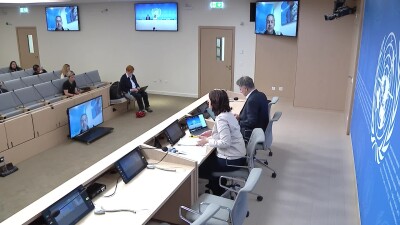
2. Wide shot: Speaker on screens; journalists in the Press room.
3. SOUNDBITE (English) – Ricardo Pires, Communication Manager for Emergencies, UN Children’s Fund (UNICEF): “Over the past nine years, at least 422,000 incidents involving UXOs [unexploded ordnance] were reported in 14 governorates across Syria, with half estimated to have ended in tragic child casualties.”
4. Wide lateral shot: Journalists in the Press room; speaker on screens.
5. SOUNDBITE (English) – Ricardo Pires, Communication Manager for Emergencies, UN Children’s Fund (UNICEF): “In December last year alone as well, 116 children were killed or injured by UXO, an average of nearly four per day. This is believed to be underestimated given the fluidity of the situation.”
6. Wide shot: Cameraperson and technicans’ booths in the Press room.
7. SOUNDBITE (English) – Ricardo Pires, Communication Manager for Emergencies, UN Children’s Fund (UNICEF): “It's the main cause of child casualties in Syria right now and has been for many years, and will continue to be because the ground continues to be infested, infested and contaminated. Over 300,000 mines are still spread across the country.”
8. Wide lateral shot: Speaker on screens; journalists in the Press room.
9. SOUNDBITE (English) – Ricardo Pires, Communication Manager for Emergencies, UN Children’s Fund (UNICEF): “Even if children survive these blasts, the struggle doesn't end. Life-changing injuries and disabilities often mean they cannot return to school or might find it harder to access proper health care.”
10. Wide lateral shot: Speakers at the podium of the press conference from rear; speaker on screens; journalists in the Press room.
11. SOUNDBITE (English) – Ricardo Pires, Communication Manager for Emergencies, UN Children’s Fund (UNICEF): “Since 8 December, when the previous government fell, a lot of weapons have been left behind. A lot of explosive weapons or just weapons in general, in many areas, including in Homs, where I was, but also in Damascus.”
12. Wide lateral shot: Speakers at the podium of the press conference from rear; speaker on screens; journalists in the Press room.
13. SOUNDBITE (English) – James Elder, Spokesperson, UN Children’s Fund (UNICEF): “We're talking tens of millions of dollars, which, as we've just heard, would save thousands of lives and will be an absolutely imperative part if Syria is to again become a middle-income country. So, if you're talking about tens of millions of dollars as a major influence to help Syria regain that status it had as a middle-income country, then it is a very, a very cheap price that needs to be paid.”
14. Various shots of journalists in the Press room.
Similar Stories

1
1
1
Edited News | OCHA , UNICEF , WFP
Aid agencies warned on Friday of the fast-developing humanitarian emergency inside Taiz City in Yemen, which has been encircled by de facto Houthi forces fighting government troops along the country’s west coast.

2
17
1
2
Edited News , Press Conferences , Images | OCHA , WMO
Two UN agencies teamed up on Wednesday to issue an appeal for immediate assistance to help communities already being impacted by the strongest El Niño on record.

3
16
2
2
Edited News , B-roll , Conferences , Images | UNITED NATIONS , UNOG
Sixth Consultative Meeting on Enhancing Coordination of Peace Initiatives and Efforts for Sudan

1
1
1
Edited News | UNICEF , WHO , UNHCR
Yemen war continues to force families from homes amid hunger and disease
More than 250,000 people have now fled renewed fighting in Yemen, the UN said on Tuesday, citing particular concern for those sheltering in the southwestern city of Taiz and the wider governorate, where access is “essentially blocked”.

1
1
1
Edited News | UNICEF
A little over one year since a ceasefire agreement was announced between Hamas fighters and Israel, more than 340 children have been reported killed and hundreds more injured, the UN Children’s Fund, UNICEF, said on Friday.

1
1
1
Edited News | UNICEF , IFRC
Six weeks after Nepal’s deadly flooding disaster, communities are still struggling to rebuild their lives, but they will need sustained help as global warming increases the risk of another Himalayan catastrophe, the UN Children’s Fund (UNICEF) said on Friday.

1
1
1
Edited News | WHO
In suspected Russia plague death, testing and monitoring underway – WHO
The death of a lab worker in Russia’s Siberia region has sparked concerns about plague being the cause, the UN World Health Organization (WHO) said on Tuesday, adding that it was following the situation closely.

1
1
Edited News | OHCHR , UNOG
UN Human Rights Chief Volker Türk on Friday provided and oral update to the 63rd session of the Human rights Council on Ukraine.

1
1
1
Edited News | OHCHR , UNOG
UN Human Rights Chief Volker Türk on Friday provided and oral update to the 63rd session of the Human rights Council on the human rights situation in Haiti.

1
1
1
Edited News | WHO
Repeated delays in bringing lifesaving medicines, prosthetics and more from Israel into Gaza risk having devastating consequences on Palestinians who urgently need them in the wartorn enclave, the UN World Health Organization (WHO) said on Friday. “A truck full of non-priority supplies or the right supplies arriving too late, doesn't save lives. That's the question that actually matters," said Dr Reinhilde Van De Weerdt, WHO Representative in the OPT.

1
1
1
Edited News | WHO
DRC: Early access to care and oxygen decisive for Ebola patients’ survival – WHO
In the Democratic Republic of the Congo (DRC), health workers fighting the country’s largest-ever Ebola outbreak are struggling to overcome critical challenges to patient care, the UN World Health Organization (WHO) warned on Tuesday.

1
1
1
Edited News | OCHA , UN
Civilians in Iran are continuing to feel the consequences of months of conflict and military escalation, the UN’s top official in the country has said, as loss of life, damage to civilian infrastructure and mounting economic pressures leave many facing continued uncertainty.