

The United Nations Office at Geneva
Multimedia Newsroom
Lebanon crisis: needs soar as UN launches new funding appeal
The UN in Lebanon appealed for an additional $331.5 million on Friday to help 1.4 million people in crisis as already massive needs continue to grow, three months after deadly violence erupted between Hezbollah fighters and Israeli forces.
“Humanitarian needs are soaring with each day of the conflict; our work is unfortunately far from over…we need the funding,” said Imran Riza, UN Humanitarian Coordinator in Lebanon.
Speaking from Beirut, the veteran humanitarian expressed his shock at the devastation caused by the hostilities, including air and drone strikes and shelling.
He described “hospitals and clinics hit by airstrikes, government buildings destroyed, agricultural land scorched, water stations demolished and schools turned to displacement sites”.
Since the latest escalation of violence, more than 3,500 people have been killed and more than 10,000 injured. Nearly one million people remain displaced from their homes.
"Health workers and first responders are facing death and injury on a horrific scale" while entire neighbourhoods have been turned to rubble, Mr. Riza said.
He also cited the deep and lasting trauma of repeated displacement faced by families, a lack of adequate shelter and uncertainty about being able to return home. Providing critical aid assistance in these conditions is extremely complicated and requires an urgent scale-up in support for the most vulnerable, he insisted.
“There are a lot of displacement orders happening all the time. And in fact, this morning there have been a number that have been issued…people keep moving. So, it’s very difficult to know where people are at certain times.”
“Affected people are rapidly exhausting their coping capacities and essential services are under increasing strain,” the UN aid coordination office, OCHA, said in an update accompanying the appeal.
Just as in conflicts everywhere, mass displacement has increased the risks for women and girls across Lebanon.
“Overcrowded shelters lack privacy, adequate sanitation and basic protection measures,” warned Andrew Saberton, Deputy Executive Director for UN population fund, UNFPA, in an appeal for .
More than 600,000 women and girls are estimated to be at risk of gender-based violence, he noted, speaking from Cairo via video to journalists in Geneva.
In addition, approximately 1,800 women are expected to give birth every month across Lebanon. “And yet healthcare facilities continue to come under attack, hospitals and primary healthcare centres have been forced to close and women are finding it increasingly difficult to access essential maternal health services”, Mr. Saberton explained.
He described how one UNFPA-supported primary health care centre and a women and girls’ safe space in south Lebanon that he had visited while it was being rebuilt in 2025 was now “once again severely damaged by airstrikes. These were amongst the few, very few facilities that continue to operate in the area.”
Warning of the protracted displacement crisis now unfolding across southern Lebanon, Mr. Riza noted that after conflict between Hezbollah fighters and Israel in 2024, some 68,000 people “could not go back to their villages after the cessation of hostilities”, either because it was not safe or “mainly that their villages had been destroyed. I think our estimation now is that number is going to be much, much larger, at minimum probably around 200,000, but probably more than that”.
Friday’s emergency appeal brings the overall ask by the UN and partners for Lebanon through August this year to $639.9 million.
ends
Lebanon flash appeal – OCHA, UNFPA
TRT: 2 min 03s
SOURCE: UNTV CH
RESTRICTIONS: NONE
LANGUAGE: ENGLISH / NATS
ASPECT RATIO: 16:9
DATELINE: 5 JUNE 2026 GENEVA, SWITZERLAND & 2 JUNE 2026 TYRE, LEBANON, please credit OCHA.
Speakers:
- Imran Riza, Humanitarian Coordinator in Lebanon, from Beirut
- Andrew Saberton, Deputy Executive Director, UNFPA, from Cairo
SHOTLIST
- Exterior wide, UN Geneva flag alley.
- Wide, UN Geneva Press room, podium speakers.
- SOUNDBITE (English) – Imran Riza, Humanitarian Coordinator in Lebanon: “Humanitarian needs are soaring with each day of the conflict. Our work is unfortunately far from over. Today, we call for an additional $331.5 million to sustain lifesaving efforts for 1.4 million people, bringing our overall ask for the flash appeal through August of this year to $639.9 million.”
- Wide, journalists, participants, TV screens.
- SOUNDBITE (English) – Imran Riza, Humanitarian Coordinator in Lebanon: “There are a lot of displacement orders happening all the time. And in fact, this morning there have been a number that have been issued, where people keep moving. So, it's very difficult to know where people are at certain times.”
- Medium, podium speakers, TV screen showing speaker.
- SOUNDBITE (English) – Imran Riza, Humanitarian Coordinator in Lebanon: “In the communities I have visited in recent weeks, I was shocked by the devastation of infrastructure and essential services. Hospitals and clinics hit by airstrikes, government buildings destroyed, agricultural land scorched, water stations demolished and schools turned to displacement sites.”
- Wide, journalists, participants.
- SOUNDBITE (English) – Andrew Saberton, Deputy Executive Director, UNFPA, from Cairo: “Around 1,800 women are expected to give birth every month. And yet healthcare facilities continue to come under attack, hospitals and primary healthcare centres have been forced to close and women are finding it increasingly difficult to access essential maternal health services.”
- Medium, journalist.
- SOUNDBITE (English) – Andrew Saberton, Deputy Executive Director, UNFPA, from Cairo: “Just this week, a UNFPA supported primary health care centre and women and girls safe space in south Lebanon, which I visited while it was being rebuilt in 2025, was once again severely damaged by airstrikes. These were amongst the few, very few facilities that continue to operate in the area.”
- Wide, shelter at a school in Tyre, south Lebanon, 2 June. Please credit OCHA.
- Medium, drawing on chalkboard at school shelter in Tyre, south Lebanon, 2 June. Please credit OCHA.
- Young girl looking at camera at a shelter at a school in Tyre, south Lebanon, 2 June. Please credit OCHA.
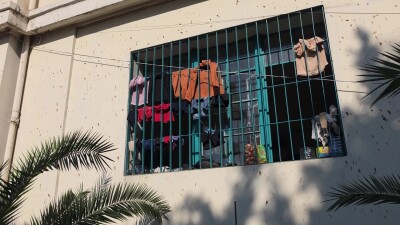
- Wide, clothes drying on window bars at a shelter at a school in Tyre, south Lebanon, 2 June. Please credit OCHA.
Similar Stories

1
1
1
Edited News | OCHA , UNICEF , WFP
Aid agencies warned on Friday of the fast-developing humanitarian emergency inside Taiz City in Yemen, which has been encircled by de facto Houthi forces fighting government troops along the country’s west coast.

2
17
1
2
Edited News , Press Conferences , Images | OCHA , WMO
Two UN agencies teamed up on Wednesday to issue an appeal for immediate assistance to help communities already being impacted by the strongest El Niño on record.

3
16
2
2
Edited News , B-roll , Conferences , Images | UNITED NATIONS , UNOG
Sixth Consultative Meeting on Enhancing Coordination of Peace Initiatives and Efforts for Sudan

1
1
1
Edited News | UNICEF , WHO , UNHCR
Yemen war continues to force families from homes amid hunger and disease
More than 250,000 people have now fled renewed fighting in Yemen, the UN said on Tuesday, citing particular concern for those sheltering in the southwestern city of Taiz and the wider governorate, where access is “essentially blocked”.

1
1
1
Edited News | UNICEF
A little over one year since a ceasefire agreement was announced between Hamas fighters and Israel, more than 340 children have been reported killed and hundreds more injured, the UN Children’s Fund, UNICEF, said on Friday.

1
1
1
Edited News | UNICEF , IFRC
Six weeks after Nepal’s deadly flooding disaster, communities are still struggling to rebuild their lives, but they will need sustained help as global warming increases the risk of another Himalayan catastrophe, the UN Children’s Fund (UNICEF) said on Friday.

1
1
1
Edited News | WHO
In suspected Russia plague death, testing and monitoring underway – WHO
The death of a lab worker in Russia’s Siberia region has sparked concerns about plague being the cause, the UN World Health Organization (WHO) said on Tuesday, adding that it was following the situation closely.

1
1
Edited News | OHCHR , UNOG
UN Human Rights Chief Volker Türk on Friday provided and oral update to the 63rd session of the Human rights Council on Ukraine.

1
1
1
Edited News | OHCHR , UNOG
UN Human Rights Chief Volker Türk on Friday provided and oral update to the 63rd session of the Human rights Council on the human rights situation in Haiti.

1
1
1
Edited News | WHO
Repeated delays in bringing lifesaving medicines, prosthetics and more from Israel into Gaza risk having devastating consequences on Palestinians who urgently need them in the wartorn enclave, the UN World Health Organization (WHO) said on Friday. “A truck full of non-priority supplies or the right supplies arriving too late, doesn't save lives. That's the question that actually matters," said Dr Reinhilde Van De Weerdt, WHO Representative in the OPT.

1
1
1
Edited News | WHO
DRC: Early access to care and oxygen decisive for Ebola patients’ survival – WHO
In the Democratic Republic of the Congo (DRC), health workers fighting the country’s largest-ever Ebola outbreak are struggling to overcome critical challenges to patient care, the UN World Health Organization (WHO) warned on Tuesday.

1
1
1
Edited News | OCHA , UN
Civilians in Iran are continuing to feel the consequences of months of conflict and military escalation, the UN’s top official in the country has said, as loss of life, damage to civilian infrastructure and mounting economic pressures leave many facing continued uncertainty.