

The United Nations Office at Geneva
Multimedia Newsroom
Press Conferences | OCHA , UNHCR , UN WOMEN , WHO , OHCHR
UN Geneva Press Briefing - 27 September 2024
UN GENEVA PRESS BRIEFING
27 September 2024
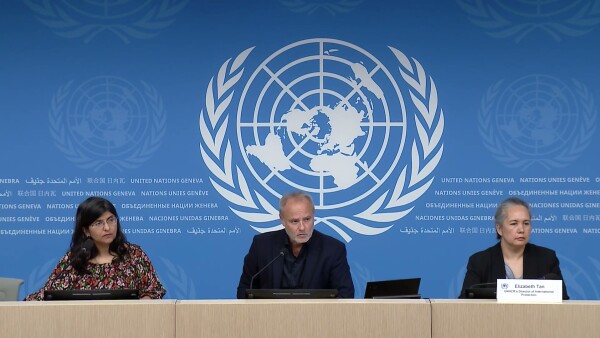
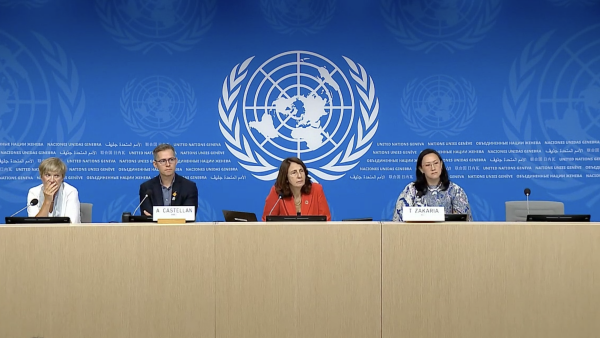
Rolando Gómez, Chief of the Press and External Relations Section at the United Nations Information Service in Geneva, chaired a hybrid briefing, which was attended by the United Nations Humanitarian Coordinator in Lebanon, representatives and spokespersons of the United Nations Refugee Agency, the Office of the High Commissioner for Human Rights, the World Health Organization, and UN Women.
War in Lebanon
Imran Riza, United Nations Humanitarian Coordination in Lebanon, speaking from Beirut, said that recent escalations in Lebanon were nothing short of catastrophic. The surge in violence had extended to previously unaffected areas, leading to widespread destruction of homes and infrastructure across the country. In less than a week, at least 700 lives had been lost, thousands had been injured, and nearly 120,000 people had been displaced within mere hours, with these numbers continuing to rise. This was the deadliest period in Lebanon in a generation, and many feared that this was just the beginning.
The UN and its partners were closely coordinating with the Lebanese Government to support the response efforts, which included aligning aid distribution, conducting joint assessments, and identifying urgent needs for affected populations. Lebanon's health system was already overwhelmed, and the events of the previous week, including the explosions of communication devices, had nearly depleted health supplies. The system was struggling with limited resources to meet the growing demands.
Together with its partners, the UN was delivering food, mattresses, hygiene kits, and emergency medical supplies to those affected by displacement. Nearly 500 shelters were accommodating around 80,000 displaced individuals, including 300 schools that had been repurposed, impacting the education of over 100,000 students. Mr. Riza said that critical funding gaps persisted in various areas, including shelter repair, site management, food stocks, fuel, and coordination. He emphasized that civilians had to be protected, civilian infrastructure should not be targeted, and the safety and security of all UN personnel and assets had to be guaranteed. International law had to be upheld. The priority now had to be to secure an immediate ceasefire to halt further civilian suffering and destruction. The humanitarian community urged all countries to leverage their influence to facilitate an immediate de-escalation. The region could not endure further bloodshed.
Gonzalo Vargas Llosa, United Nations Refugee Agency (UNHCR) Representative in Syria, speaking from the Syria-Lebanon border, said that thousands of Lebanese and Syrians had crossed into Syria, following the escalation of violence in Lebanon. The Government of Syria was leading the response to the crisis, while keeping an open-door policy: the border was open to both Syrian and Lebanese nationals. The Syrian Arab Red Crescent was taking the lead on the ground, informed Mr. Vargas Llosa, while the UNHCR was also on the ground, working closely with other UN agencies and NGOs. Over the past 72 hours, well over 30,000 people had crossed into Syria; up to 80 per cent of them were Syrian and some 20 per cent Lebanese. Both groups were making a difficult choice by deciding to cross into Syria, which itself had been in conflict and economic crisis for over a decade. Over 50 per cent of those who had arrived so far were children and adolescents. Those who crossed had a palpable sense of relief, said Mr. Vargas Llosa. Numbers of injured people had also been observed; a woman carrying two dead children had been seen crossing the border the day before. Mr. Vargas Llosa said that the provision of water, food, and blankets was for now largely covered by the Syrian Government.
Assisting people when they reached their final destinations would be a different kind of challenge, noted Mr. Vargas Llosa. UNHCR had established structures across the country for some time already, including 114 community centres providing a whole range of services. Those services were now providing support to both Syrian returnees and Lebanese refugees. The Government was establishing a number of collective centres to welcome those Lebanese who did not have families or relatives to stay with in Syria.
Ivo Freijsen, United Nations Refugee Agency (UNHCR) Representative in Lebanon, also speaking from Beirut, said that the UNHCR had been preparing for the current scenario for almost a year. Two UNHCR employees in Lebanon had been killed, reminded Mr. Freijsen, asking once again parties to the conflict to respect international humanitarian law and avoid targeting civilians and humanitarian workers. Fewer people were moving now than in the beginning of the week, but the movement of people from the most affected areas continued, and it was now increasingly expensive to rent housing in the center of the country. Compared to 2006, the humanitarian community was larger and had more resources, noted Mr. Freijsen. Over 140,000 relief items had been provided to the displaced people so far. He reminded that Lebanon had been hosting large numbers of refugees, both from Syria and Palestine, for decades. It was not easy for Lebanese to have access to shelter, so the UNHCR was working with the authorities to address this challenge. UNHCR pled to donors to step up their assistance so that the humanitarian actors could respond adequately and timely.
Replying to questions from the media, Mr. Vargas Llosa, for the UNHCR, said that the preparations were underway to receive more refugees. The Government of Syria had allowed Lebanese to enter the country as long as they had any kind of document with their name, not only a passport or a national identity card. They were given an open-ended authorization to stay. Fortunately, over the past 72 hours, the border crossings had been safe and working 24 hours per day. Mr. Riza, the UN Humanitarian Coordinator in Lebanon, said that over the past five days, 118,000 newly displaced people had been registered, bringing the total number to over 210,000. Some people had been displaced for the second or third time, displacement was spreading, and it was difficult to establish exact numbers. In the 34-day war between Israel and Lebanon in 2006, twice as many people had been killed as in one single day, 23 September 2024. The health sector had been completely overrun; luckily the UN system and partners had prepared trauma kits and undertaken other preparedness measures. Margaret Harris, for the World Health Organization (WHO), said that, as of the previous day, there had been 738 recorded deaths and 5,908 injuries. Many of the injured were currently waiting for their surgeries. Some 37 health facilities had been closed due to the escalation. Mr. Freijsen, for the UNHCR, said that Lebanese or Syrians trying to reach Cyprus or other parts of Europe by boat was not a new phenomenon.
Gender alert from Sudan
Hodan Addou, Regional Director a.i. for East and Southern Africa at UN Women, speaking from South Sudan, presented findings from a UN Women report published today which put a spotlight on the impact of the humanitarian crisis in Sudan on women and girls. The report found distinct and disproportionate impact on women and girls, which had led to a twofold increase of sexual violence. The violent conflict had exacerbated risks for women and girls for sexual violence, exploitation, and abuse. Some 5.8 million internally displaced women and girls were particularly vulnerable, and a lot of sexual violence was going unreported. Those trends had to end, and appropriate justice mechanisms needed to be introduced, stressed Ms. Addou.
With 64 per cent of female-headed households experiencing food insecurity compared to 48 per cent of male-headed households in ten states, women and girls were eating least and last. Access to health care services was another challenge: 1.63 million women of reproductive age are without adequate services. Among them, over 160,000 are pregnant, and an estimated 54,000 childbirths are expected in the next three months.
Women and girls in Sudan were facing unimaginable challenges, yet their strength and resilience continued to inspire. Sudan should not become a forgotten crisis. Now, more than ever, the international community had to rally together to support women in Sudan, ensuring they have the resources and protection they need to survive and rebuild their lives. Together with its partners, UN Women urged the international community, donors, and humanitarian partners to prioritize the protection and empowerment of Sudanese women and girls, including through the increase of funding for local women-led organizations, which received less than two per cent of the Sudan Humanitarian Fund’s financial resources in 2023. The atrocities in Sudan were simply unacceptable, and UN Women stood with the people of Sudan during this deteriorating humanitarian crisis and called for an immediate halt to the war and a return to the negotiating table for peace dialogues, which would include full women’s participation.
UN Women’s report can be found here.
Responding to questions, Ms. Addou said that UN Women was calling for a cessation of hostilities and protection for all women and girls, accountability, and provision of justice for all victims. Rape and sexual violence were used as a despicable weapon of war, and all perpetrators had to be held accountable. Ms. Addou stressed that the looming famine was another grave concern; shocking numbers of people were facing dire conditions in IDP sites. Margaret Harris, for the World Health Organization (WHO), said that the access to healthcare continued to be extremely limited. People were dying due to the lack of access to basic health care and medication. While surveillance was very poor, there were reports of cholera, measles, meningitis, and dengue, said Ms. Harris.
Tacking insecurity in Haiti
Ravina Shamdasani, for the Office of the High Commissioner for Human Rights (OHCHR), stated that a new OHCHR report found that tackling insecurity in Haiti, where hundreds had been killed, injured, or displaced as a result of gang violence, had to be the utmost priority. Latest figures documented by the OHCHR indicated that at least 3,661 people had been killed since January this year, maintaining the high levels of violence seen in 2023.
“No more lives should be lost to this senseless criminality,” UN High Commissioner for Human Rights Volker Türk stressed. “I welcome recent positive steps, such as the establishment of a Transitional Presidential Council, the new transitional government, and the deployment of the first contingents of the Multinational Security Support Mission (MSS). It is clear, however, that the Mission needs adequate and sufficient equipment and personnel to counter the criminal gangs effectively and sustainably and stop them spreading further and wreaking havoc on people’s lives.”
The report detailed extremely serious patterns of human rights violations and abuses taking place across the capital of Port-au- Prince and in the Artibonite Department – as well as in the southern part of West Department, which until recently had been largely unaffected by the violence. The number of victims of sexual violence, including rape, had also increased in the first half of the year. According to the report, gangs had continued to use sexual violence to punish, spread fear and subjugate populations. During the reporting period, at least 860 people had been killed and 393 injured during police operations and patrols across Port-au-Prince, including at least 36 children, in what could constitute use of unnecessary and disproportionate force.
Full report is available here.
Answering questions from the media, Ms. Shamdasani said that any multinational force in Haiti had to be adequately funded and resourced, which was not the case now. It would be up for the Security Council to decide on a possible deployment of a peacekeeping mission in Haiti. The continuous flow of weapons into Haiti had to be immediately stemmed, stressed Ms. Shamdasani. The gangs operating in Haiti seemed to be after both territorial and financial gains by using various methods, including kidnapping, asking for ransom, racketeering, killing and raping people.
UNHCR guidance against penalization of asylum-seekers for irregular entry
Elizabeth Tan, United Nations Refugee Agency (UNHCR) Director of International Protection, informed that the UNHCR had issued its latest legal guidance today on the way States should treat asylum-seekers who arrived at their borders in an irregular way. Under Article 31 of the Refugee Convention, States were prohibited from penalizing asylum-seekers and refugees merely because they had entered a country irregularly, if they met certain requirements. This was because the fact that many fled life-threatening situations and might have no other available means to seek safety. In addition to a dearth of legal or safer pathways to seek asylum, many might face impediments in accessing or retrieving essential documentation during their flight.
Ms. Tan informed that the Refugee Convention stated that refugees could not be punished for irregular entry as long as three conditions were met – “directness”, “promptness” and the showing of “good cause”. UNHCR’s legal guidance provided an interpretation of these terms, including that refugees and asylum-seekers had to present themselves to the authorities without delay and show valid reasons why they had entered without a visa. If these requirements were met, refugees and asylum-seekers should also not be detained for entering irregularly – including for the purposes of deterrence. UNHCR’s guidance also addressed the issue of penalization due to smuggling: refugees could not be penalized if they were suspected or found to have been involved in organizing, assisting, or facilitating their own or others' illegal entry or stay, as long as they were the ones being smuggled, or if they had taken these actions to secure their own, their family's, or others' entry for humanitarian reasons.
UNHCR press release can be found here.
Replying to a question on Sudanese refugees in Egypt, Ms. Tan said that more than one million refugees from Sudan were in Egypt. Following this large influx, the Government of Egypt had put in place visa procedures. Ms. Tan said that UNHCR advised that those who had arrived to the country without a visa should not be penalized. The guidance issued today was of global nature and not directed at any specific country, she explained.
Announcements
Rolando Gómez, for the United Nations Information Service (UNIS), informed that the Committee on Economic, Social and Cultural Rights would conclude its 76th session at 5:30 pm today and issue its concluding observations on the countries reviewed: Iceland, Poland, Honduras, Kyrgyzstan, Albania, Cyprus, and Malawi.
The Committee on Enforced Disappearances would have a meeting with States and then with NGOs, National Human Rights Institutions, and intergovernmental organizations in the morning of 30 September.
The Human Rights Council today hear from Hilda C. Heine, President of the Marshall Islands. It had been followed by an interactive dialogue with José Francisco Calí Tzay, Special Rapporteur on the rights of Indigenous Peoples, on his reports on indigenous persons with disabilities and visit to Colombia. Following that, an interactive dialogue would take place with Ilze Brands Kehris, UN Assistant Secretary-General for Human Rights, on the report of the Secretary-General’s report on cooperation with the United Nations, its representatives and mechanisms in the field of human rights (reprisals). In the afternoon, the Council would adopt the final outcome documents of the fourth Universal Periodic Review of North Macedonia, Viet Nam, Argentina, and Cyprus.
On 30 September at 5 pm, a hybrid press conference would take place to provide an update on the situation in the occupied Palestinian territory. Speaker would be Philippe Lazzarini, UNRWA Commissioner-General.
Several journalists expressed appreciation for François Subiger, the radio assistant at the UN Information Service, who would be retiring shortly.
Similar Stories
1
1
1
Statements , Press Conferences | OHCHR
1
1
1
Press Conferences | UNHCR , UNICEF , IFRC , OHCHR , UN WOMEN , IOM , OCHA , WHO
UNHCR – ExCom Meeting, UNICEF – Nepal Recovery, IFRC – Flash Floods, WHO – Mental Health, IOM – South Sudan Floods, OCHA – DRC Humanitarian aid, UNHCR – Sahel Displacement, UNICEF – Yemen Update, IOM – Gaza Shelter, UN Women – Gaza Women, OHCHR – Arrests and detentions of Syrians by Israeli force
2
1
2
Press Conferences | UNCTAD
Presentation of the Trade and Developement Report 2026
Embargoed until 9 October 2026 at 11 a.m. (Geneva Time)
UNCTAD: UNCTAD’s flagship report finds that governments increasingly use industrial, trade, financial and technology policies to pursue economic and national security objectives. Market access and the ability to move into higher-value activities now depend more heavily on technology, finance and geopolitics.
1
1
1
Press Conferences | UPU
Release of the State of the Postal Sector Report 2026
1
1
1
Press Conferences | IOM , ITU , UNECE , UNICEF , WHO , WMO
UNICEF: Ebola, DRC - children orphans or separating them from parents and caregivers; IOM: Humanitarian needs in Djibouti amid arrivals from Yemen and increased migrant movements; WHO: Darfur, scale of health needs far exceeds available resources; WMO co-sponsored Global Heat Forum, Bangkok, monthly Global Seasonal Climate Update; UNECE: UN Forum of Mayors; ITU Plenipotentiary Conference 2026; WHO: child and adolescent obesity guidelines and new global roadmap to tackle pregnancy hypertension, a leading cause of maternal mortality
1
1
1
Press Conferences | OCHA , UN WOMEN , UNHCR , WFP , WHO , WTO , UNEP
OCHA – $160M CERF allocation to 12 underfunded crises; UNHCR – 5.8M refugee children remain out of school amid funding cuts; UN Women – Middle East escalation and food security among women/girls; WHO – Gaza supplies and overall situation; WFP – Yemen food insecurity and impact on global hunger ; UNEP - First International Conference of the Global Framework on Chemicals in Geneva | 16-20 November 2026
1
1
1
Press Conferences | UNHCR , WHO
Yemen's health system nears collapse amid conflict, causing rising casualties and medicine shortages.
1
1
1
Press Conferences | HRC
Update by the Expert Mechanism to Advance Racial Justice and Equality in Law Enforcement
1
1
1
Press Conferences | WIPO , WHO , UNICEF , UNHCR , IOM , WFP , FAO
WIPO Global Innovation Index 2026 launch and press conference, WHO Composition of influenza vaccines for the 2027 Southern Hemisphere flu season, UNICEF Yemen hunger and malnutrition; UNHCR Sudan displacement into Chad; IOM Ebola and population movements in DRC; WFP emergency food assistance in Nepal; and FAO food loss and waste.
2
1
2
Press Conferences | UNCTAD
Gaza reconstruction needs reach $71.5 billion as Palestinian economy and public finances face severe strain. Latest UNCTAD report documents the loss of decades of development gains, economic collapse in Gaza and tightening economic constraints in the West Bank.
The report identifies three immediate priorities: transferring withheld Palestinian revenues, safeguarding the banking system and aligning reconstruction support with the documented scale of damage and economic losses.
1
1
1
Press Conferences | HRC
Press conference on the situation of human rights in Nicaragua by the UN Group of Human Rights Experts
1
1
1
Press Conferences | ITU , UNHCR , WHO , WMO
YEMEN - UNHCR: Escalating conflict in Yemen could fuel more displacement, refugee movement
CLIMATE - WHO / WMO: Health and Climate impact of El Niño