

The United Nations Office at Geneva
Multimedia Newsroom
Edited News , Press Conferences , Images | UNEP
UNEP Press conference: Plastic Pollution (INC-5.2)- 05 August 2025
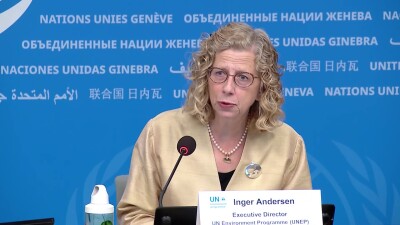
The world wants a treaty to curb growing plastic pollution, insists UN agency chief
Negotiations got under way at UN Geneva on Tuesday to agree on a legally binding treaty to curb plastic pollution, with delegates from nearly 180 countries attending.
“The world wants and indeed needs a plastic conventional treaty because the crisis is getting out of hand and people are frankly outraged,” said Inger Andersen, UNEP Executive Director of the UN Environment Programme (UNEP), the UN agency leading the talks. “We know that plastic is in our nature, in our oceans, and yes, even in our bodies…What is sure is that no one wants to live with the plastic pollution.”
Unless an international accord is inked, plastic production and waste is projected to triple by 2060, causing significant damage – including to our health - according to UNEP.
Switzerland’s top environment official Katrin Schneeberger echoed the call for a legally binding treaty, insisting that plastic waste “is choking our lakes, harming wildlife and threatening human health. This is more than just an environmental issue, it is a global challenge that demands urgent and collective action.”
Speaking to journalists on the sidelines of the treaty negotiations, Ms. Schneeberger underscored that there was “no call for a production cap” by producing countries. “Reaching a shared understanding that measures are needed on both the production and consumption sides can help unlock the negotiations,” she said in her capacity as Director of the Swiss Federal Office for the Environment.
Supporters of a deal have compared it to the Paris Climate Accord in terms of its significance. They have also pointed to the pressure allegedly being brought to bear against a deal by petrostates, whose crude oil and natural gas provide the building blocks of plastics.
“We will not recycle our way out of the plastic pollution crisis: we need a systemic transformation to achieve the transition to a circular economy,” UNEP Executive Director Inger Andersen has insisted in previous comments on the need for global regulations on plastics.
With 10 days of talks scheduled on the treaty at the UN in Geneva, supporters of an accord hope that the deal will cover the full life cycle of plastics, from design to production and disposal.
The treaty should “promote plastic circularity and prevent leakage of plastics in the environment”, according to the text now guiding negotiations led by the Intergovernmental Negotiating Committee (INC).
At 22 pages, the INC current draft text contains 32 draft articles which will be discussed in fine detail. The text is designed to shape the future instrument and serves as a starting point for negotiations by countries meeting in Geneva.
“Some [countries] will have to deal with reduction, others will have to deal with mechanical recycling and others will deal with alternatives,” Ms. Andersen said. “Let’s see how we can get to this through the negotiations. I think there's a lot of good faith in the working group right now.”
The UNEP-led talks follow a decision in 2022 by Member States to meet and develop an international legally binding instrument to end the plastic pollution crisis, including in the marine environment.
The scale of the problem is massive, with straws, cups and stirrers, carrier bags and cosmetics containing microbeads just a few of the single-use products ending up in our oceans and landfill sites.
In comments to journalists, Ms. Andersen recalled touring Pakistan after deadly flooding killed more than 1,000 people in 2022 and seeing that debris and plastic were “a big part of the problem and so this is why we’re here, to find a solution while not leaving anyone behind and while ensuring that the economic wheels would keep turning”.
Campaigners gathering on the sidelines of the negotiations expressed their hopes for as ambitious a treaty as possible.
They included Shellan Saling, from California, who’s the interim chair of the Youth Plastic Action Network (YPAN). “Plastic affects everything from climate change to health to fertility to even birth defects; it affects physical disabilities, as well as invisible disabilities,” she told UN News. “People don't realize how much it actually impacts, and you know every single day we are impacted by plastic and without production cuts, it could get significantly worse.”
Any treaty inked in Geneva will have to be sufficiently robust to accommodate the needs of all countries of the world whose approach differs regarding plastic design, production, waste and recycling. It will also have to stand the test of time, Ms. Andersen said.
“It begins with having global rules, that's really it. And that's what this treaty will enable; when there are global rules around how these things are managed, investors can see that they have predictability because they know that there's a market for what they collect and then there will be investments. Because all of a sudden, that thing that today's waste, tomorrow will have value.”
According to the Intergovernmental Negotiating Committee on Plastic Pollution, in 2024 alone, humanity was expected to consume more than 500 million tonnes of plastic. Of this, 399 million tonnes will become waste.
ends
STORY: Widespread starvation in Gaza – IPC, UN Women
TRT: 3’10”
SOURCE: UNTV CH
RESTRICTIONS: NONE
LANGUAGE: ENGLISH/ NATS
ASPECT RATIO: 16:9
DATELINE: 05 AUGUST 2025 GENEVA, SWITZERLAND
Speakers:
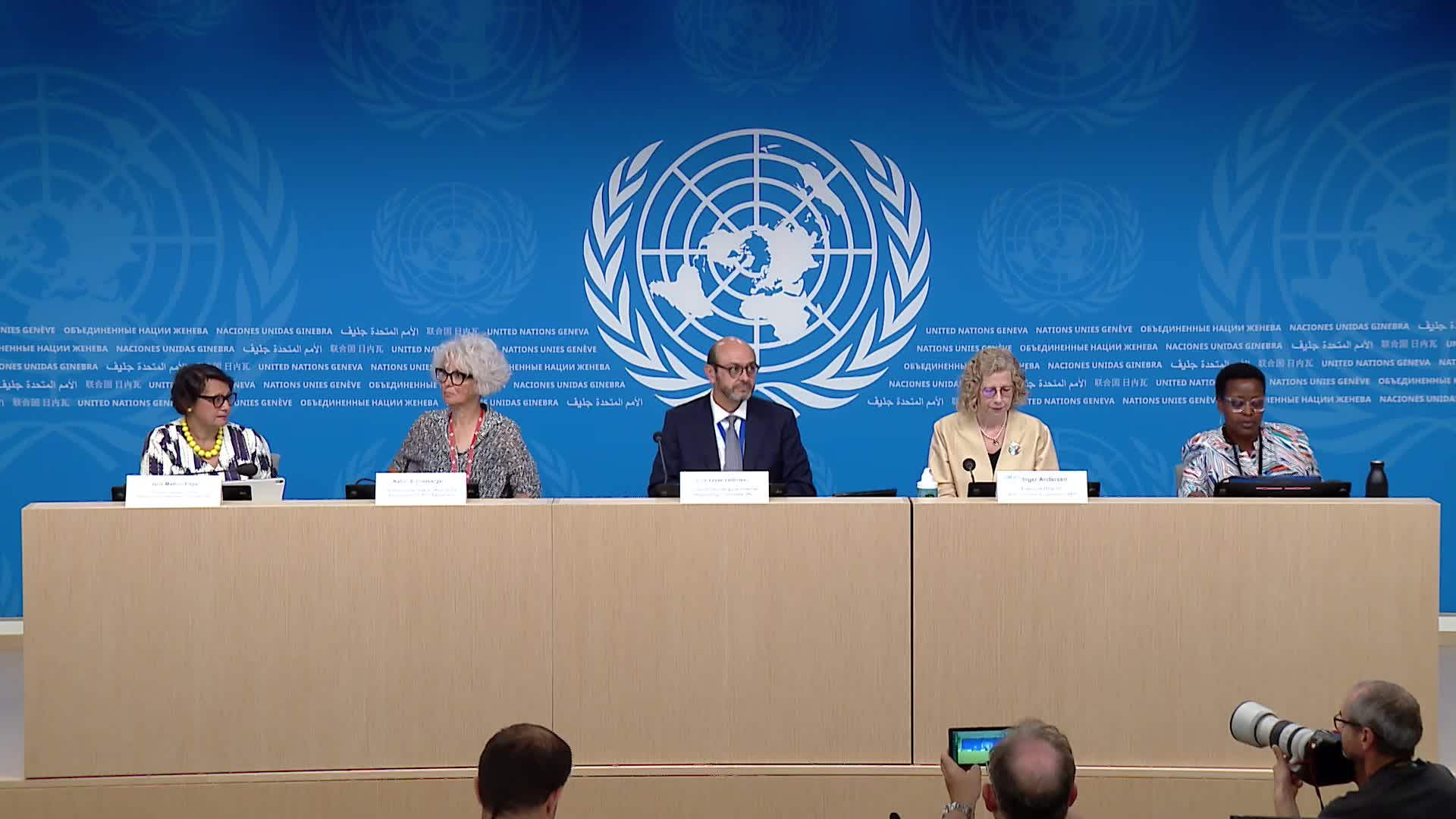
- Inger Andersen, Executive Director, United Nations Environment Programme (UNEP)
- Katrin Schneeberger, Director of the Federal Office for the Environment (FOEN), Switzerland
SHOTLIST
- Exterior wide shot: Palais des Nations, flag alley.
- Wide, Press room podium and journalists, TV screens.
- SOUNDBITE (English) – Inger Andersen, Executive Director, United Nations Environment Programme (UNEP): “We can't forget that the world wants and indeed needs a plastic conventional treaty because the crisis is getting out of hand and people are frankly outraged; people who are living with that pollution. We know that plastic is in our nature, in our oceans, and yes, even in our bodies.”
- Wide, podium speakers.
- SOUNDBITE (English) – Katrin Schneeberger, Director of the Federal Office for the Environment (FOEN), Switzerland: “Today, we stand at a critical crossroads. Plastic waste is choking our lakes, harming wildlife and threatening human health. This is more than just an environmental issue, it is a global challenge that demands urgent and collective action.”
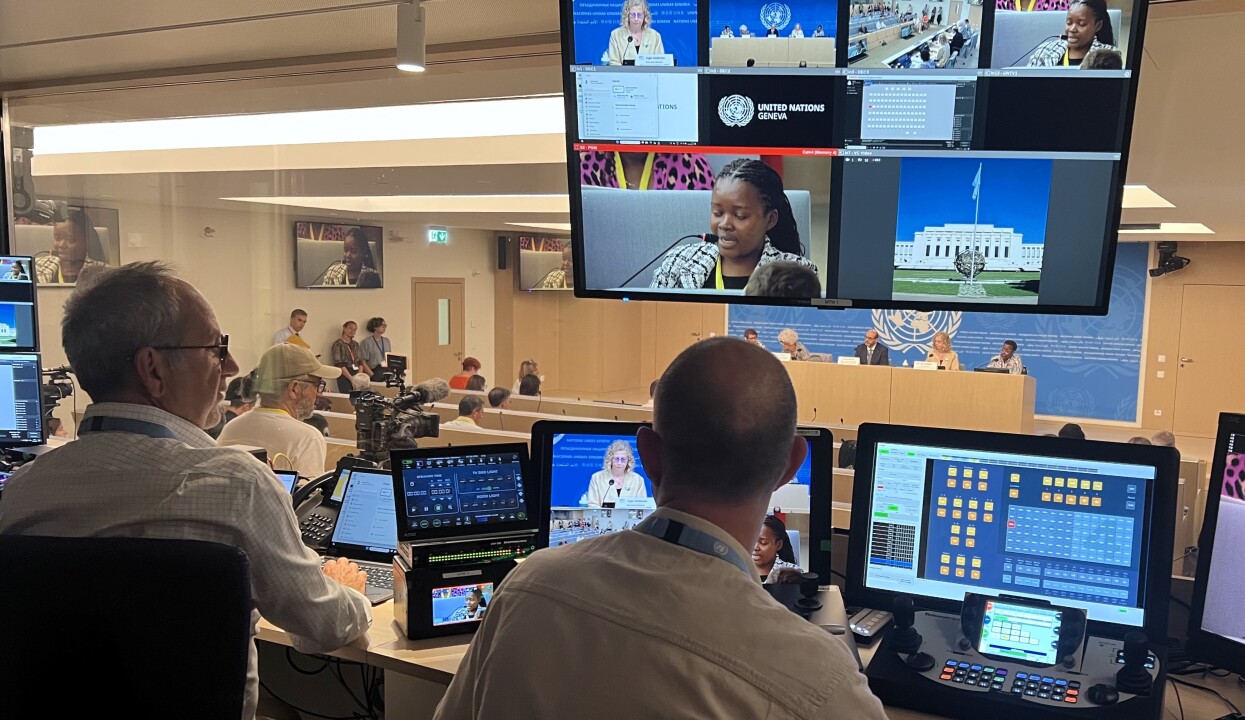
- Wide, journalists, participants, TV screens showing speaker.
- SOUNDBITE (English) – Katrin Schneeberger, Director of the Federal Office for the Environment (FOEN), Switzerland: “Contrary to some media reports, this is no call for a production cap. Clarifying this in informal meetings was an important message to producing countries. Reaching a shared understanding that measures are needed on both the production and consumption sides can help unlock the negotiations.”
- Wide, journalists, participants, TV screens showing speaker
- SOUNDBITE (English) – Inger Andersen, Executive Director, United Nations Environment Programme (UNEP): “What is sure is that no one wants to live with the plastic pollution. No one wants it in the soils, in the drinking water, let alone in our oceans and in our bodies.”
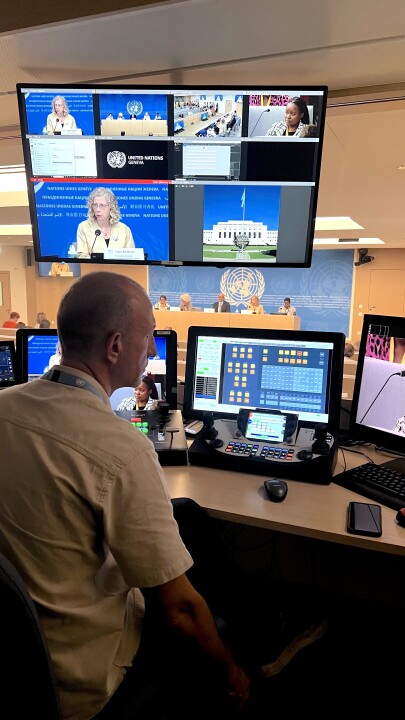
- Wide, Press room journalists, participants, TV screens showing speaker, control booths.
- SOUNDBITE (English) – Inger Andersen, Executive Director, United Nations Environment Programme (UNEP): “I had the privilege but also the heavy duty of visiting Pakistan right after the floods; these dreadful, dreadful, unbelievably catastrophic floods. And debris and plastic was a big part of the problem and so this is why we're here, to find a solution while not leaving anyone behind and while ensuring that the economic wheels would keep turning.”
- Wide, journalists, photographers, participants.
- SOUNDBITE (English) – Inger Andersen, Executive Director, United Nations Environment Programme (UNEP): “Some will have to deal with reduction, others will have to deal with mechanical recycling and others will deal with alternatives. Let's see how we can get to this through the negotiations. I think there's a lot of good faith in the working group right now.”
- Medium-wide, TV video journalists, journalists, control booths.
- SOUNDBITE (English) – Inger Andersen, Executive Director, United Nations Environment Programme (UNEP): “It begins with having global rules. That's really it. And that's what this treaty will enable; when there are global rules around how these things are managed, investors can see that they have predictability because they know that there's a market for what they collect and then there will be investments. Because all of a sudden, that thing that today's waste, tomorrow will have value.”
- Medium-wide, journalists.
- Medium, journalists.
- Medium, photographer.
- Medium-wide, journalists, participants.
Similar Stories
1
1
1
Press Conferences | UNHCR
End of UNHCR's 77th Annual Executive Committee (ExCom) meeting week

1
1
1
Edited News | UNICEF
A little over one year since a ceasefire agreement was announced between Hamas fighters and Israel, more than 340 children have been reported killed and hundreds more injured, the UN Children’s Fund, UNICEF, said on Friday.
1
1
1
Press Conferences | UNICEF , IOM , UNHCR
UN Special Assistant to the Personal Envoy Office (SUDAN): Peace Initiatives and Efforts in Sudan; UNICEF: Dire situation of children in Gaza; IOM: Damaged Homes and Energy Attacks Risk Displacing Ukrainians for this winter; UNHCR: update on EXCOM week
1
1
1
Press Conferences | IOM , UNDRR
UN stresses importance of household preparedness for disaster risk reduction.

1
1
1
Edited News | UNICEF , IFRC
Six weeks after Nepal’s deadly flooding disaster, communities are still struggling to rebuild their lives, but they will need sustained help as global warming increases the risk of another Himalayan catastrophe, the UN Children’s Fund (UNICEF) said on Friday.
1
1
1
Statements , Press Conferences | OHCHR
1
1
1
Press Conferences | UNHCR , UNICEF , IFRC , OHCHR , UN WOMEN , IOM , OCHA , WHO
UNHCR – ExCom Meeting, UNICEF – Nepal Recovery, IFRC – Flash Floods, WHO – Mental Health, IOM – South Sudan Floods, OCHA – DRC Humanitarian aid, UNHCR – Sahel Displacement, UNICEF – Yemen Update, IOM – Gaza Shelter, UN Women – Gaza Women, OHCHR – Arrests and detentions of Syrians by Israeli force
2
1
2
Press Conferences | UNCTAD
Presentation of the Trade and Developement Report 2026
Embargoed until 9 October 2026 at 11 a.m. (Geneva Time)
UNCTAD: UNCTAD’s flagship report finds that governments increasingly use industrial, trade, financial and technology policies to pursue economic and national security objectives. Market access and the ability to move into higher-value activities now depend more heavily on technology, finance and geopolitics.
1
1
1
Press Conferences | UPU
Release of the State of the Postal Sector Report 2026

1
1
1
Edited News | WHO
In suspected Russia plague death, testing and monitoring underway – WHO
The death of a lab worker in Russia’s Siberia region has sparked concerns about plague being the cause, the UN World Health Organization (WHO) said on Tuesday, adding that it was following the situation closely.
1
1
1
Press Conferences | IOM , ITU , UNECE , UNICEF , WHO , WMO
UNICEF: Ebola, DRC - children orphans or separating them from parents and caregivers; IOM: Humanitarian needs in Djibouti amid arrivals from Yemen and increased migrant movements; WHO: Darfur, scale of health needs far exceeds available resources; WMO co-sponsored Global Heat Forum, Bangkok, monthly Global Seasonal Climate Update; UNECE: UN Forum of Mayors; ITU Plenipotentiary Conference 2026; WHO: child and adolescent obesity guidelines and new global roadmap to tackle pregnancy hypertension, a leading cause of maternal mortality

1
1
Edited News | OHCHR , UNOG
UN Human Rights Chief Volker Türk on Friday provided and oral update to the 63rd session of the Human rights Council on Ukraine.