

The United Nations Office at Geneva
Multimedia Newsroom
UN INFORMATION SERVICE GENEVA PRESS BRIEFING
28 November 2025
Humanitarian Situation in South Sudan
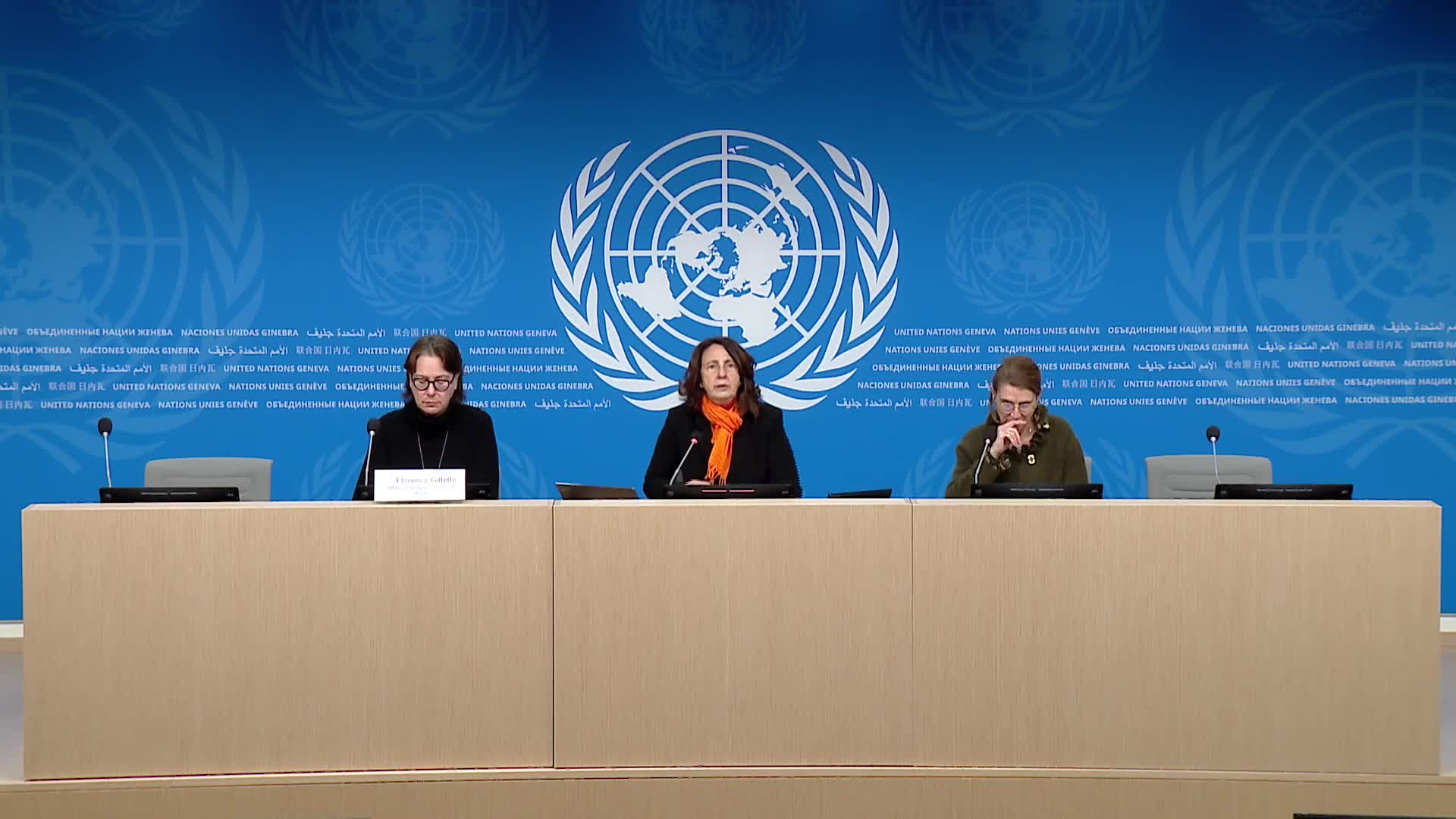
Florence Gillette, Head of the International Committee of the Red Cross (ICRC) delegation in South Sudan, said that she had witnessed a situation that was continually degrading in the country. Seven out of ten States had experienced hostilities, with an increased use of aerial means – aircraft and barrel bombs, incendiary bombs, gunships and drones. Hostilities on the ground had killed and injured many, having also displaced close to half a million people. In addition, some 1,2 million people had fled the conflict in Sudan and were now living in South Sudan in dire conditions.
There had been an alarming number of wounded individuals. Nearly 1,000 weapon-wounded patients had been treated in ICRC-supported hospitals in South Sudan in 2025 so far – the highest number recorded since 2018. In 2025, more than 3,700 people had received physical rehabilitation services at ICRC-supported centres; in the past eight years, the ICRC had conducted more than 25,000 surgeries on 5,000 persons wounded by weapons.
Health facilities in South Sudan had suffered a drastic reduction as they were highly dependent on international assistance and struggled to get enough funding from their government. It was still a major challenge for any child or woman to receive healthcare. The humanitarian situation was worsening, with about 57 percent of the population facing food insecurity.
The situation was particularly concerning at a time when the immense humanitarian needs in South Sudan were not being met. This was further exacerbated by the fact that funding continued to decline, donor interest having decreased in recent years.
Answering questions from journalists, Ms. Gillette explained that the aerial weapons used in the conflict most likely came from private companies. They were not very sophisticated but created challenges for the population and for humanitarian actors. Humanitarian actors could still fly, contrary to what happened in Sudan, for instance, but ICRC needed to coordinate with the armed forces to be able to fly to certain areas, collect wounded, and deploy its teams.
ICRC had witnessed a very drastic reduction of human assistance in the last three years, with worse to come. Already there was less and less support to victims of sexual violence. The downsizing of the United Nations Mission in South Sudan (UNMISS) would also affect the humanitarian assistance and the protection of civilians, Ms. Gillette warned.
Concerns over Myanmar's Upcoming Elections
Jeremy Laurence, for the Office of the High Commissioner for Human Rights (OHCHR), noted that on 28 December 2025, people in Myanmar would start voting in an election imposed by the junta. This military-controlled ballot would be conducted in an atmosphere rife with threats and violence, putting the lives of civilians at risk, and in an environment in which the military was actively suppressing participation: many major political parties were excluded and over 30,000 of the military’s political opponents – including members of the democratically elected government and political representatives – had been detained since 2021.
Far from being a process that could spear-head a political transition from crisis to stability and the restoration of democratic, civilian rule, UN Human Rights Chief Volker Türk said this process seemed nearly certain to further ingrain insecurity, fear and polarization throughout the country. The utmost priority must be to end the violence and ensure the flow of humanitarian aid.
The High Commissioner had also urged the United States to reconsider its plan to end its Temporary Protected Status, or TPS program, with respect to Myanmar.
James Rodehaver, Head of OHCHR’s team in Myanmar, speaking from Bangkok, described the concerns about holding a vote in the present environment in Myanmar. First, the military claimed that they had issued some 4,000 pardons to dissidents who had been charged or convicted of sedition or incitement. In fact, the military had already issued announcements of pardons in past, but rarely did the numbers released by the military match those who had been allowed to leave prison, particularly political detainees. At the same time, the military were boasting of over a hundred persons it claimed to have arrested under its newly imposed “election protection rules”. For instance, OHCHR had credible information that three young people had been condemned to 49 years in prison for having hung up posters depicting a ballot box with a bullet.
Second, the military itself, which was a party to the conflict, had been suppressing its population for years. Now the military was being heavy-handed in encouraging voting; at the same time, its armed opposition was being very aggressive in discouraging voting. It was a very fraught process where civilians were caught in the middle. Finally, there were concerns with the electronic-only voting system itself, considering that the military had introduced a wide range of electronic surveillance throughout the country utilizing AI and biometric tracking.
Answering questions, Mr. Rodehaver said that one of the biggest problems in this crisis was access for humanitarians on the ground. The Myanmar military had, for several years, a strategy of denying humanitarian access in areas impacted by the conflict. In the context of the elections, constraints were, in some ways, intensifying. Civilians were being forced to return to their villages to vote, even it meant returning in complete insecurity.
Mr. Rodehaver explained that 30,000 persons had been arbitrarily arrested since February 2021; almost 23,000 remained in detention who should not have been arrested in the first place. 4,000 individuals had been convicted of incitement or sedition; of these, some 550 had been seen leaving detention centres, while others had been freed only to be arrested again upon leaving their prison.
The military felt they were winning and their messaging reflected that: “this is just a normal election in line with a crisis that is ending”. However, in early October, the Secretary-General had warned that under the current circumstances, any elections “risked further exclusion and instability”, Mr. Rodehaver noted.
Pakistan: Concerns about Constitutional Amendments and Immunity Provision
Jeremy Laurence, for the OHCHR, quoted the Human Rights Chief, Mr. Volker Türk, according to whom the latest amendment in Pakistan’s Constitution, like the 26th amendment last year, “run counter to the separation of powers that underpin the rule of law and safeguard the protection of human rights in Pakistan (…) The systems for appointment, promotion and transfer of judges have been changed in a manner raising serious concerns about undermining the structural independence of Pakistan’s judiciary (…)”. Also, “the amendment establishes lifetime immunity from criminal proceedings and arrest for the President, Field Marshall, Marshall of the Air Force and Admiral of the Fleet. (…) These amendments risk far-reaching consequences for the principles of democracy and rule of law which the Pakistani people hold dear,” Mr. Türk had remarked.
Jenin, West Bank, Killings Incident
Jeremy Laurence, for the OHCHR, said the Office was appalled at the brazen killing by Israeli border police, on 27 November, of two Palestinian men in Jenin, in the occupied West Bank, in an apparent summary execution. Following the incident, which had been caught on film by a TV channel, an internal review had been announced: but there were serious concerns about the credibility of any future review or investigation conducted by any entity that was not fully independent from the Government. The Office had verified that between 7 October 2023 and 27 November 2025, Israeli forces and settlers had killed 1,030 Palestinians in the occupied West Bank, including East Jerusalem, with 223 children among them.
Impunity for Israel security forces, unlawful use of force and ever-growing Israeli settler violence must end. In this regard, Mr. Türk had called for an independent and effective investigation into the killings of Palestinians, and for those responsible for violations to be held to account.
Answering questions, Mr. Laurence stressed that such brutal use of force was abhorrent and that all cases should be dealt with by the rule of law and due process. Violence in the West Bank was on the rise, Mr. Laurence also remarked that in November 2025 alone, 21 Palestinians had been killed by Israeli forces.
Other Matters
Jeremy Laurence, for the OHCHR, said the Office had not received any details, and therefore could not make a judgment call, about the latest Israeli military incursion into Syria. The Office had created a mission there and was following closely the violence which continued to take place. Since the fall of the Assad regime, the Office had regularly raised issues with respect to Syria but also had expressed a modicum of hope for the country.
Questions were raised regarding the UN’s reaction to US President Trump’s comments on halting immigration from “third-world countries”. Mr. Laurence, for OHCHR, reminded that all States had human rights obligations, and people fleeing countries were entitled to protection and due process. Eujin Byun, for the UN Refugee Agency (UNHCR), said UNHCR acknowledged the country's right to protect its borders. She stressed that when people who needed protection arrived in a country, they had a right to due process regarding asylum. In the US current situation, the overwhelming majority of the refugees and asylum seekers were law-abiding members of their host community and wanted to make a positive contribution to society.
Announcements
Catherine Huissoud, for UN Trade and Development (UNCTAD), said UNCTAD would present its Trade and Development Report 2025, entitled On the Brink – Trade, finance and the reshaping of the global economy [advance preview] on Tuesday 2 December, with an embargo until 6:30 p.m., Geneva time. The presentation would be made by UNCTAD Secretary-General Rebeca Grynspan at the University College London, to be followed by a Q&A with Professor Mariana Mazzucato. Registration required.
Alessandra Vellucci, for the United Nations Information Service, said that the 22nd Meeting of States Parties to the Convention on the prohibition of the use, stockpiling, production, and transfer of anti-personnel mines and on their destruction would take place from 1 to 5 December 2025 at the Palais des Nations. On this occasion, the United Nations Mine Action Service (UNMAS) would organise a briefing for journalists on “Protecting people from mines and other explosive ordnance in complex settings” on Wednesday, 3 December, at 11 a.m. Speakers would be representatives of UNMAS in Afghanistan, Sudan, Nigeria and the occupied Palestinian territory.
During the same Meeting, UNMAS would touch on the UN Secretary-General’s campaign on Humanitarian Disarmament and Mine Action, which was launched on 16 June “to uphold the norms of humanitarian disarmament and accelerate mine action to advance human rights and sustainable development”. Also scheduled were a public exhibition in the Salle des Pas Perdus (during the week); and an event on “Challenges and Implications for South Sudan of Sustaining Article Five Progress in the Global Funding Crisis” on Monday, 1 December, 1 p.m.
On a related note, on Monday, 1 December, 9:30 a.m., the UN Institute for Disarmament Research (UNIDIR) would present its Landmine Monitor 2025 report. Speakers would be the four authors of the report.
Regarding human rights treaty body meetings, the Committee Against Torture (CAT), on closing its 83rd session this morning, would issue concluding observations on the reports of the four countries reviewed during the session: Israel, Argentina, Bahrain and Albania (documentation here). On Thursday, 4 December, the Committee on the Elimination of Racial Discrimination (CERD) would hold a public, day-long celebration of the 60th anniversary of the International Convention on the Elimination of All Forms of Racial Discrimination. The Committee on the Protection of the Rights of all Migrant Workers and Members of their Families (CMW) would open next Monday morning its 41st session, during which it would review the reports of Mauritania, Indonesia and Honduras (1-11 December, Palais Wilson).
A special meeting in observance of the International Day of Solidarity with the Palestinian People would be held this afternoon at the Palais des Nations, at 3 p.m., in Room XII. Statements would be made by the UNOG Director-General Tatiana Valovaya, among others.
The World Trade Organization (WTO) and the World Bank would convene a high-level Trade in Services for Development Conference on 3–4 December at WTO headquarters in Geneva (Room CR). (Registration and programme here; contact: Ivy Zhang (ivy.zhang@wto.org)).
Mrs. Vellucci reminded that the UN High Commissioner for Human Rights’ end-of-year press conference would take place on Wednesday 10 December at 10:30 a.m. (not on 4 December as previously mentioned); and that the last UNOG press briefing of 2025 would be held on 19 December, with briefings then resuming on 6 January 2026.
Finally, Ms. Vellucci said that on Sunday, UN Women would participate in a civil society “ceremony of lanterns” at Bains des Pâquis, to remember victims of feminicide.
***
- UNCTAD, Catherine Huissoud - UN Trade and Development - Trade and Development Report 2025 - 2 December at 6:30 pm Geneva Time
- OHCHR, Jeremy Laurencewith James Rodehaver, Head of the Myanmar team - Concerns over Myanmar's upcoming elections
- ICRC, Florence Gillette, Head of delegation in South Sudan - Humanitarian situation in South Sudan
Similar Stories
1
1
1
Press Conferences | UN WOMEN , WFP , WHO
UN WOMEN: Sudan Women and girls one year after the fall of El Fasher; increasing drone attacks across the country; WFP: DRC - Ebola spreads to eighth DRC province as WFP delivers food, builds treatment centres and keeps supplies moving; WHO - Update on Ebola (Bundibugyo Virus Disease)
1
12
1
1
Press Conferences , Images | UNOG
Closing Press Conference following the Sixth Consultative Meeting on Enhancing Coordination of Peace Initiatives and Efforts in Sudan

2
17
1
2
Edited News , Press Conferences , Images | OCHA , WMO
Two UN agencies teamed up on Wednesday to issue an appeal for immediate assistance to help communities already being impacted by the strongest El Niño on record.
1
1
1
Press Conferences | CITES
Wildlife trade and conservation policy discussions at the 81st meeting of the CITES Standing Committee (SC81)
1
1
1
Press Conferences | UNHCR , UNCTAD , WMO , OCHA , UNICEF , WHO
UNHCR Hungary’s 1956 Refugee Crisis: 70 Years On, UNCTAD World Investment Forum 2026, Doha, WMO Greenhouse Gas Bulletin and Climate Update for COP31, OCHA Afghanistan: Malnutrition, Girls’ Education and Recovery, UNICEF Yemen: Child Malnutrition and Unsafe Water in Taiz, WHO Inequalities in Noncommunicable Diseases and Risk Factors
1
1
1
Press Conferences | UNHCR
End of UNHCR's 77th Annual Executive Committee (ExCom) meeting week
1
1
1
Press Conferences | UNICEF , IOM , UNHCR
UN Special Assistant to the Personal Envoy Office (SUDAN): Peace Initiatives and Efforts in Sudan; UNICEF: Dire situation of children in Gaza; IOM: Damaged Homes and Energy Attacks Risk Displacing Ukrainians for this winter; UNHCR: update on EXCOM week
1
1
1
Press Conferences | IOM , UNDRR
UN stresses importance of household preparedness for disaster risk reduction.
1
1
1
Statements , Press Conferences | OHCHR
1
1
1
Press Conferences | UNHCR , UNICEF , IFRC , OHCHR , UN WOMEN , IOM , OCHA , WHO
UNHCR – ExCom Meeting, UNICEF – Nepal Recovery, IFRC – Flash Floods, WHO – Mental Health, IOM – South Sudan Floods, OCHA – DRC Humanitarian aid, UNHCR – Sahel Displacement, UNICEF – Yemen Update, IOM – Gaza Shelter, UN Women – Gaza Women, OHCHR – Arrests and detentions of Syrians by Israeli force
2
1
2
Press Conferences | UNCTAD
Presentation of the Trade and Developement Report 2026
Embargoed until 9 October 2026 at 11 a.m. (Geneva Time)
UNCTAD: UNCTAD’s flagship report finds that governments increasingly use industrial, trade, financial and technology policies to pursue economic and national security objectives. Market access and the ability to move into higher-value activities now depend more heavily on technology, finance and geopolitics.
1
1
1
Press Conferences | UPU
Release of the State of the Postal Sector Report 2026