

The United Nations Office at Geneva
Multimedia Newsroom
UN GENEVA PRESS BRIEFING
18 July 2025
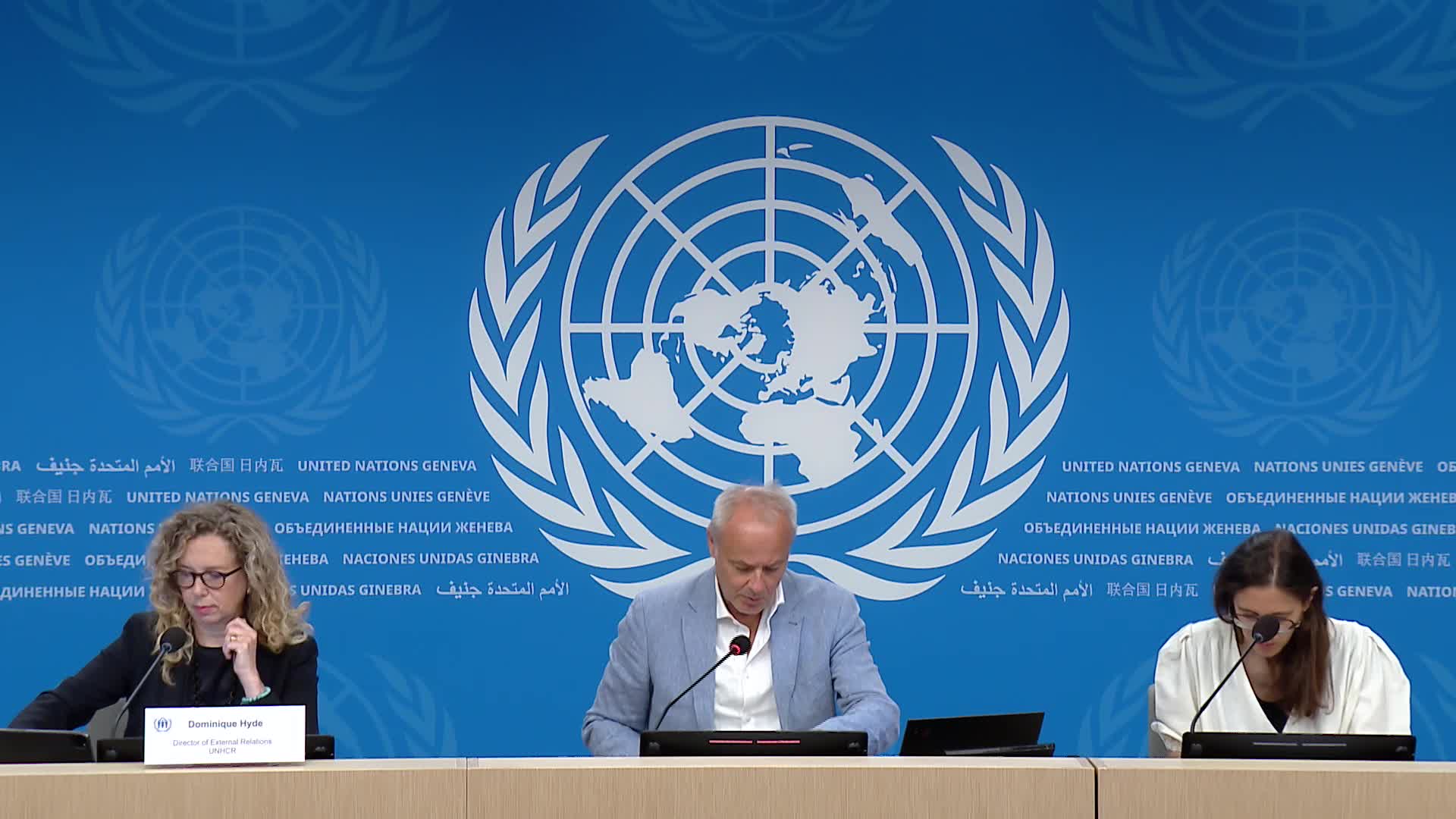
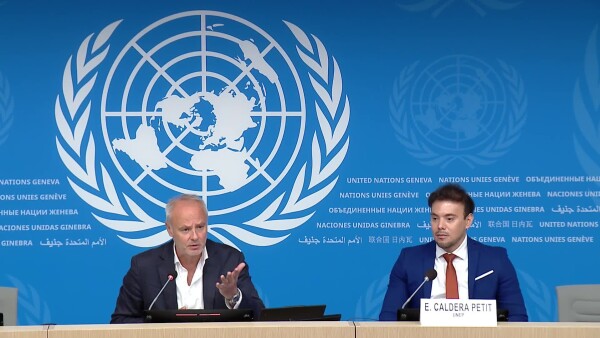
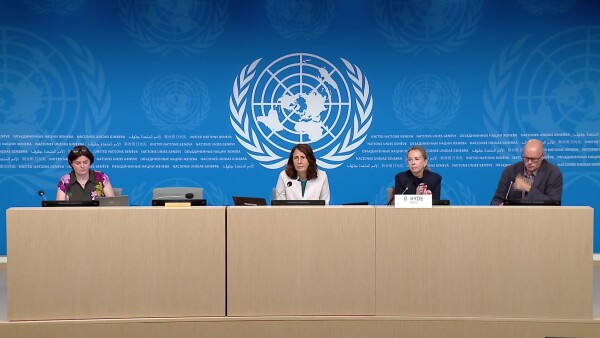
Rolando Gómez of the United Nations Information Service (UNIS) in Geneva, chaired the hybrid briefing, attended by spokespersons and representatives of the United Nations High Commissioner for Refugees and the Office of the High Commissioner for Human Rights.
UN Refugee Agency report on aid cuts
Dominique Hyde, for the United Nations High Commissioner for Refugees (UNHCR), said today UNHCR were releasing a new report, “On the Brink”. Currently, there was a deadly cocktail of increasing forced displacement and financial aid cuts, and UNHCR was extremely concerned for refugee populations around the world who were being impacted. The seven countries highlighted in the report were those that were the most impacted, including countries in South Saharan Africa and Afghanistan, where many had been forced to return home. The funding situation was dramatic; up to 11.6 million refugees and others forced to flee risked losing access to direct humanitarian assistance from UNHCR this year. The cuts had left millions in undignified conditions, at heightened risk of exploitation and abuse, and in situations of uncertainty. UNHCR needed an additional 1.4 billion dollars to allow their regular programmes to continue. Health and education services were at the bare minimum in many countries and there was a 60 percent cut when it came to refugees and relief supplies. UNHCR were concerned about resettlement, involuntary returns of refugees and protection gains which were at risk. One in ten Sudanese refugees arriving in Chad were suffering from severe and acute malnutrition. Malnutrition rates of children under five had exceeded the 15 percent emergency threshold.
Globally, UNHCR had been forced to cut one fourth their gender-based violence support and response programmes. It was important to highlight the impact of these aid cuts on vulnerable women and girls. In South Sudan, 75 percent of safe spaces for women and girls’ survivors of violence had closed. Women and girls in Afghanistan were the hardest hit, with protection activities slashed by 50 percent. UNCHR had established transition services around the world to hand over some work to local partners, however they were often unable to pick up the pieces. Due to the financial situation, UNCHR had to move swiftly and implement reductions in their workforce, in headquarters and regional offices. This limited the reach for the agency in many contexts. For 2025, the agency’s funding requirements were 10.6 billion dollars. At this point in the year, UNHCR had typically reached around 50 percent of funding required, but currently they had only reached around 23 percent. The agency was thankful to all donors who had stood by them, however, governments, institutions and the private sector were urged to step up with flexible funding to meet the immense needs. UNHCR had the systems in place and were able to scale up if the funding came in.
The full notes can be accessed here.
Responding to questions from the media, Ms. Hyde said everyone was aware of the large decrease from the United States, however they remained UNHCR’s largest donor in 2025. France, Sweden, Japan, and the United Arab Emirates had also reduced their contributions. However, there had been increases from the European Union, the African Development Bank, Canada and the Mastercard Foundation, for which UNHCR was very grateful.
Responding to further questions, Ms. Hyde said she could not quantify what the figures meant in terms of deaths. Some children would die from malnutrition and others would be born stunted. Around 800,000 children would not have access to education in the eastern Horn of Africa. It translated into an 80 percent of lack of shelter, increasing exposure to sexual violence. The lack of education meant early marriages would take place. UNCHR was no longer able to stabilize the populations as they no longer had enough support. West Africa, North Africa, the Middle East, Ukraine and Europe were considered “the belt of the crisis”.
Responding to additional questions, Olga Sarrado, for the United Nations High Commissioner for Refugees (UNHCR), said the number of Sudanese refugees arriving in Libya had increased by 170 percent compared to the first six months of 2024. The situation was becoming dire in Sudan, Libya and Chad. Ms. Hyde said it was estimated that around 350,000 Sudanese had arrived in Libya since the start of the year.
Responding to further questions from the media, Ms. Hyde said across the board, around a third of UNHCR staff had been cut at the country office level. The United States had been one of the largest donors when it came to flexible funding for child protection and gender-based violence. Norway and Sweden had now provided additional support in this area. UNHCR was trying to advocate for more funding for women and girls, and for unearmarked funding which could be allocated in this regard.
Humanitarian aid and human rights situation in Suweida, Syria
Responding to questions from the media, Dominique Hyde, for the United Nations High Commissioner for Refugees (UNHCR), said the number of people displaced from Suweida, Syria, had continued to increase since 16 July. UNCHR was one of the only agencies with an office in rural Suweida but they had to relocate to a safer place. The agency stood ready to mobilise with emergency supplies.
William Spindler, for the United Nations High Commissioner for Refugees (UNHCR), said the situation in Suweida was very concerning. It was difficult for UNHCR to operate there, as capacities were limited, and he called on all parties to allow humanitarian access. UNHCR had items such as blankets jerry cans, and solar lamps in stock and were ready to deliver as soon as the security situation allowed. Water shortages were also a major concern, while road closures were also restricting access to the affected areas. A Syrian Red Crescent warehouse had been damaged by shelling. UNHCR called on all parties to the conflict to respect and protect humanitarian assets in accordance with international law.
Rolando Gómez, for the United Nations Information Service (UNIS), said statements had been shared with the media from the Secretary-General and the Special Envoy for Syria, who both expressed alarm over the continuing escalation of violence.
Mr. Spindler said UNHCR’s office in Suweida had 18 staff, and 15 people had been on the ground at the start of hostilities. UNCHR had not been able to relocate them all, but all staff, and their families were well accounted for. Civilian, government and humanitarian infrastructure had been damaged. The situation continued to escalate, meaning it was difficult to operate, but UNCHR were ready to resume their response when the situation permitted.
Ravina Shamdasani, for the Office of the High Commissioner for Human Rights (OHCHR), read a statement from UN Human Rights Chief Volker Türk, who said Syria’s interim authorities must ensure accountability and justice for the killings and other gross human rights violations and abuses in the southern city of Suweida, repeating his call for a new Syria that worked for all its people, equal in dignity and without discrimination.
Credible reports received by the UN Human Rights Office indicated widespread violations and abuses, including summary executions and arbitrary killings, kidnappings, destruction of private property and looting of homes. Among the reported perpetrators were members of the security forces and individuals affiliated with the interim authorities, as well as other armed elements from the area, including Druze and Bedouins. This had led to a mass displacement of the population in the predominantly Druze governorate. In one incident, on 15 July, the UN Human Rights Office documented the unlawful killing of at least 13 people when armed individuals affiliated with the interim authorities deliberately opened fire at a family gathering. On the same day, they reportedly summarily executed six men near their homes in two separate incidents. In all, hundreds had been reportedly killed since 12 July.
UN High Commissioner for Human Rights, Volker Türk, called for a thorough, urgent and independent vetting process to ensure that those responsible for human rights violations and abuses were not integrated into Syria’s official security or military structures. He also called on the Syrian interim authorities to publish the results of the national fact-finding committee’s investigations into the violence in coastal areas earlier this year.
The full statement can be accessed here.
Responding to questions from the media, Ms. Shamdasani said the death toll in Suweida was reported to have been in the hundreds, but it was very difficult to verify exact numbers. The information had come from primary sources including families and those on the ground. There were also electricity cuts which further hampered efforts.
Answering additional questions, Ms. Shamdasani said there was a lot of misinformation and disinformation out there, which was being used to inflame tensions. Many videos were circulating of fighters in the area, which OHCHR was attempting to verify. The National Fact-Finding Committee had concluded its work and submitted their report. OHCHR was in touch with the Committee and encouraged the authorities to publish their findings, as transparency was key. Ms. Shamdasani said some suspects had been captured but there was no further news on prosecution.
Surge in returns to Afghanistan creating multiple human rights crises
Ravina Shamdasani, for the Office of the High Commissioner for Human Rights (OHCHR), said the surge in the number of Afghans forced or compelled to return to Afghanistan this year was creating a multi-layered human rights crisis requiring the urgent attention of the international community. Many had been either directly forced to return by States where they were residing, and others had felt compelled to do so because of threats, harassment and intimidation. UN High Commissioner for Human Rights Volker Türk called for an immediate halt to the forcible return of all Afghan refugees and asylum-seekers, particularly those at risk of persecution, arbitrary detention, or torture upon their return.
In just over seven months, over 1.9 million Afghans had returned from Iran and Pakistan to Afghanistan. From Iran alone, over 1.5 million have arrived since the start of the year. Of these, 938,000 or 60 percent were deported, including 500,000 since 13 June. Sending people back to a country in which they were at risk of persecution, torture, cruel, inhuman or degrading treatment or punishment or other irreparable harm, violates the core international law principle of non-refoulement. Deportations in violation of these basic rules must stop immediately.
The UN Human Rights Chief implored States to do everything in their power to help those who had already endured decades of warfare, poverty and hardship, as well as extreme discrimination and threats. The UN Human Rights Office and the UN Assistance Mission in Afghanistan would be publishing a report next week on the risks faced by those forcibly returned to Afghanistan.
The full statement can be viewed here.
Responding to questions from the media, regarding 13 Afghans who had committed crimes and were being sent back from Germany, Ms. Shamdasani said people should not be sent back to Afghanistan. The UN High Commissioner had called for an immediate halt to forcible returns from Afghanistan, especially those who may face reprisals. There was also the humanitarian situation; 70 percent of Afghanistan lived in poverty. If people feared persecution upon being returned to a country they should not be returned, in line with the principle of nonrefoulment.
Responding to additional questions, Ms. Shamdasani said people should not be returned to a country where they were likely to face human rights violations and situations of extreme poverty, in line with the principle of non-refoulement. There needed to be support from the international community and pressure to address what was going on there, to end these violations.
Babar Baloch, for the United Nations High Commissioner for Refugees (UNHCR), said the volumes of returnees from Afghanistan were putting a huge strain on the humanitarian situation in the country. UNCHR had not seen this number of returnees in such a short time, with no mechanism in place to support them. The last time this had been seen was in early 2002 when Afghans were choosing to return. There needed to be international support and solidarity. Since mid-June the number had been increasing; there had been 50,000 returned in one day on 4 July alone. As numbers increased it was becoming increasingly difficult to provide support.
UN Human Rights Office to open new mission in Bangladesh
Ravina Shamdasani, for the Office of the High Commissioner for Human Rights (OHCHR), said this week, the UN Human Rights Office and the Government of Bangladesh had signed a three-year Memorandum of Understanding to open a mission in the country to support the promotion and protection of human rights. Since last August, the UN Human Rights Office’s engagement with Bangladesh had significantly increased. The Office had been working with various stakeholders in advancing human rights reforms and conducting a comprehensive fact-finding inquiry into deadly repression of mass protests. The new mission would offer training and technical assistance to the authorities across a range of areas, towards meeting the country’s national and international human rights commitments, as well as undertake capacity-building for government institutions and civil society actors.
The full summary can be viewed here.
Gaza
Responding to a question from the media on the number of people killed while trying to access food aid in Gaza, Ravina Shamdasani, for the Office of the High Commissioner for Human Rights (OHCHR), said the most recent figure was from 13 July which was 875 people killed. OHCHR were continuing to document and try to corroborate information.
Decision of the US Justice Department
Responding to a question from the media about the one-day prison sentence for the officer responsible for the death of Briana Taylor, Ravina Shamdasani, for the Office of the High Commissioner for Human Rights (OHCHR), said this was an ongoing judicial process, making it difficult to comment. Generally, OHCHR had documented systematic abuses against people of African descent in many countries including the United States. There was an accountability gap; justice needed to be served.
Rolando Gómez, for the United Nations Information Service (UNIS), recalled the work of the Expert Working Group created by the Human Rights Council responsible for advancing racial justice and equality in the context of law enforcement globally.
Announcements
Rolando Gómez, for the United Nations Information Service (UNIS), said a press transcript had been shared following a meeting convened by the Secretary-General yesterday with Greek Cypriot and Turkish Cypriot leaders in New York, which had been proposed at the March talks on the Cyprus issue, in Geneva. Progress had been noted in four of the six initiatives agreed on.
The Secretary-General would deliver his climate address, “A Moment of Opportunity”, on Tuesday 22 July, at 3 pm Geneva time, 9 am New York time. The Secretary-General will address the need to transition from fossil fuels to renewable energy. A background briefing would be held on Monday 21 July at 3:30pm.
Mr. Gómez said the Human Rights Committee concluded its 144th session yesterday. There would be no human rights treaty body meeting until 11 August, when the Committee on the Rights of Persons with Disabilities was set to open its 39th session.
The third and last part of the 2025 session of the Conference on Disarmament would officially begin on 28 July.
The Secretary-General had appointed Guang Cong of China as his Special Envoy for the Horn of Africa. The Secretary-General had also appointed a 21-person independent scientific panel on the effects of nuclear war. Details on both appointments had been shared in notes to the media.
Today was Nelson Mandela Day and the Secretary-General had issued a message to mark the occasion, noting how Mandela’s life of service continued to inspire the UN’s own efforts as the organization celebrated its 80th anniversary.
***
The webcast for this briefing is available here
The audio for this briefing is available here- UNHCR Olga Sarrado with Dominique Hyde, UNHCR Director of External Relations
- The devastating toll of aid cuts on people forced to flee
- The devastating toll of aid cuts on people forced to flee
- OHCHR Ravina Shamdasani
-
- Afghanistan - Surge in returns to Afghanistan creating multiple human rights crises
- Syria - Türk calls for immediate steps to ensure protection of people in Suweida and across Syria
- Bangladesh - UN Human Rights Office to open mission in Bangladesh
Similar Stories
1
1
1
Press Conferences | CITES
Wildlife trade and conservation policy discussions at the 81st meeting of the CITES Standing Committee (SC81)
1
1
1
Press Conferences | UNHCR , UNCTAD , WMO , OCHA , UNICEF , WHO
UNHCR Hungary’s 1956 Refugee Crisis: 70 Years On, UNCTAD World Investment Forum 2026, Doha, WMO Greenhouse Gas Bulletin and Climate Update for COP31, OCHA Afghanistan: Malnutrition, Girls’ Education and Recovery, UNICEF Yemen: Child Malnutrition and Unsafe Water in Taiz, WHO Inequalities in Noncommunicable Diseases and Risk Factors

1
1
1
Press Conferences | UNHCR
End of UNHCR's 77th Annual Executive Committee (ExCom) meeting week

1
1
1
Press Conferences | UNICEF , IOM , UNHCR
UN Special Assistant to the Personal Envoy Office (SUDAN): Peace Initiatives and Efforts in Sudan; UNICEF: Dire situation of children in Gaza; IOM: Damaged Homes and Energy Attacks Risk Displacing Ukrainians for this winter; UNHCR: update on EXCOM week

1
1
1
Press Conferences | IOM , UNDRR
UN stresses importance of household preparedness for disaster risk reduction.
1
1
1
Statements , Press Conferences | OHCHR
1
1
1
Press Conferences | UNHCR , UNICEF , IFRC , OHCHR , UN WOMEN , IOM , OCHA , WHO
UNHCR – ExCom Meeting, UNICEF – Nepal Recovery, IFRC – Flash Floods, WHO – Mental Health, IOM – South Sudan Floods, OCHA – DRC Humanitarian aid, UNHCR – Sahel Displacement, UNICEF – Yemen Update, IOM – Gaza Shelter, UN Women – Gaza Women, OHCHR – Arrests and detentions of Syrians by Israeli force
2
1
2
Press Conferences | UNCTAD
Presentation of the Trade and Developement Report 2026
Embargoed until 9 October 2026 at 11 a.m. (Geneva Time)
UNCTAD: UNCTAD’s flagship report finds that governments increasingly use industrial, trade, financial and technology policies to pursue economic and national security objectives. Market access and the ability to move into higher-value activities now depend more heavily on technology, finance and geopolitics.
1
1
1
Press Conferences | UPU
Release of the State of the Postal Sector Report 2026
1
1
1
Press Conferences | IOM , ITU , UNECE , UNICEF , WHO , WMO
UNICEF: Ebola, DRC - children orphans or separating them from parents and caregivers; IOM: Humanitarian needs in Djibouti amid arrivals from Yemen and increased migrant movements; WHO: Darfur, scale of health needs far exceeds available resources; WMO co-sponsored Global Heat Forum, Bangkok, monthly Global Seasonal Climate Update; UNECE: UN Forum of Mayors; ITU Plenipotentiary Conference 2026; WHO: child and adolescent obesity guidelines and new global roadmap to tackle pregnancy hypertension, a leading cause of maternal mortality
1
1
1
Press Conferences | OCHA , UN WOMEN , UNHCR , WFP , WHO , WTO , UNEP
OCHA – $160M CERF allocation to 12 underfunded crises; UNHCR – 5.8M refugee children remain out of school amid funding cuts; UN Women – Middle East escalation and food security among women/girls; WHO – Gaza supplies and overall situation; WFP – Yemen food insecurity and impact on global hunger ; UNEP - First International Conference of the Global Framework on Chemicals in Geneva | 16-20 November 2026
1
1
1
Press Conferences | UNHCR , WHO
Yemen's health system nears collapse amid conflict, causing rising casualties and medicine shortages.