

The United Nations Office at Geneva
Multimedia Newsroom
Edited News | OHCHR , UNOG
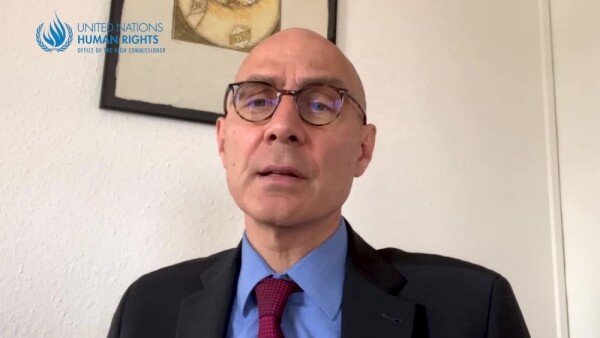
“I strongly condemn this wanton violence, in which both sides have trampled international humanitarian law”, says UN human rights chief Volker Türk at opening of Council’s Emergency Session on Sudan
“I strongly condemn this wanton violence, in which both sides have trampled international humanitarian law,” said UN human rights chief Volker Türk at the opening of Council’s Special Session on Sudan.
The UN human rights chief urged countries with influence in Africa to help end the fighting in Sudan and called on Sudanese combatants to agree to peace talks and the protection of civilians, as he addressed the Geneva-based forum.
“It is essential that both parties urgently commit to an inclusive political process and to a negotiated peace,” said Mr. Türk. “The ongoing talks in Jeddah, which focus on creating a ceasefire, need to be complemented by commitments to establish a humanitarian truce, to enable life-saving deliveries of aid; to allow for safe passage for civilians from areas of hostilities; and to protect humanitarian supplies from looting,” the High Commissioner said, adding that “it is also crucial that discussions expand to respecting international humanitarian law, protecting civilians and bringing an end to human rights violations.”
The special session on "the human rights impact of the ongoing conflict in the Sudan" comes after fighting erupted in Sudan’s capital Khartoum on 15 April between the Sudanese Armed Forces (SAF), the national military, and the paramilitary Rapid Support Forces (RSF). The conflict has since spread throughout the country after weeks of growing tension between the SAF and RSF during negotiations surrounding a new transitional government and security force reforms.
To date, more than 600 people have been killed in the fighting, more than 150,000 have fled Sudan, and over 700,000 have become internally displaced.
Mr. Türk, who said that the warring sides had ignored principles of distinction, proportionality and precaution that provide protection to non-combatants, as per the Geneva Conventions, added that the Sudanese military had launched attacks in densely occupied civilian areas, including airstrikes. “Last week one airstrike reportedly hit the vicinity of a hospital in the East Nile area of Khartoum, killing several civilians,” the UN human rights chief continued. “The RSF, meanwhile, has allegedly taken over numerous buildings in Khartoum to use as operational bases, evicting residents and launching attacks from densely inhabited urban areas.”
The Council was expected to take action on a resolution tabled by the United Kingdom, Norway, the United States, and Germany that echoes the common call for all parties to the conflict to immediately cease hostilities, adhere to a ceasefire and return to the transition process. It also highlighted the urgent need to protect civilians and humanitarian workers, as well as to ensure accountability for human rights violations.
"We urge the immediate initiation of independent and impartial investigations into the loss of civilian lives, injuries sustained by individuals, and cases of ill treatment and other gross human rights violations inflicted upon humanitarian personnel, health care workers, human rights defenders, journalists as well as attacks on civilian infrastructure,” said Tlaleng Mofokeng, Chair of the Coordination Committee of Special Procedures and Special Rapporteur on the right to health.
Speaking on behalf of the country concerned, Hassan Hami Hassan, Permanent Representative of Sudan to the United Nations Office at Geneva, pointed out that the holding of the special session had not received the support of any African nor Arab state.
He said that “what is happening in Sudan is an internal affair and what the Sudanese armed forces is doing is a constitutional duty as for all armies in the world, I repeat what the Sudanese armed forces is doing is a constitutional duty as for all armies in the world.”
Mr Hassan added that “what is needed is to give the space and time for the regional efforts taking place at the moment and not to override them or influence them in a negative way.”
The resolution reiterated its firm support for the ongoing efforts by national, regional and international actors, including the United Nations, the African Union, and the Inter-Governmental Authority on Development (IGAD) to facilitate a ceasefire and end the fighting.
“Human rights also apply in times of conflict, and International Humanitarian Law must be respected,” said Katharina Stasch, Permanent Representative of Germany to the United Nations Office at Geneva. “This is why, together with the core group we have called for this special session. The high number of states supporting today’s session proves one thing: the international community is steadfast in its support of the people of Sudan and their struggle for freedom, peace and justice.”
A joint statement issued today by UN independent rights experts pointed out that civilians of all ages are victims of sexual assault and gender-based violence, amid looting and shortages of food, water, healthcare. The experts were alarmed about hospitals that have been attacked and local and international humanitarian personnel who have been the victims of what appears to be both targeted and indiscriminate attacks.
“This is the moment to send a clear message to the parties of the conflict that the world is watching and expects them to deliver for the people of Sudan,” said Michèle Taylor, Permanent Representative of the United States of America to the United Nations Office at Geneva. “Parties of the conflict need to ensure safe humanitarian access and the protection of civilians. And here at the HRC (Human Rights Council) we have a duty to help make that more likely.”
-ends-
STORY: Special Session Sudan – Human Rights Council
TRT: 03’42”
SOURCE: UNTV CH
LANGUAGE: ENGLISH/NATS
ASPECT RATIO: 16:9
RELEASE DATE: 11 May 2023
GENEVA, SWITZERLAND
SHOTLIST
- Exterior wide shot: UN flag alley UN Geneva.
- Wide shot of Room XX, Palais des Nations, Geneva
- SOUNDBITE (ENGLISH) Volker Türk, United Nations High Commissioner for Human Rights: “It is essential that both parties urgently commit to an inclusive political process and to a negotiated peace. The ongoing talks in Jeddah, which focus on creating a ceasefire, need to be complemented by commitments to establish a humanitarian truce, to enable life-saving deliveries of aid; to allow for safe passage for civilians from areas of hostilities; and to protect humanitarian supplies from looting. It is also crucial that discussions expand to respecting international humanitarian law, protecting civilians and bringing an end to human rights violations.”
- Wide shot of screens, Room XX, Palais des Nations
- SOUNDBITE (ENGLISH) Volker Türk, United Nations High Commissioner for Human Rights: “I strongly condemn this wanton violence, in which both sides have trampled international humanitarian law, notably the principles of distinction, proportionality and precaution. The Sudanese military has launched attacks in densely occupied civilian areas, including airstrikes. Last week one airstrike reportedly hit the vicinity of a hospital in the East Nile area of Khartoum, killing several civilians. The RSF, meanwhile, has allegedly taken over numerous buildings in Khartoum to use as operational bases, evicting residents and launching attacks from densely inhabited urban areas.”
- Wide shot: cameras, technicians
- SOUNDBITE (ENGLISH) Tlaleng Mofokeng, Chair of the Coordination Committee of Special Procedures: "We urge the immediate initiation of independent and impartial investigations into the loss of civilian lives, injuries sustained by individuals, and cases of ill treatment and other gross human rights violations inflicted upon humanitarian personnel, health care workers, human rights defenders, journalists as well as attacks on civilian infrastructure.”
- Medium shot: speakers, screen in the background, Room XX, Palais des Nations
- SOUNDBITE (ARABIC) Hassan Hami Hassan, Permanent Representative of Sudan to the United Nations Office at Geneva: “What is happening in Sudan is an internal affair and what the Sudanese armed forces is doing is a constitutional duty as for all armies in the world, I repeat what the Sudanese armed forces is doing is a constitutional duty as for all armies in the world. We thank this Council for his interest and his close follow up of the unfortunate events happening in Sudan.”
- Medium shot: Special Session on Sudan, Human Rights Council (HRC), Room XX, Palais des Nations
- SOUNDBITE (ARABIC) Hassan Hami Hassan, Permanent Representative of Sudan to the United Nations Office at Geneva: “What is needed is to give the space and time for the regional efforts taking place at the moment and not to override them or influence them in a negative way.”
- Medium shot: speaker on screen, ceiling of Room XX during HRC’s Special Session on Sudan
- SOUNDBITE (ENGLISH) Katharina Stasch, Permanent Representative of Germany to the United Nations Office at Geneva: “Human Rights also apply in times of conflict, and International Humanitarian Law must be respected. This is why, together with the core group we have called for this special session. The high number of states supporting today’s session proves one thing: the international community is steadfast in its support of the people of Sudan and their struggle for freedom, peace and justice.“
- Wide shot: Human Rights room, Palais des Nations, Geneva
- SOUNDBITE (ENGLISH) Michèle Taylor, Permanent Representative of the United States of America to the United Nations Office at Geneva: “This is the moment to send a clear message to the parties of the conflict that the world is watching and expects them to deliver for the people of Sudan. Parties of the conflict need to ensure safe humanitarian access and the protection of civilians. And here at the HRC we have a duty to help make that more likely.”
- Medium angle shot: screen showing speaker
- Close-up: representatives in the room
- Medium shot: Room XX, Palais des Nations, Geneva
- Medium shot: Room XX, Palais des Nations, Geneva
- Medium shot: panel
Similar Stories

1
1
1
Edited News | UNICEF
A little over one year since a ceasefire agreement was announced between Hamas fighters and Israel, more than 340 children have been reported killed and hundreds more injured, the UN Children’s Fund, UNICEF, said on Friday.

1
1
1
Edited News | UNICEF , IFRC
Six weeks after Nepal’s deadly flooding disaster, communities are still struggling to rebuild their lives, but they will need sustained help as global warming increases the risk of another Himalayan catastrophe, the UN Children’s Fund (UNICEF) said on Friday.

1
1
1
Edited News | WHO
In suspected Russia plague death, testing and monitoring underway – WHO
The death of a lab worker in Russia’s Siberia region has sparked concerns about plague being the cause, the UN World Health Organization (WHO) said on Tuesday, adding that it was following the situation closely.

1
1
Edited News | OHCHR , UNOG
UN Human Rights Chief Volker Türk on Friday provided and oral update to the 63rd session of the Human rights Council on Ukraine.

1
1
1
Edited News | OHCHR , UNOG
UN Human Rights Chief Volker Türk on Friday provided and oral update to the 63rd session of the Human rights Council on the human rights situation in Haiti.

1
1
1
Edited News | WHO
Repeated delays in bringing lifesaving medicines, prosthetics and more from Israel into Gaza risk having devastating consequences on Palestinians who urgently need them in the wartorn enclave, the UN World Health Organization (WHO) said on Friday. “A truck full of non-priority supplies or the right supplies arriving too late, doesn't save lives. That's the question that actually matters," said Dr Reinhilde Van De Weerdt, WHO Representative in the OPT.

1
1
1
Edited News | WHO
DRC: Early access to care and oxygen decisive for Ebola patients’ survival – WHO
In the Democratic Republic of the Congo (DRC), health workers fighting the country’s largest-ever Ebola outbreak are struggling to overcome critical challenges to patient care, the UN World Health Organization (WHO) warned on Tuesday.

1
1
1
Edited News | OCHA , UN
Civilians in Iran are continuing to feel the consequences of months of conflict and military escalation, the UN’s top official in the country has said, as loss of life, damage to civilian infrastructure and mounting economic pressures leave many facing continued uncertainty.
1
1
1
Edited News | WHO , UNICEF
Aid agencies in Yemen highlighted the growing hunger emergency sparked by renewed fighting between Houthi opposition forces and Government troops, after mobile health clinics reported that hundreds of children displaced by the violence are suffering from the most deadly form of malnutrition.
1
1
1
Edited News | UNHCR
Displacement on the rise in Yemen as fighting continues - UNHCR
As hostilities worsen in Yemen, more people have been fleeing their homes, further intensifying the humanitarian crisis within the region, the UN Refugee Agency (UNHCR) warned on Tuesday.
1
1
1
Edited News | IOM , OHCHR , UNFPA , UNOG , UNHCR , WHO
Yemen’s humanitarian crisis growing by the hour amid spike in displacement
Yemenis displaced by renewed fighting have described fleeing for their lives amid shelling and gunfire, aid agencies reported on Friday, while highlighting the dramatic increase in humanitarian needs in the country and in Djibouti, where thousands have sought shelter.
1
1
1
Edited News | OHCHR , UNOG
The UN Human Rights Office issued on Friday a report documenting a shocking pattern of sexual violence amid Russia’s full-scale armed attack on Ukraine.