

The United Nations Office at Geneva
Multimedia Newsroom
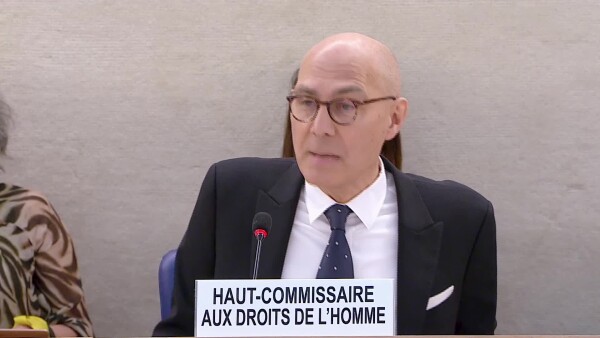
Here is a selection of quotes from his speech:
“I am aware that discussions of complex human rights issues may be difficult or sensitive, for some. Others may feel they are best whispered behind closed doors. Yet, we need to regain the space where we can discuss them in a constructive and open spirit, undisturbed by the tug of geopolitics and bearing in mind that nobody is perfect. In the spur of the moment you may not like what you hear but over time you may appreciate what we had to say. My only consideration, and in fact my duty, is to stay true to the mandate, the normative human rights framework and the imperative of improving people's lives,” he said.
“Contempt for the human being reaches agonizing levels when war breaks out, and violence becomes a daily occurrence. One quarter of humanity is living today in places affected by violent conflict, and it is civilians who suffer the most. Peace is precious and fragile. We must nurture it. First and foremost, by respecting the Charter of the United Nations and international law, including international human rights law,” Türk said.
“Discrimination and racism are virulent threats, both to human dignity and to our relationships as human beings. They weaponize contempt. They humiliate and violate human rights, fuelling grievances and despair, and obstructing development,” he said.
“I am shocked to the core by the contempt for women, and women's equality, that is spawned across the Internet by some so-called “influencers,” feeding social attitudes that make it possible to ignore, or even condone, gender-based violence, and the pervasive commodification of women,” the UN Human Rights Chief said.
“More generally, the scope and magnitude of discrimination against women and girls makes this one of the most overwhelming human rights violations worldwide, and dismantling it will be a major focus of our work,” he said.
“Vicious hate speech is directed not only at women and girls, but also people of African descent; Jews; Muslims; LGBTIQ+ people; refugees; migrants; and many other people from minority groups. Deliberate provocations, such as recent incidents of burning the Qu'ran, are intended to drive wedges between communities. This is deeply dangerous,” he said.
“The violence that is so disproportionately inflicted on people of African descent by law enforcement officers is an example of the deep structural harm rooted in racial discrimination,” Türk said.
“To face these challenges of structural injustice and inequalities, we need to build economies that build trust in government and advance people’s rights and well-being. A human rights economy is one in which the aim of advancing human rights informs all national economic, fiscal, monetary, investment and business decisions,” he stressed.
“Harsh restriction of the civic space is the Achilles heel – the fatal weakness – of governance. If I have one message to deliver to every Head of State or Government it is this: listen to the people – and in particular, to victims and defenders, the people who have the deepest experience of issues. They have something to say that you need to hear,” Türk said.
“Transparent governance is critical, to repair harms and build resilience. Climate finance funds need to reach those most affected and most vulnerable, building in strong human rights safeguards,” Türk said.
“In every country, I strongly encourage the following. Public access to information on environmental risks and Government policies. Full participation and consultation on environmental laws and measures, notably for indigenous peoples and others who are first in line for climate harms. And protection of those who raise concerns over environmental crimes or policies that result in harm,” he said.
“Bashing climate protests; designing laws that unfairly restrict activities that call the public's attention to climate harms; and allowing attacks on activists to go unpunished: these are tactics that harm all States and all human beings. This needs to be addressed urgently,” Türk said.
“Conflict, discrimination, poverty, restrictions on civic space and the triple planetary crisis. We face the continued and compounding effects of these crises – while also confronting a surge of new human rights challenges, notably in the digital realm and involving artificial intelligence and surveillance. Fresh thinking, political leadership, renewed commitments, and dramatically scaled-up financing — with the centrality of human rights at their core — are urgently needed to meet these challenges,” the High Commissioner said in conclusion.
For more information and media requests, please contact:
Ravina Shamdasani - + 41 22 917 9169 / ravina.shamdasani@un.org or
Liz Throssell + 41 22 917 9296 / elizabeth.throssell@un.org or
Jeremy Laurence + +41 22 917 9383 / jeremy.laurence@un.org or
Marta Hurtado - + 41 22 917 9466 / marta.hurtadogomez@un.org
Tag and share
Twitter @UNHumanRights
Facebook unitednationshumanrights
Instagram @unitednationshumanrights
Tag and share - Twitter: @UNHumanRights and Facebook: unitednationshumanrights
- SOUNDBITE (English)—Volker Türk, UN High Commissioner for Human Rights (OHCHR): “I am aware that discussions of complex human rights issues may be difficult or sensitive, for some. Others may feel they are best whispered behind closed doors. Yet, we need to regain the space where we can discuss them in a constructive and open spirit, undisturbed by the tug of geopolitics and bearing in mind that nobody is perfect. In the spur of the moment you may not like what you hear but over time you may appreciate what we had to say. My only consideration, and in fact my duty, is to stay true to the mandate, the normative human rights framework and the imperative of improving people's lives,”
- Cut aways: Room 20
- SOUNDBITE (English)—Volker Türk, UN High Commissioner for Human Rights (OHCHR): “Contempt for the human being reaches agonizing levels when war breaks out, and violence becomes a daily occurrence. One quarter of humanity is living today in places affected by violent conflict, and it is civilians who suffer the most. Peace is precious and fragile. We must nurture it. First and foremost, by respecting the Charter of the United Nations and international law, including international human rights law,”
- Cut aways: Room 20
- SOUNDBITE (English)—Volker Türk, UN High Commissioner for Human Rights (OHCHR): “Discrimination and racism are virulent threats, both to human dignity and to our relationships as human beings. They weaponize contempt. They humiliate and violate human rights, fuelling grievances and despair, and obstructing development,”
- Cut aways: Room 20
- SOUNDBITE (English)—Volker Türk, UN High Commissioner for Human Rights (OHCHR): “I am shocked to the core by the contempt for women, and women's equality, that is spawned across the Internet by some so-called “influencers,” feeding social attitudes that make it possible to ignore, or even condone, gender-based violence, and the pervasive commodification of women,”
- Cut aways: Room 20
- SOUNDBITE (English)—Volker Türk, UN High Commissioner for Human Rights (OHCHR): “More generally, the scope and magnitude of discrimination against women and girls makes this one of the most overwhelming human rights violations worldwide, and dismantling it will be a major focus of our work,”
- Cut aways: Room 20
- SOUNDBITE (English)—Volker Türk, UN High Commissioner for Human Rights (OHCHR): “Vicious hate speech is directed not only at women and girls, but also people of African descent; Jews; Muslims; LGBTIQ+ people; refugees; migrants; and many other people from minority groups. Deliberate provocations, such as recent incidents of burning the Qu'ran, are intended to drive wedges between communities. This is deeply dangerous,”
- Cut aways: Room 20
- SOUNDBITE (English)—Volker Türk, UN High Commissioner for Human Rights (OHCHR): “The violence that is so disproportionately inflicted on people of African descent by law enforcement officers is an example of the deep structural harm rooted in racial discrimination,”
- Cut aways: Room 20
- SOUNDBITE (English)—Volker Türk, UN High Commissioner for Human Rights (OHCHR): “To face these challenges of structural injustice and inequalities, we need to build economies that build trust in government and advance people’s rights and well-being. A human rights economy is one in which the aim of advancing human rights informs all national economic, fiscal, monetary, investment and business decisions,”
- Cut aways: Room 20
- SOUNDBITE (English)—Volker Türk, UN High Commissioner for Human Rights (OHCHR): “Harsh restriction of the civic space is the Achilles heel – the fatal weakness – of governance. If I have one message to deliver to every Head of State or Government it is this: listen to the people – and in particular, to victims and defenders, the people who have the deepest experience of issues. They have something to say that you need to hear,”
- Cut aways: Room 20
- SOUNDBITE (English)—Volker Türk, UN High Commissioner for Human Rights (OHCHR): “ Transparent governance is critical, to repair harms and build resilience. Climate finance funds need to reach those most affected and most vulnerable, building in strong human rights safeguards,”
- Cut aways: Room 20
- SOUNDBITE (English)—Volker Türk, UN High Commissioner for Human Rights (OHCHR): “In every country, I strongly encourage the following. Public access to information on environmental risks and Government policies. Full participation and consultation on environmental laws and measures, notably for indigenous peoples and others who are first in line for climate harms. And protection of those who raise concerns over environmental crimes or policies that result in harm,”
- Cut aways: Room 20
- SOUNDBITE (English)—Volker Türk, UN High Commissioner for Human Rights (OHCHR): “Bashing climate protests; designing laws that unfairly restrict activities that call the public's attention to climate harms; and allowing attacks on activists to go unpunished: these are tactics that harm all States and all human beings. This needs to be addressed urgently,”
- Cut aways: Room 20
- SOUNDBITE (English)—Volker Türk, UN High Commissioner for Human Rights (OHCHR): “Conflict, discrimination, poverty, restrictions on civic space and the triple planetary crisis. We face the continued and compounding effects of these crises – while also confronting a surge of new human rights challenges, notably in the digital realm and involving artificial intelligence and surveillance. Fresh thinking, political leadership, renewed commitments, and dramatically scaled-up financing — with the centrality of human rights at their core — are urgently needed to meet these challenges,”
Similar Stories

1
1
1
Edited News | UNICEF , WHO , UNHCR
Yemen war continues to force families from homes amid hunger and disease
More than 250,000 people have now fled renewed fighting in Yemen, the UN said on Tuesday, citing particular concern for those sheltering in the southwestern city of Taiz and the wider governorate, where access is “essentially blocked”.

1
1
1
Edited News | UNICEF
A little over one year since a ceasefire agreement was announced between Hamas fighters and Israel, more than 340 children have been reported killed and hundreds more injured, the UN Children’s Fund, UNICEF, said on Friday.

1
1
1
Edited News | UNICEF , IFRC
Six weeks after Nepal’s deadly flooding disaster, communities are still struggling to rebuild their lives, but they will need sustained help as global warming increases the risk of another Himalayan catastrophe, the UN Children’s Fund (UNICEF) said on Friday.

1
1
1
Edited News | WHO
In suspected Russia plague death, testing and monitoring underway – WHO
The death of a lab worker in Russia’s Siberia region has sparked concerns about plague being the cause, the UN World Health Organization (WHO) said on Tuesday, adding that it was following the situation closely.

1
1
Edited News | OHCHR , UNOG
UN Human Rights Chief Volker Türk on Friday provided and oral update to the 63rd session of the Human rights Council on Ukraine.

1
1
1
Edited News | OHCHR , UNOG
UN Human Rights Chief Volker Türk on Friday provided and oral update to the 63rd session of the Human rights Council on the human rights situation in Haiti.

1
1
1
Edited News | WHO
Repeated delays in bringing lifesaving medicines, prosthetics and more from Israel into Gaza risk having devastating consequences on Palestinians who urgently need them in the wartorn enclave, the UN World Health Organization (WHO) said on Friday. “A truck full of non-priority supplies or the right supplies arriving too late, doesn't save lives. That's the question that actually matters," said Dr Reinhilde Van De Weerdt, WHO Representative in the OPT.

1
1
1
Edited News | WHO
DRC: Early access to care and oxygen decisive for Ebola patients’ survival – WHO
In the Democratic Republic of the Congo (DRC), health workers fighting the country’s largest-ever Ebola outbreak are struggling to overcome critical challenges to patient care, the UN World Health Organization (WHO) warned on Tuesday.

1
1
1
Edited News | OCHA , UN
Civilians in Iran are continuing to feel the consequences of months of conflict and military escalation, the UN’s top official in the country has said, as loss of life, damage to civilian infrastructure and mounting economic pressures leave many facing continued uncertainty.

1
1
1
Edited News | WHO , UNICEF
Aid agencies in Yemen highlighted the growing hunger emergency sparked by renewed fighting between Houthi opposition forces and Government troops, after mobile health clinics reported that hundreds of children displaced by the violence are suffering from the most deadly form of malnutrition.
1
1
1
Edited News | UNHCR
Displacement on the rise in Yemen as fighting continues - UNHCR
As hostilities worsen in Yemen, more people have been fleeing their homes, further intensifying the humanitarian crisis within the region, the UN Refugee Agency (UNHCR) warned on Tuesday.
1
1
1
Edited News | IOM , OHCHR , UNFPA , UNOG , UNHCR , WHO
Yemen’s humanitarian crisis growing by the hour amid spike in displacement
Yemenis displaced by renewed fighting have described fleeing for their lives amid shelling and gunfire, aid agencies reported on Friday, while highlighting the dramatic increase in humanitarian needs in the country and in Djibouti, where thousands have sought shelter.