

The United Nations Office at Geneva
Multimedia Newsroom
Gaza: Rafah attack horror heightens focus on lack of health resources
UN agencies reiterated their call for urgent ceasefire and humanitarian access following the devastating Israeli air strikes on Sunday that hit a camp for displaced Palestinians in Rafah. The Hamas-run Ministry of Health reported 35 killed, including women and children.
Many of the injured suffered terrible burns according to the World Health Organization (WHO) which will require intensive treatment, electricity and high-level medical services, all of which are scarce in the Gaza Strip.
It is just another massive challenge for all the medical teams in the enclave, said Dr. Margaret Harris, spokesperson for the UN health agency. “This is one of the hardest things for a doctor or nurse as you want to help, but you don't have what it takes. You are watching people who shouldn't die, die in front of you because you simply either lack the tools, the skills, or the supplies to do what needs to be done,” she told journalists in Geneva.
The incursion in Rafah displaced medical staff while essential fuel stocks continue to run low as the UN humanitarian relief operation has been all but shut down in the latest escalation that began three weeks ago, sparked by a deadly Hamas rocket attack on Kerem Shalom border crossing. The UN health agency confirmed three WHO supply trucks managed to cross the Kerem Shalom border since the Rafah incursion began, but 60 are stuck in Egypt owing to the closure of the border.
The estimated fuel requirement is 200,000 litres per day and the UN health agency has been able to access approximately 70,000 litres per day at best but some days absolutely none, according to Dr. Harris. “All the hospitals are really struggling and making decisions about what they can do,” she added.
Fuel is critical to run hospital generators but it is also much needed for bakeries to provide food and run water desalination plants which have received only 10 per cent of the fuel they need in the past week, according to the UN Children’s Fund, UNICEF.
The dire conditions mean that medical staff are not able to carry out the surgery needed to save a limb. “Decisions are having to be made by doctors to remove a limb to save a life and again, that's a horrible, horrible decision to have to take,” insisted Dr. Harris.
Many children who suffered single or double amputations are sitting in tents in Rafah with immense psychological stress echoed James Elder, spokesperson for the United Nations Children’s Fund, UNICEF. “What do we say of those countless children who've had arms and legs amputated? Or the thousands who have been orphaned? And what is the language used to describe the unprecedented devastation to homes and schools, to the uncharted territory of trauma of children? I think then surely the question that needs to be asked is, ‘How many more mistakes is the world going to tolerate?’” he warned.
About one million people have fled Rafah since the increasingly intense Israeli military incursion began. Humanitarian agencies now fear further displacement following Sunday’s deadly raid on a UN agency for Palestinian refugees (UNRWA) site in northwest Rafah that has been widely condemned, while Israeli tanks incursions have been reported in central Rafah.
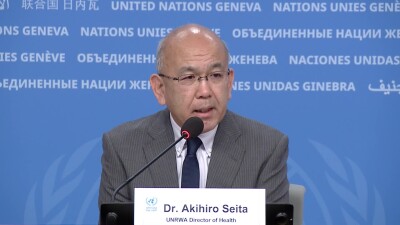
Meanwhile, the flow of aid into Gaza has shrunk so much in May that humanitarian officials warn the threat of widespread starvation is more acute than ever. On top of this, the ongoing lack of clean water and sanitation has also triggered a very high rate of “acute respiratory infections, diarrhoea, including bloody diarrhea, as well as the hepatitis A”, explained Dr. Akihiro Seita, UNRWA Director of Health. “What we need now is ceasefire. We continue to do whatever we can do, but without ceasefire, without peace on the ground, peace in mind, we continue to suffer, and I'm sorry to say that the people in Gaza may continue to suffer,” he told journalists in Geneva.
ends
Story: “Gaza update – WHO, UNICEF, UNRWA” – 28 May 2024
Speakers:
· Margaret Harris, WHO spokesperson
· James Elder, UNICEF spokesperson
· Dr. Akihiro Seita, UNRWA Director of Health
TRT: 02’37”
SOURCE: UNTV CH
LANGUAGE: ENGLISH
ASPECT RATIO: 16:9
DATELINE: 28 May 2024 - GENEVA, SWITZERLAND
Geneva Press briefing
SHOTLIST
- Exterior medium shot: UN flag alley
- Wide shot of the podium with speakers in the press conference room
- SOUNDBITE (English) Margaret Harris, WHO spokesperson: “It's an enormous struggle for all the medical teams to meet the needs. And this is one of the hardest things for a doctor or nurse. You know you want to help, but you don't have what it takes, and you are watching people who shouldn't die, die in front of you because you simply either lack the tools, the skills, or the supplies to do what needs to be done.”
- Wide shot: speakers at podium from behind and journalists in the room
- SOUNDBITE (English) Margaret Harris, WHO spokesperson: “Fuel is particularly critical, as you know, the estimated requirement is 200,000 liters per day. And we have been able to get in approximately 70,000 liters per day at best, some days, none. So, that's an approximation over what's been able to get in. So, all the hospitals are really struggling and making decisions about what they can do.”
- Medium shot: speakers at podium from behind and journalists in the room
- SOUNDBITE (English) Margaret Harris, WHO spokesperson: “It's not simply the bombs, it's the lack of infection prevention and control, the lack of being able to provide the level of surgery that could save a limb. Decisions are having to be made by doctors to remove a limb, to save a life, and again, that's a horrible, horrible decision to have to take.”
- Cutaway: wide shot of journalists in press conference room
- SOUNDBITE (English) James Elder, UNICEF spokesperson: “What do we say of those countless children who've had arms and legs amputated? Or the thousands who have been orphaned? And what is the language used to describe the unprecedented devastation to homes and schools, to the uncharted territory of trauma of children? I think then, surely, the question that needs to be asked is ‘how many more mistakes is the world going to tolerate?’”
- Wide shot of press conference room with journalists and control room
- SOUNDBITE (English) Dr. Akihiro Seita, UNRWA Director of Health: “We treat everybody and the health condition is dire because of the lack of goods to wash, water and sanitation, that we have a very high rate of other acute respiratory infections, diarrhea, including bloody diarrhea, as well as the hepatitis A, this remains too high.”
- Cutaway: wide shot speakers at podium from behind and journalists in the room
- SOUNDBITE (English) Dr. Akihiro Seita, UNRWA Director of Health: “What we need now is ceasefire. We continue to do whatever we can do, but without ceasefire, without peace on the ground, peace in mind, we continue to suffer, and I'm sorry to say that the people in Gaza may continue to suffer. So, ceasefire is highly requested.”
- Various shots of the press conference room
Similar Stories

2
17
1
2
Edited News , Press Conferences | OCHA , WMO
Two UN agencies teamed up on Wednesday to issue an appeal for immediate assistance to help communities already being impacted by the strongest El Niño on record.
3
16
2
2
B-roll , Conferences , Edited News | UNITED NATIONS , UNOG
Sixth Consultative Meeting on Enhancing Coordination of Peace Initiatives and Efforts for Sudan

1
1
1
Edited News | UNICEF , WHO , UNHCR
Yemen war continues to force families from homes amid hunger and disease
More than 250,000 people have now fled renewed fighting in Yemen, the UN said on Tuesday, citing particular concern for those sheltering in the southwestern city of Taiz and the wider governorate, where access is “essentially blocked”.

1
1
1
Edited News | UNICEF
A little over one year since a ceasefire agreement was announced between Hamas fighters and Israel, more than 340 children have been reported killed and hundreds more injured, the UN Children’s Fund, UNICEF, said on Friday.

1
1
1
Edited News | UNICEF , IFRC
Six weeks after Nepal’s deadly flooding disaster, communities are still struggling to rebuild their lives, but they will need sustained help as global warming increases the risk of another Himalayan catastrophe, the UN Children’s Fund (UNICEF) said on Friday.

1
1
1
Edited News | WHO
In suspected Russia plague death, testing and monitoring underway – WHO
The death of a lab worker in Russia’s Siberia region has sparked concerns about plague being the cause, the UN World Health Organization (WHO) said on Tuesday, adding that it was following the situation closely.

1
1
Edited News | OHCHR , UNOG
UN Human Rights Chief Volker Türk on Friday provided and oral update to the 63rd session of the Human rights Council on Ukraine.

1
1
1
Edited News | OHCHR , UNOG
UN Human Rights Chief Volker Türk on Friday provided and oral update to the 63rd session of the Human rights Council on the human rights situation in Haiti.

1
1
1
Edited News | WHO
Repeated delays in bringing lifesaving medicines, prosthetics and more from Israel into Gaza risk having devastating consequences on Palestinians who urgently need them in the wartorn enclave, the UN World Health Organization (WHO) said on Friday. “A truck full of non-priority supplies or the right supplies arriving too late, doesn't save lives. That's the question that actually matters," said Dr Reinhilde Van De Weerdt, WHO Representative in the OPT.

1
1
1
Edited News | WHO
DRC: Early access to care and oxygen decisive for Ebola patients’ survival – WHO
In the Democratic Republic of the Congo (DRC), health workers fighting the country’s largest-ever Ebola outbreak are struggling to overcome critical challenges to patient care, the UN World Health Organization (WHO) warned on Tuesday.

1
1
1
Edited News | OCHA , UN
Civilians in Iran are continuing to feel the consequences of months of conflict and military escalation, the UN’s top official in the country has said, as loss of life, damage to civilian infrastructure and mounting economic pressures leave many facing continued uncertainty.
1
1
1
Edited News | WHO , UNICEF
Aid agencies in Yemen highlighted the growing hunger emergency sparked by renewed fighting between Houthi opposition forces and Government troops, after mobile health clinics reported that hundreds of children displaced by the violence are suffering from the most deadly form of malnutrition.