

The United Nations Office at Geneva
Multimedia Newsroom
“I met a little boy who was wounded by a tank shell at one of these sites on the final day of me leaving Gaza - I learnt that this little boy had since died of those injuries,” said UN Children’s Fund (UNICEF) spokesperson James Elder. “That speaks to both what is happening at these sites and what is not happening when it comes to medical evacuations.”
A recent online video featuring a dying 13-year-old Abed al-Rahman who Mr. Elder met while on mission in Gaza has been seen thousands of times since it was published on 6 June. In the clip, Abed explains that he has been asking for pain relief for his shrapnel wounds but none is available.
Speaking to journalists from Amman, Mr. Elder explained that partly destroyed hospitals including Nasser Medical Complex in Khan Younis continue to treat wounded children, despite a shortage of medicine and medical supplies.
“Humanitarian aid is so much more than food in a box; it's oxygen kits, it's ventilators, it's hygiene packs; it's medicines, it's incubators. It's all those things the United Nations was doing just a couple of months ago.”
Mr. Elder added that parents whose children need oxygen have been leaving hospital “because of the fear that Nasser may come under attack again. As the doctors told me, if you have a child who needs oxygen and they leave without the oxygen, they will, over a matter of time, die in a tent.”
The dire shortage of the most basic life-sustaining aid linked to Israeli restrictions continues to create desperation and starvation across Gaza.
“I spoke to a grandmother in tears saying, how am I possibly to get to these sites?” Mr. Elder explained. “I've met young men who've been seven times and never returned with anything. So, there's a complete lack of equity. There's a complete lack of sites. You cannot distribute aid in a militarized zone, in a combat zone, by one party to the conflict.”
Those most susceptible to the lack of fresh drinking water, food and fuel are the weakest Gazans: the young, pregnant women, the elderly and amputees, Mr. Elder said. It would be impossible for them to walk the long distances required to fetch scant supplies from controversial non-UN aid hubs.
“You have half a million people facing starvation with a lethal choice of being forced into very small pockets where most people can't access into what are officially known as combat sites,” the UNICEF spokesperson explained. “We know children [who have been] killed at these sites.”
Meanwhile, malnutrition and the impact of it on people’s weakened immune systems continues to take its toll, the UN World Health Organization (WHO) warned.
“The latest reports say 610 patients have been admitted due to severe malnutrition complications,” said WHO spokesperson Christian Lindmeier. “But what does that mean? That means these are the lucky ones who made it so far to get to a place. This does not count the many who were too weak to reach any point, who are too weak, who cannot be transported because the roads are blocked, because there are no ambulances, or because the hospitals, some of the health emergency centres have been shelled and bombed and are being constantly shelled and bombed.”
ends
STORY: Gaza update – UNICEF, WHO
TRT: 3’06”
SOURCE: UNTV CH
RESTRICTIONS: NONE
LANGUAGE: ENGLISH/ NATS
ASPECT RATIO: 16:9
DATELINE: 20 JUNE 2025 GENEVA, SWITZERLAND and various from Gaza – see shotlist for details.
Speakers
- James Elder, spokesperson, UNICEF (from Amman)
- Christian Lindmeier, spokesperson, WHO
SHOTLIST
- Exterior wide shot, Palais des Nations, flag alley.
- Wide shot, podium speakers.
- SOUNDBITE (English) – James Elder, UNICEF: “You have half a million people facing starvation with a lethal choice of being forced into very small pockets where most people can't access into what are officially known as combat sites. I have met children - we know children - killed at these sites.”
- Medium, podium speakers, TV screen showing external speaker.
- SOUNDBITE (English) – James Elder, UNICEF: “I met a little boy who was wounded by a tank shell at one of these sites on the final day of me leaving Gaza. I learnt that this little boy had since died of those injuries. That speaks to both what is happening at these sites and what is not happening when it comes to medical evacuations.”
- Medium, journalist.
- SOUNDBITE (English) – James Elder, UNICEF: “I spoke to a grandmother in tears saying, how am I possibly to get to these sites? It's the same people all the time that get them; it's the same people, it's the people with knives. I've met young men who've been seven times and never returned with anything. So, there's a complete lack of equity. There's a complete lack of sites. You cannot distribute aid in a militarized zone, in a combat zone, by one party to the conflict.”
- Medium, journalists.
- SOUNDBITE (English) – James Elder, UNICEF: “Of course, humanitarian aid is so much more than food in a box; it's oxygen kits, it's ventilators, it's hygiene packs; it's medicines, it's incubators. It's all those things the United Nations was doing just a couple of months ago.”
- Medium, journalist typing on laptop.
- SOUNDBITE (English) – James Elder, UNICEF: “Civilians with children who are on oxygen have left because of the fear that Nasser may come under attack again, as the doctors told me, if you have a child who needs oxygen and they leave without the oxygen, they will, over a matter of time, die in a tent.”
- Medium-wide, podium speakers.
- SOUNDBITE (English) – Christian Lindmeier, WHO: “The latest reports say 610 patients have been admitted due to severe malnutrition complications. But what does that mean? That means these are the lucky ones who made it so far to get to a place. This does not count the many who were too weak to reach any point, who are too weak, who cannot be transported because the roads are blocked, because there are no ambulances, or because the hospitals, some of the health emergency centres have been shelled and bombed and are being constantly shelled and bombed.”
- Wide pan, destruction and a still-functioning ICU ward at Nasser Hospital, Khan Younis, Gaza, 14 June 2025.
- Medium-wide, young patient lying in hospital bed, bandaged, 14 June 2025.
- Medium, young patient lying in a bed wearing respirator mask, 14 June 2025.
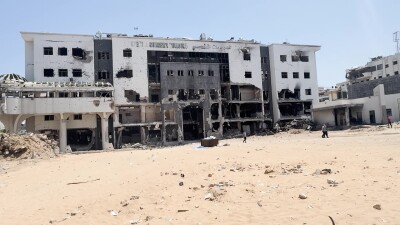
- Wide, destroyed frontage of Al Shifa Hospital, Gaza Strip, 10 June 2025.
- Wide, debris and damaged ambulance vehicle at the hospital compound, 10 June 2025.
- Wide, healthcare workers at Al Sahabah hospital in a neonatal intensive care unit, 11 June 2025.
- Close, infant receiving manual respiration at Al Sahabah hospital in a neonatal intensive care unit, 11 June 2025.
- Wide, UN water trucks at Al Zohor displacement camp, Khan Younis, Gaza, 15 June 2025.
- Medium, girls pour water from a pipe into their jerry cans while other children watch, Al Zohor displacement camp, Khan Younis, Gaza, 15 June 2025.
Similar Stories

2
17
1
2
Edited News , Press Conferences | OCHA , WMO
Two UN agencies teamed up on Wednesday to issue an appeal for immediate assistance to help communities already being impacted by the strongest El Niño on record.

3
16
2
2
B-roll , Conferences , Edited News | UNITED NATIONS , UNOG
Sixth Consultative Meeting on Enhancing Coordination of Peace Initiatives and Efforts for Sudan

1
1
1
Edited News | UNICEF , WHO , UNHCR
Yemen war continues to force families from homes amid hunger and disease
More than 250,000 people have now fled renewed fighting in Yemen, the UN said on Tuesday, citing particular concern for those sheltering in the southwestern city of Taiz and the wider governorate, where access is “essentially blocked”.

1
1
1
Edited News | UNICEF
A little over one year since a ceasefire agreement was announced between Hamas fighters and Israel, more than 340 children have been reported killed and hundreds more injured, the UN Children’s Fund, UNICEF, said on Friday.

1
1
1
Edited News | UNICEF , IFRC
Six weeks after Nepal’s deadly flooding disaster, communities are still struggling to rebuild their lives, but they will need sustained help as global warming increases the risk of another Himalayan catastrophe, the UN Children’s Fund (UNICEF) said on Friday.

1
1
1
Edited News | WHO
In suspected Russia plague death, testing and monitoring underway – WHO
The death of a lab worker in Russia’s Siberia region has sparked concerns about plague being the cause, the UN World Health Organization (WHO) said on Tuesday, adding that it was following the situation closely.

1
1
Edited News | OHCHR , UNOG
UN Human Rights Chief Volker Türk on Friday provided and oral update to the 63rd session of the Human rights Council on Ukraine.

1
1
1
Edited News | OHCHR , UNOG
UN Human Rights Chief Volker Türk on Friday provided and oral update to the 63rd session of the Human rights Council on the human rights situation in Haiti.

1
1
1
Edited News | WHO
Repeated delays in bringing lifesaving medicines, prosthetics and more from Israel into Gaza risk having devastating consequences on Palestinians who urgently need them in the wartorn enclave, the UN World Health Organization (WHO) said on Friday. “A truck full of non-priority supplies or the right supplies arriving too late, doesn't save lives. That's the question that actually matters," said Dr Reinhilde Van De Weerdt, WHO Representative in the OPT.

1
1
1
Edited News | WHO
DRC: Early access to care and oxygen decisive for Ebola patients’ survival – WHO
In the Democratic Republic of the Congo (DRC), health workers fighting the country’s largest-ever Ebola outbreak are struggling to overcome critical challenges to patient care, the UN World Health Organization (WHO) warned on Tuesday.

1
1
1
Edited News | OCHA , UN
Civilians in Iran are continuing to feel the consequences of months of conflict and military escalation, the UN’s top official in the country has said, as loss of life, damage to civilian infrastructure and mounting economic pressures leave many facing continued uncertainty.
1
1
1
Edited News | WHO , UNICEF
Aid agencies in Yemen highlighted the growing hunger emergency sparked by renewed fighting between Houthi opposition forces and Government troops, after mobile health clinics reported that hundreds of children displaced by the violence are suffering from the most deadly form of malnutrition.