

The United Nations Office at Geneva
Multimedia Newsroom
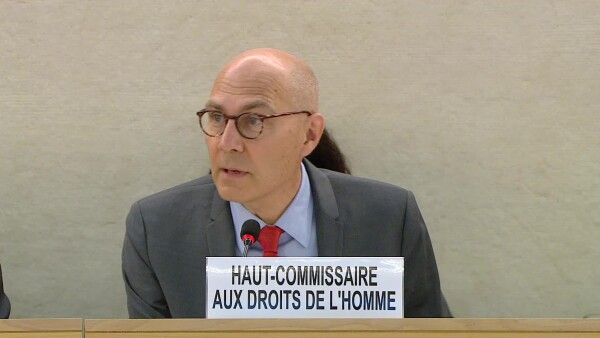
UN Human Rights Chief Volker Türk on Friday said it was imperative for the military in Myanmar to end the violence, allow unhindered humanitarian access, and release all those arbitrarily detained.
He told the UN Human Rights Council that despite several ceasefire announcements following the March earthquake, the military had escalated its attacks, killing more than 500 civilians and injuring more than 1000.
“Instead of increasing access to lifesaving aid, the military doubled down on violence and restricted access even further,” Türk said at the 59th session of the UN Human Rights Council. “In many cases, airstrikes or artillery hit schools, religious sites and other protected locations.”
Since the beginning of the coup in 2021, Myanmar’s military has killed some 6,800 civilians. More than 22,000 people are still detained, and 172 were sentenced to death by military-controlled courts that do not ensure respect for judicial guarantees and fair trial rights.
“In Rakhine State, the situation remains dire, with Rohingya in situations of extreme vulnerability,” the High Commissioner said. “Civilians are caught between the Arakan Army and the military, who act with complete impunity. I am deeply concerned that civilians face a dire humanitarian crisis due to the military’s blocking of widescale humanitarian support across the state.”
Across the country, the humanitarian situation is deteriorating. More than 3.5 million people have been displaced by conflict and nearly 22 million need assistance, while over 45 million people in Myanmar – four out of five – live below or just above the poverty line, according to the UN Human Rights Chief.
“Pursuing accountability and justice will be crucial to a peaceful, inclusive and democratic Myanmar. The conflict is rooted in grave violations of international humanitarian and human rights law - killings, abductions, torture, arbitrary detention - that have largely gone unpunished,” Türk said, adding: “Freeing all political prisoners and bringing all perpetrators of human rights violations to justice are key to reconciliation and the way forward.”
“I again urge the Security Council to refer the situation of Myanmar to the International Criminal Court,” he said.
“It is also crucial to repeal laws that have long discriminated based on race, religion and sex. This would be an important step to ensure the rights of many minorities, including the Rohingya,” stressed the High Commissioner.
“Corruption and cronyism are entrenched; ordinary people are impoverished. People displaced across borders told my Office that they wanted to return to economic opportunities at home,” Türk said. “The way forward will require a radical shift towards an economy that can ensure people’s rights are fulfilled - with investments in education, health, social protection, and inclusive policies on land and administering natural resources.”
The UN Human Rights Chief also repeated his call for an arms embargo, coupled with sanctions consistent with international law – including on jet fuel and dual-use goods – to better protect the people of Myanmar.
“It is imperative for the military immediately to end the violence, allow unhindered humanitarian access, and release all arbitrarily detained people – as demanded, by the way, by Security Council resolution 2669,” he said.
ENDS
For more information and media requests, please contact:
Liz Throssell: +41 22 917 9296 / elizabeth.throssell@un.org
Thameen Al-Kheetan: +41 22 917 4232 / thameen.alkheetan@un.org
Seif Magango: +41 79 752 0488 / seif.magango@un.org
Tag and share - Twitter: @UNHumanRights and Facebook: unitednationshumanrights
STORY: UN High Commissioner for Human Rights Volker Türk updates the Human Rights Council on the situation in Myanmar
TRT: 3’23
SOURCE: OHCHR
RESTRICTIONS: NONE
LANGUAGE: English/NATS
ASPECT RATIO: 16:9
DATELINE: 27 June 2025 – GENEVA, SWITZERLAND
SHOTLIST
- Exterior shot: Palais des Nations.
- Interior shots: Human Rights Council.
- SOUNDBITE (English) — Volker Türk, UN High Commissioner for Human Rights: “Instead of increasing access to lifesaving aid, the military doubled down on violence and restricted access even further. In many cases, airstrikes or artillery hit schools, religious sites and other protected locations.”
- Cutaway: Human Rights Council.
- SOUNDBITE (English) — Volker Türk, UN High Commissioner for Human Rights: “In Rakhine State, the situation remains dire, with Rohingya in situations of extreme vulnerability. Civilians are caught between the Arakan Army and the military, who act with complete impunity. I am deeply concerned that civilians face a dire humanitarian crisis due to the military’s blocking of widescale humanitarian support across the state.”
- Cutaway: Human Rights Council.
- SOUNDBITE (English) — Volker Türk, UN High Commissioner for Human Rights: “Across the country, the humanitarian situation is deteriorating. More than 3.5 million people have been displaced by conflict and nearly 22 million need assistance.”
- Cutaway: Human Rights Council.
- SOUNDBITE (English) — Volker Türk, UN High Commissioner for Human Rights: “Pursuing accountability and justice will be crucial to a peaceful, inclusive and democratic Myanmar. The conflict is rooted in grave violations of international humanitarian and human rights law - killings, abductions, torture, arbitrary detention - that have largely gone unpunished. Freeing all political prisoners and bringing all perpetrators of human rights violations to justice are key to reconciliation and the way forward.”
- Cutaway: Human Rights Council.
- SOUNDBITE (English) — Volker Türk, UN High Commissioner for Human Rights: “I again urge the Security Council to refer the situation of Myanmar to the International Criminal Court.”
- Cutaway: Human Rights Council.
- SOUNDBITE (English) — Volker Türk, UN High Commissioner for Human Rights: “It is also crucial to repeal laws that have long discriminated based on race, religion and sex. This would be an important step to ensure the rights of many minorities, including the Rohingya.”
- Cutaway: Human Rights Council.
- SOUNDBITE (English) — Volker Türk, UN High Commissioner for Human Rights: “Corruption and cronyism are entrenched; ordinary people are impoverished. People displaced across borders told my Office that they wanted to return to economic opportunities at home. The way forward will require a radical shift towards an economy that can ensure people’s rights are fulfilled - with investments in education, health, social protection, and inclusive policies on land and administering natural resources.”
- Cutaway: Human Rights Council.
- SOUNDBITE (English) — Volker Türk, UN High Commissioner for Human Rights: “I repeat my call for an arms embargo, coupled with sanctions consistent with international law – including on jet fuel and dual-use goods – to better protect the people of Myanmar.”
- Cutaway: Human Rights Council.
- SOUNDBITE (English) — Volker Türk, UN High Commissioner for Human Rights: “It is imperative for the military immediately to end the violence, allow unhindered humanitarian access, and release all arbitrarily detained people – as demanded, by the way, by Security Council resolution 2669.”
- Cutaway: Human Rights Council.
Similar Stories

1
1
1
Edited News | UNICEF , IFRC
Six weeks after Nepal’s deadly flooding disaster, communities are still struggling to rebuild their lives, but they will need sustained help as global warming increases the risk of another Himalayan catastrophe, the UN Children’s Fund (UNICEF) said on Friday.
1
1
1
Statements , Press Conferences | OHCHR

1
1
1
Edited News | WHO
In suspected Russia plague death, testing and monitoring underway – WHO
The death of a lab worker in Russia’s Siberia region has sparked concerns about plague being the cause, the UN World Health Organization (WHO) said on Tuesday, adding that it was following the situation closely.

1
1
Edited News | OHCHR , UNOG
UN Human Rights Chief Volker Türk on Friday provided and oral update to the 63rd session of the Human rights Council on Ukraine.
2
1
2
Statements , Conferences | HRC , OHCHR
Interactive dialogue with the High Commissioner for Human Rights, Volker Türk on the oral update on Ukraine.

1
1
1
Edited News | OHCHR , UNOG
UN Human Rights Chief Volker Türk on Friday provided and oral update to the 63rd session of the Human rights Council on the human rights situation in Haiti.

1
1
1
Edited News | WHO
Repeated delays in bringing lifesaving medicines, prosthetics and more from Israel into Gaza risk having devastating consequences on Palestinians who urgently need them in the wartorn enclave, the UN World Health Organization (WHO) said on Friday. “A truck full of non-priority supplies or the right supplies arriving too late, doesn't save lives. That's the question that actually matters," said Dr Reinhilde Van De Weerdt, WHO Representative in the OPT.

1
1
1
Edited News | WHO
DRC: Early access to care and oxygen decisive for Ebola patients’ survival – WHO
In the Democratic Republic of the Congo (DRC), health workers fighting the country’s largest-ever Ebola outbreak are struggling to overcome critical challenges to patient care, the UN World Health Organization (WHO) warned on Tuesday.

1
1
1
Edited News | OCHA , UN
Civilians in Iran are continuing to feel the consequences of months of conflict and military escalation, the UN’s top official in the country has said, as loss of life, damage to civilian infrastructure and mounting economic pressures leave many facing continued uncertainty.
1
1
1
Edited News | WHO , UNICEF
Aid agencies in Yemen highlighted the growing hunger emergency sparked by renewed fighting between Houthi opposition forces and Government troops, after mobile health clinics reported that hundreds of children displaced by the violence are suffering from the most deadly form of malnutrition.
1
1
1
Edited News | UNHCR
Displacement on the rise in Yemen as fighting continues - UNHCR
As hostilities worsen in Yemen, more people have been fleeing their homes, further intensifying the humanitarian crisis within the region, the UN Refugee Agency (UNHCR) warned on Tuesday.
1
1
1
Statements , Conferences | HRC , OHCHR
Interactive dialogue on the oral update of the Independent International Commission of Inquiry on Ukraine at the 63rd regular session of the Human Rights Council