

The United Nations Office at Geneva
Multimedia Newsroom
DR Congo hunger crisis worsening amid fighting and lack of aid funding
The crisis in eastern Democratic Republic of the Congo (DRC) continues to worsen amid ongoing fighting that has driven tens of thousands of people from their homes and created acute hunger, the UN World Food Programme (WFP) said on Friday.
UN aid agencies are struggling in particular in provinces overrun by Rwanda-backed M23 rebel fighters at the start of the year, although dramatic funding shortfalls for humanitarian work have also contributed to the dire situation.
Kigali has consistently denied providing military backing to the group.
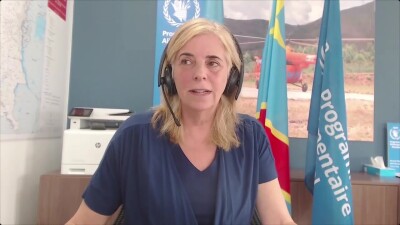
Help could be provided more easily if air access were re-established, WFP insisted, as two airports in M23 areas “have been closed basically since the end of January…we're urgently calling for a humanitarian air corridor, to be established”, said Cynthia Jones, WFP’s Country Director for DRC.
The alert follows the release of a report by UN-backed food insecurity experts at the Integrated Food Security Phase Classification platform (IPC), warning that nearly 25 million people are experiencing high levels of food insecurity, denoted as IPC3 on a scale of one to five, with five indicating famine.
This includes an alarming three million individuals who face “emergency” levels of hunger – IPC4 – a number that is “surging” and which is “almost double since last year”, said Ms. Jones. “This means what for families? It means that they're skipping their meals, depleting all of their household assets. They're selling off their animals,” she said, speaking via video from Kinshasa to journalists in Geneva.
According to the UN agency, “people are already dying of hunger” in parts of eastern DR Congo.
Ms. Jones noted that fighting between M23 members and DRC government forces is continuing, sparking new displacement and people “forced from their home over and over again”.
In eastern DR Congo, this has left about 5.2 million displaced people “including 1.6 million that have been displaced this year alone, making DRC one of the world's largest displaced person crisis”, the WFP official added.
Despite deepening hunger, funding is running out for lifesaving humanitarian work and the UN agency has been forced to reduce the number of people it assists, from around one million at the start of the year, to 600,000 now.
“We will only be able to support a fraction of those in need” moving forward, Ms. Jones said, in an appeal for $350 million to support emergency food and nutrition assistance over the next six months. “Without it, we will have to make further cuts reduce [assistance] even further, down to 300,000 - which is only 10 per cent of the three million in need.”
Without a significant funding boost, the WFP warned of a “total pipeline break” in assistance by March 2026. “That means a complete halt of all emergency food assistance in the eastern provinces.”
The dire funding shortfall has also impacted the agency internally, too. “We're starting to close downtown offices, we're reducing our footprint, the number of staff and juggling how to maintain the operational capacity to deliver in a very complex environment,” Ms. Jones explained.
And yet aid assistance remains vital for those displaced in eastern provinces including North Kivu, South Kivu, Ituri and Tanganyika because vital services have closed amid ongoing insecurity.
“The banks are closed, there's no money available and this has just had a major impact on the population and on the humanitarian response,” Ms. Jones explained. “It has devastated livelihoods and really put the food security of affected people in dire, dire circumstances.”
As the conflict drags on, families seek shelter in urban centres such as Ituri, where host communities are already struggling to cope. Equally worrying is the fact that millions of subsistence farmers forced from their homes or too fearful to access their land have missed the planting season this year.
“The women, children, men, they've just been suffering devastating sequences of the violence, perpetrated by the non-state armed groups and fleeing from conflict. They're tired, exhausted and need peace,” Ms. Jones insisted.
ends
STORY: DR Congo crisis - WFP
TRT: 03 min 35s
SOURCE: UNTV CH
RESTRICTIONS: NONE
LANGUAGE: ENGLISH / NATS
ASPECT RATIO: 16:9
DATELINE: 7 NOVEMBER 2025 GENEVA, SWITZERLAND
Speaker:
- Cynthia Jones, Country Director for DRC, UN World Food Programme (WFP) from Kinshasa
Broll from WFP available here: https://multimedia.wfp.org/Share/25ix1m0364641i54l858u18a42504418
SHOTLIST
- Exterior wide shot, Palais des Nations flag alley, nations’ flags flying.
- Wide shot, podium speaker and remote speaker shown on TV screens, UN Information Service Geneva Press room, Palais des Nations.
- SOUNDBITE (English) — Cynthia Jones, Country Director for DRC, UN World Food Programme (WFP) from Kinshasa: “What we have is the latest food security analysis report by IPC which has been released a few days ago. And it shows that the numbers of people that are facing emergency levels of hunger is surging. It is almost double since last year.”
- Wide shot, podium speaker and remote speaker shown on TV screens.
- 3. SOUNDBITE (English) — Cynthia Jones, Country Director for DRC, UN World Food Programme (WFP) from Kinshasa: “An alarming three million people are in that emergency category. And this means what for families? It means that they're skipping their meals, depleting all of their household assets. They're selling off their animals, their last goat. And as I said, this figure has doubled since the last one since last year, last year's report, so the report a year ago.”
- Wide, TV screens showing remote speaker, journalists in Press room.
- SOUNDBITE (English) — Cynthia Jones, Country Director for DRC, UN World Food Programme (WFP) from Kinshasa: “Two airports in M23 areas have been closed basically since the end of January and we're urgently calling on – calling for - a humanitarian air corridor, to be established.”
- Wide, journalists.
- SOUNDBITE (English) — Cynthia Jones, Country Director for DRC, UN World Food Programme (WFP) from Kinshasa: “New displacement continues as the fighting continues. So, people have been forced from their home over and over again. In the eastern part, there's about 5.2 million displaced people including 1.6 million that have been displaced this year alone, making DRC one of the world's largest displaced person crisis.”
- Wide, Press room, TV journalist, control booth operators.
- SOUNDBITE (English) — Cynthia Jones, Country Director for DRC, UN World Food Programme (WFP) from Kinshasa: “Hunger is deepening and getting worse, funding is running out. And we will only be able to support a fraction of those in need. We have been forced to cut our assistance right here.”
- Wide, journalists, participants, TV screen showing remote speaker.
- SOUNDBITE (English) — Cynthia Jones, Country Director for DRC, UN World Food Programme (WFP) from Kinshasa: “That's how dire the situation is. We're starting to close downtown offices, we're reducing our footprint, the number of staff and juggling how to maintain the operational capacity to deliver in a very complex environment.”
- Medium, journalist working on laptop.
- SOUNDBITE (English) — Cynthia Jones, Country Director for DRC, UN World Food Programme (WFP) from Kinshasa: “The banks are closed, there's no money available and this has just had a major impact on the population and on the humanitarian response. And of course, it has devastated livelihoods and really put the food security of affected people in dire, dire circumstances.”
- Medium, participants.
- SOUNDBITE (English) — Cynthia Jones, Country Director for DRC, UN World Food Programme (WFP) from Kinshasa: “Behind all of these stark statistics, you know, the women, children, men, they've just been suffering devastating sequences of the violence, perpetrated by the non-state armed groups and fleeing from conflict. They're tired, exhausted and need peace.”
- Medium, journalist.
Similar Stories
1
1
1
Edited News | OCHA , UNICEF , WFP
Aid agencies warned on Friday of the fast-developing humanitarian emergency inside Taiz City in Yemen, which has been encircled by de facto Houthi forces fighting government troops along the country’s west coast.

2
17
1
2
Edited News , Press Conferences , Images | OCHA , WMO
Two UN agencies teamed up on Wednesday to issue an appeal for immediate assistance to help communities already being impacted by the strongest El Niño on record.

3
16
2
2
Edited News , B-roll , Conferences , Images | UNITED NATIONS , UNOG
Sixth Consultative Meeting on Enhancing Coordination of Peace Initiatives and Efforts for Sudan

1
1
1
Edited News | UNICEF , WHO , UNHCR
Yemen war continues to force families from homes amid hunger and disease
More than 250,000 people have now fled renewed fighting in Yemen, the UN said on Tuesday, citing particular concern for those sheltering in the southwestern city of Taiz and the wider governorate, where access is “essentially blocked”.

1
1
1
Edited News | UNICEF
A little over one year since a ceasefire agreement was announced between Hamas fighters and Israel, more than 340 children have been reported killed and hundreds more injured, the UN Children’s Fund, UNICEF, said on Friday.

1
1
1
Edited News | UNICEF , IFRC
Six weeks after Nepal’s deadly flooding disaster, communities are still struggling to rebuild their lives, but they will need sustained help as global warming increases the risk of another Himalayan catastrophe, the UN Children’s Fund (UNICEF) said on Friday.

1
1
1
Edited News | WHO
In suspected Russia plague death, testing and monitoring underway – WHO
The death of a lab worker in Russia’s Siberia region has sparked concerns about plague being the cause, the UN World Health Organization (WHO) said on Tuesday, adding that it was following the situation closely.

1
1
Edited News | OHCHR , UNOG
UN Human Rights Chief Volker Türk on Friday provided and oral update to the 63rd session of the Human rights Council on Ukraine.

1
1
1
Edited News | OHCHR , UNOG
UN Human Rights Chief Volker Türk on Friday provided and oral update to the 63rd session of the Human rights Council on the human rights situation in Haiti.

1
1
1
Edited News | WHO
Repeated delays in bringing lifesaving medicines, prosthetics and more from Israel into Gaza risk having devastating consequences on Palestinians who urgently need them in the wartorn enclave, the UN World Health Organization (WHO) said on Friday. “A truck full of non-priority supplies or the right supplies arriving too late, doesn't save lives. That's the question that actually matters," said Dr Reinhilde Van De Weerdt, WHO Representative in the OPT.

1
1
1
Edited News | WHO
DRC: Early access to care and oxygen decisive for Ebola patients’ survival – WHO
In the Democratic Republic of the Congo (DRC), health workers fighting the country’s largest-ever Ebola outbreak are struggling to overcome critical challenges to patient care, the UN World Health Organization (WHO) warned on Tuesday.

1
1
1
Edited News | OCHA , UN
Civilians in Iran are continuing to feel the consequences of months of conflict and military escalation, the UN’s top official in the country has said, as loss of life, damage to civilian infrastructure and mounting economic pressures leave many facing continued uncertainty.