

The United Nations Office at Geneva
Multimedia Newsroom
West Bank settler violence must end with accountability, says UN rights office
The UN human rights office (OHCHR) on Friday called for an end to continuing expansion of Israeli settlements in the occupied West Bank, where “unchecked” settler violence has surged since the war in Gaza began more than two years ago.
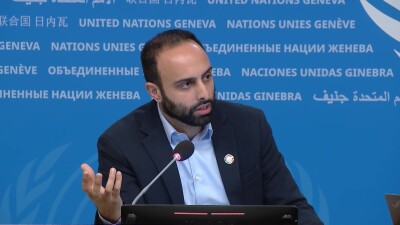
“When it comes to the West Bank, attacks by settlers are continuing,” said Thameen Al-Keetan, OHCHR spokesperson.
Speaking in Geneva, he maintained that since war erupted in Gaza following Hamas-led terror attacks in Israel, “Israeli security forces and settlers killed 1,010 Palestinians in the West Bank, including East Jerusalem. And this figure includes 215 children.”
A new report from the UN human rights office into settlement expansion in the West Bank highlights how new demolition orders impacting longstanding Palestinian communities there threaten more with forced displacement.
This includes Umm Al Khair residents, a community of 35 extended families living there since their expulsion from their lands in Negev during the mass forcible displacement of Palestinians in 1948 to1949, which is known as the Nakba, OHCHR said.
Residents of Umm Al Khair have long faced “discriminatory” land regulations and demolitions imposed by Israel, which regards their housing as illegal because they lack building permits which are “almost impossible” for them to obtain, OHCHR alleged.
According to the UN rights office, Israeli settlers have built new outposts connected to the nearby Carmel settlement and expanded their footprint in the occupied territories. In September, they allegedly erected an outpost in the centre of Umm Al Khair “and intensified harassment” of Palestinian residents to force them to leave.
And although a Jerusalem court issued a temporary injunction stopping construction and barring settlers from entering the outpost, “authorities have taken no action to enforce the court order, in stark contrast to the frequent and swift demolitions of Palestinian structures,” OHCHR maintained.
“The attacks have been increasing and we have seen that recently especially with the olive harvest season. These must stop and there must be accountability,” Mr. Al-Keetan told journalists.
“There must be accountability for settlers and for members of Israeli security forces who are involved in these attacks. And of course, we refer back to the ruling by the International Court of Justice that it's very crucial for the unlawful Israeli presence in the Occupied Palestinian Territory to end.”
Gaza update
In Gaza, as a fragile ceasefire between Hamas fighters and Israel holds, thousands of schoolchildren have reportedly returned to in-person classes, while aid teams continue to push for greater humanitarian access.
“Hundreds of thousands of families face the onset of winter without essential protection from the elements,” said the Office for the Coordination of Humanitarian Affairs (OCHA).
In an update on Friday it highlighted the UN Secretary-General’s warning that the despite improved aid access, “[the UN is] far from [having] what is necessary to eliminate famine quickly and to create the conditions for the people in Gaza to have the very, very minimum that is necessary for dignity in life”.
The UN aid office also noted continuing reports of military activity in the shattered enclave along with “daily detonations” of residential buildings in areas where the Israeli military remains deployed, especially eastern Khan Younis and eastern Gaza City.
Asked about plans for an international stabilization force in Gaza, OHCHR’s Mr. Al-Keetan insisted that any such force “must respect international law and international humanitarian law”. The right to Palestinian self-determination throughout the Occupied Palestinian Territories must also be respected, he continued.
“Whether there is a ceasefire or not, international humanitarian law, and international human rights law must be respected and civilians must be protected and human rights of people – of Palestinians in Gaza - do not change, whether there is a ceasefire or not.”
ends
STORY: Gaza, West Bank comment - OHCHR
TRT: 2 min 54s
SOURCE: UNTV CH
RESTRICTIONS: NONE
LANGUAGE: ENGLISH / NATS
ASPECT RATIO: 16:9
DATELINE: 7 NOVEMBER 2025 GENEVA, SWITZERLAND
Speaker:
- Thameen Al-Keetan, spokesperson, UN human rights office, OHCHR
SHOTLIST
- Exterior wide, Palais des Nations flag alley, nations’ flags flying.
- Wide, podium speakers, UN Information Service Geneva Press room, Palais des Nations.
- SOUNDBITE (English) — Thameen Al-Keetan, spokesperson, UN human rights office, OHCHR: “When it comes to the West Bank, attacks by settlers are continuing, unfortunately. We have verified that since 7 October 2023 as of 5 November 2025, Israeli security forces and settlers killed 1,010 Palestinians in the West Bank, including East Jerusalem. And this figure includes 215 children.”
- Wide, podium speakers.
- SOUNDBITE (English) — Thameen Al-Keetan, spokesperson, UN human rights office, OHCHR:
- “The attacks have been increasing and we have seen that recently especially with the olive harvest season. These must stop and there must be accountability.”
- Medium, podium speaker and remote speaker shown on TV screens.
- SOUNDBITE (English) — Thameen Al-Keetan, spokesperson, UN human rights office, OHCHR: “There must be accountability for settlers and for members of Israeli security forces who are involved in these attacks. And of course, we refer back to the ruling by the International Court of Justice that it's very crucial for the unlawful Israeli presence in the Occupied Palestinian Territory to end.”
- Wide, podium speakers, Press room, journalists, screens.
- SOUNDBITE (English) — Thameen Al-Keetan, spokesperson, UN human rights office, OHCHR: “And the suggested force to stabilize the situation in Gaza; any force that works, operates or will work or operates in the future must respect international law and international humanitarian law.”
- Wide, TV screens showing speaker, journalists in Press room.
- SOUNDBITE (English) — Thameen Al-Keetan, spokesperson, UN human rights office, OHCHR: “Whether there is a ceasefire or not, international humanitarian law, and international human rights law must be respected and civilians must be protected and human rights of people – of Palestinians in Gaza - do not change, whether there is a ceasefire or not.”
- Wide, podium.
- SOUNDBITE (English) — Thameen Al-Keetan, spokesperson, UN human rights office, OHCHR: “It is very important that in any sort of process for the future of Gaza and the whole Occupied Palestinian Territory, that the Palestinian people are involved and that the rights of the Palestinians to self-determination is respected.”
- Medium, journalist.
- Medium, journalist.
- Wide, podium speakers, journalists, TV screens showing speaker.
Similar Stories

2
17
1
2
Edited News , Press Conferences | OCHA , WMO
Two UN agencies teamed up on Wednesday to issue an appeal for immediate assistance to help communities already being impacted by the strongest El Niño on record.

3
16
2
2
B-roll , Conferences , Edited News | UNITED NATIONS , UNOG
Sixth Consultative Meeting on Enhancing Coordination of Peace Initiatives and Efforts for Sudan

1
1
1
Edited News | UNICEF , WHO , UNHCR
Yemen war continues to force families from homes amid hunger and disease
More than 250,000 people have now fled renewed fighting in Yemen, the UN said on Tuesday, citing particular concern for those sheltering in the southwestern city of Taiz and the wider governorate, where access is “essentially blocked”.

1
1
1
Edited News | UNICEF
A little over one year since a ceasefire agreement was announced between Hamas fighters and Israel, more than 340 children have been reported killed and hundreds more injured, the UN Children’s Fund, UNICEF, said on Friday.

1
1
1
Edited News | UNICEF , IFRC
Six weeks after Nepal’s deadly flooding disaster, communities are still struggling to rebuild their lives, but they will need sustained help as global warming increases the risk of another Himalayan catastrophe, the UN Children’s Fund (UNICEF) said on Friday.

1
1
1
Edited News | WHO
In suspected Russia plague death, testing and monitoring underway – WHO
The death of a lab worker in Russia’s Siberia region has sparked concerns about plague being the cause, the UN World Health Organization (WHO) said on Tuesday, adding that it was following the situation closely.

1
1
Edited News | OHCHR , UNOG
UN Human Rights Chief Volker Türk on Friday provided and oral update to the 63rd session of the Human rights Council on Ukraine.

1
1
1
Edited News | OHCHR , UNOG
UN Human Rights Chief Volker Türk on Friday provided and oral update to the 63rd session of the Human rights Council on the human rights situation in Haiti.

1
1
1
Edited News | WHO
Repeated delays in bringing lifesaving medicines, prosthetics and more from Israel into Gaza risk having devastating consequences on Palestinians who urgently need them in the wartorn enclave, the UN World Health Organization (WHO) said on Friday. “A truck full of non-priority supplies or the right supplies arriving too late, doesn't save lives. That's the question that actually matters," said Dr Reinhilde Van De Weerdt, WHO Representative in the OPT.

1
1
1
Edited News | WHO
DRC: Early access to care and oxygen decisive for Ebola patients’ survival – WHO
In the Democratic Republic of the Congo (DRC), health workers fighting the country’s largest-ever Ebola outbreak are struggling to overcome critical challenges to patient care, the UN World Health Organization (WHO) warned on Tuesday.

1
1
1
Edited News | OCHA , UN
Civilians in Iran are continuing to feel the consequences of months of conflict and military escalation, the UN’s top official in the country has said, as loss of life, damage to civilian infrastructure and mounting economic pressures leave many facing continued uncertainty.
1
1
1
Edited News | WHO , UNICEF
Aid agencies in Yemen highlighted the growing hunger emergency sparked by renewed fighting between Houthi opposition forces and Government troops, after mobile health clinics reported that hundreds of children displaced by the violence are suffering from the most deadly form of malnutrition.