

The United Nations Office at Geneva
Multimedia Newsroom
Global foreign direct investment fell by 11%, marking the second consecutive year of decline and confirming a deepening slowdown in productive capital flows, according to the World Investment Report 2025, released today by UN Trade and Development (UNCTAD).
Although global foreign direct investment (FDI) rose by 4% in 2024 to $1.5 trillion the increase is the result of, among other factors, volatile financial conduit flows through several European economies, which often serve as transfer points for investments.
This year’s report comes ahead of the Fourth International Conference on Financing for Development (FFD4), where global leaders will address the widening gap between capital flows and development needs. The findings underscore the urgency of reshaping investment and finance systems to support inclusive and sustainable growth.
Investment dropped sharply across developed economies, particularly in Europe. In developing countries, inflows appeared broadly stable – but this concealed a deeper crisis: in too many economies, capital is stagnating or bypassing entirely the sectors that matter most – infrastructure, energy, technology, and the industries that drive job creation.
Website: https://unctad.org/wir2025
Production date: 19 June 2025
Creator: UNCTAD
Subject topical: ECONOMICS
Corporate name: UN TRADE AND DEVELOPMENT – UNCTAD
DESCRIPTION
STORY: UNCTAD / World Investment Report
TRT: 02:58
SOURCE: UNCTAD
RESTRICTIONS: NONE
LANGUAGE: ENGLISH / NATS
WEBSITE: https://unctad.org/wir2025
DATELINE: 19 JUNE 2025, GENEVA, SWITZERLAND
SHOTLIST
1. Wide shot, drone footage of the Alley of the Flags, Palais de Nations, Geneva; speaker on screens
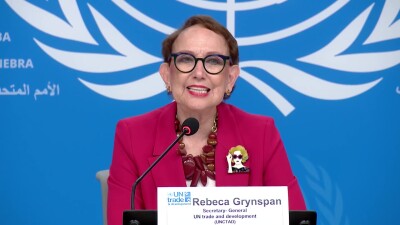
2. SOUNDBITE (English) Rebeca Grynspan, UN Trade and Development, Secretary-General: “Productive global foreign direct investment continues to be weak, with a further negative outlook for 2025 and with consequences most sharply felt in the developing world.”
3. Medium shot, journalists attending the press room.
4. SOUNDBITE (English) Rebeca Grynspan, UN Trade and Development, Secretary-General: “In 2024, global foreign direct investment fell 11%.”
5. Medium shot, journalist in the press room.
6. SOUNDBITE (English) Rebeca Grynspan, UN Trade and Development, Secretary-General: “Behind those numbers are very real consequences. Jobs not created. Infrastructure not built. Sustainable development delayed. What we see here is not just a downturn. It is a pattern.”
7. Medium shot, photographer taking pictures.
8. SOUNDBITE (English) Rebeca Grynspan, UN Trade and Development, Secretary-General: “This is happening because of growing geopolitical tensions, rising trade barriers, increasing screening measures on foreign investment, especially in the developed countries.”
9. Wide shot, speakers at the podium of the press room.
10. SOUNDBITE (English) Rebeca Grynspan, UN Trade and Development, Secretary-General: “We need to embed sustainability in the investment decision-making aligned with standards, combat greenwashing and support countries for policy reform.”
11. Medium shot, photographer taking pictures.
12. SOUNDBITE (English) Rebeca Grynspan, UN Trade and Development, Secretary-General: “We need to reform investment policies and direct capital to the real economy – energy, industry, tech, infrastructure – so we can steer capital towards these very important sectors. Finally, we need to modernize the international investment governance, update international rules to protect public interest, ensure fair treatment for investors, and preserve national policy space.”
13. Medium shot, journalist in the press room.
14. SOUNDBITE (English) Rebeca Grynspan, UN Trade and Development, Secretary-General: “The time to act is now. Investment is not just about money. It is about trust. It is about fairness. It is about a future that includes everyone.”
Similar Stories

1
1
1
Edited News | UNICEF , WHO , UNHCR
Yemen war continues to force families from homes amid hunger and disease
More than 250,000 people have now fled renewed fighting in Yemen, the UN said on Tuesday, citing particular concern for those sheltering in the southwestern city of Taiz and the wider governorate, where access is “essentially blocked”.

1
1
1
Edited News | UNICEF
A little over one year since a ceasefire agreement was announced between Hamas fighters and Israel, more than 340 children have been reported killed and hundreds more injured, the UN Children’s Fund, UNICEF, said on Friday.

1
1
1
Edited News | UNICEF , IFRC
Six weeks after Nepal’s deadly flooding disaster, communities are still struggling to rebuild their lives, but they will need sustained help as global warming increases the risk of another Himalayan catastrophe, the UN Children’s Fund (UNICEF) said on Friday.

1
1
1
Edited News | WHO
In suspected Russia plague death, testing and monitoring underway – WHO
The death of a lab worker in Russia’s Siberia region has sparked concerns about plague being the cause, the UN World Health Organization (WHO) said on Tuesday, adding that it was following the situation closely.

1
1
Edited News | OHCHR , UNOG
UN Human Rights Chief Volker Türk on Friday provided and oral update to the 63rd session of the Human rights Council on Ukraine.

1
1
1
Edited News | OHCHR , UNOG
UN Human Rights Chief Volker Türk on Friday provided and oral update to the 63rd session of the Human rights Council on the human rights situation in Haiti.

1
1
1
Edited News | WHO
Repeated delays in bringing lifesaving medicines, prosthetics and more from Israel into Gaza risk having devastating consequences on Palestinians who urgently need them in the wartorn enclave, the UN World Health Organization (WHO) said on Friday. “A truck full of non-priority supplies or the right supplies arriving too late, doesn't save lives. That's the question that actually matters," said Dr Reinhilde Van De Weerdt, WHO Representative in the OPT.

1
1
1
Edited News | WHO
DRC: Early access to care and oxygen decisive for Ebola patients’ survival – WHO
In the Democratic Republic of the Congo (DRC), health workers fighting the country’s largest-ever Ebola outbreak are struggling to overcome critical challenges to patient care, the UN World Health Organization (WHO) warned on Tuesday.

1
1
1
Edited News | OCHA , UN
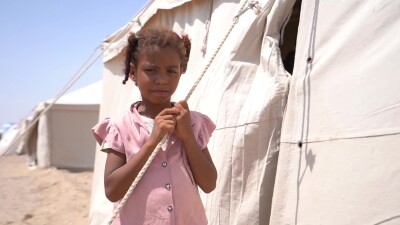
Civilians in Iran are continuing to feel the consequences of months of conflict and military escalation, the UN’s top official in the country has said, as loss of life, damage to civilian infrastructure and mounting economic pressures leave many facing continued uncertainty.
1
1
1
Edited News | WHO , UNICEF
Aid agencies in Yemen highlighted the growing hunger emergency sparked by renewed fighting between Houthi opposition forces and Government troops, after mobile health clinics reported that hundreds of children displaced by the violence are suffering from the most deadly form of malnutrition.
1
1
1
Edited News | UNHCR
Displacement on the rise in Yemen as fighting continues - UNHCR
As hostilities worsen in Yemen, more people have been fleeing their homes, further intensifying the humanitarian crisis within the region, the UN Refugee Agency (UNHCR) warned on Tuesday.
1
1
1
Edited News | IOM , OHCHR , UNFPA , UNOG , UNHCR , WHO
Yemen’s humanitarian crisis growing by the hour amid spike in displacement
Yemenis displaced by renewed fighting have described fleeing for their lives amid shelling and gunfire, aid agencies reported on Friday, while highlighting the dramatic increase in humanitarian needs in the country and in Djibouti, where thousands have sought shelter.