

The United Nations Office at Geneva
Multimedia Newsroom
Gaza: Hundreds of trucks per day of free aid needed “for months”, in addition to commercial supplies - OCHA
Despite the tactical pauses Israel introduced last week to allow some safe passage for humanitarian convoys, the amount of aid that has entered Gaza remains by far insufficient for the starving population, and UN trucks continue to face impediments on their way to delivering aid.
The shortages are not limited to food: on Monday, the UN was able to collect about 200,000 litres of much-needed fuel from the Kerem Shalom crossing, but the limited quantities that have entered Gaza in the last week are far from enough, according to the United Nations Office for the Coordination of Humanitarian Affairs (OCHA)Water, sanitation and hygiene operations continue to be severely hampered by the lack of fuel. Only 29,000 liters have been received so far, while some 70,000 litres of fuel are needed every day for emergency operations.
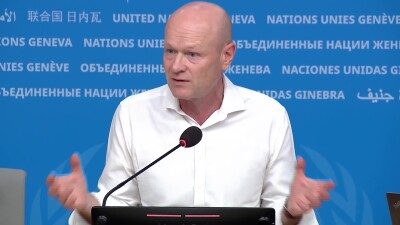
“Everybody expects me to clap and say thank you,” said OCHA spokesperson Jens Laerke, in an answer to a journalist’s question about the fuel that got into Gaza over the last week. But “the difference between the very small amount of aid that has now come in and the massive needs where people are literally dying on a daily basis, it's really out of proportion,” he insisted.
“The needs inside Gaza are such that there should be hundreds and hundreds and hundreds and hundreds and more hundreds of trucks, not only every day, not only every week, but for months, possibly years to come. This has been building up. We are now on the brink of famine -- as you know, that is not something that happens overnight,” Mr. Laerke explained.
According to the United Nations Agency for Palestine refugees (UNRWA) a minimum of 600 trucks per day are needed to meet basic humanitarian needs for the more than 2 million people in the Gaza Strip.
Amid growing international pressure over the humanitarian crisis, Israel has announced it will allow controlled entry of commercial goods into Gaza. A limited number of Gaza-based traders will be entitled to import supplies into the Strip, for the first time since fighting resumed in March. Approved goods include basic food products, baby formula, fruits, vegetables, and hygiene items. Payments will have to be made exclusively via bank transfers and Palestinian merchants will undergo strict security screenings, according to Israeli authorities who will maintain the aid distribution centers run by the Gaza Humanitarian Foundation (GHF), which the UN has described as “inherently unsafe”.
“Aid alone cannot fix the problem”, Mr. Laerke pointed out, welcoming the announcement on commercial supplies. “There needs to be a commercial supply going in as well, bearing in mind commercial supplies cost money.” The great majority of Gaza’s population is unemployed.
“Aid is free of charge,” Mr. Laerke reminded reporters in Geneva, “and we have thousands of tons of aid, including food aid, standing just outside of Gaza, which has already been paid for by the donors. And donors expect that to be given free of charge to the people in need. And it's our job to do so, but we are not getting the facilitation that we need to do so.”
Aid entering Gaza only a fraction of what is needed, UNICEF
While some nutrition supplies have entered during the past week, including high-energy biscuits for pregnant and breastfeeding women as well as infant formula and hygiene kits, UNICEF emphasized that this is still a fraction of what is needed and that malnutrition among children in Gaza is reaching catastrophic levels. Severe malnutrition is spreading among children faster than aid can reach them, according to UNICEF, which reports a spike in the number of children who have starved to death.
The vast majority of severely malnourished children will eventually die from other causes, UNICEF warns: they are 10 times more likely to contract pneumonia, measles or other deadly diseases. Most of those deaths will not even be reported as the majority of malnourished children can’t even get to hospitals.
“It's very important that there is an increasing amount of pressure now from many governments because of the deprivations, because of the nutritional situation we see in children and in mothers and in women and in the elderly,” said UNICEF spokesperson James Elder “We mustn't forget as well, that on average, a girl or a boy has been killed in these bombardments every single hour since the horrors of October 7. So, the facts speak for themselves,” he said.
The war in the Gaza Strip has taken an unconscionable toll on children. According to UNICEF, more than 50,000 boys and girls have reportedly been killed or injured in Israel’s military operations since the Hamas massacre and hostage-taking in Israel on 7 October 2023.
-Ends-
Story: “Gaza aid update – OCHA, UNICEF” – Tuesday 5 August 2025
Speakers are spokespersons:
- Jens Laerke, OCHA
- James Elder, UNICEF
TRT: 02’11”
SOURCE: UNTV CH
LANGUAGE: ENGLISH / NATS
ASPECT RATIO: 16:9
DATELINE: 05 August 2025 - GENEVA, SWITZERLAND
Geneva Press briefing
SHOTLIST
- Exterior medium shot: UN flag alley.
- Wide shot of the podium with speakers at the press conference room.
- SOUNDBITE (English) Jens Laerke, OCHA spokesperson: "I hope you understand that the magnitude, the difference between this very small amount of aid that has now come in -and everybody expects me to clap and say thank you- and the massive needs that are, where people are literally dying on a daily basis, it's really out of proportion."
- Medium lateral shot of the press conference room.
- SOUNDBITE (English) Jens Laerke, OCHA spokesperson: “The needs inside Gaza are such that there should be hundreds and hundreds and hundreds and hundreds and more hundreds of trucks, not only every day, not only every week, but for months, possibly years to come. This has been building up. We are now on the brink of famine as you know, that is not something that happens overnight.”
- Medium shot: journalists at the press conference room.
- SOUNDBITE (English) Jens Laerke, OCHA spokesperson: “We've always pointed out that aid alone cannot fix the problem. There needs to be a commercial supply going in as well. Well, bearing in mind commercial supplies cost money for people. Aid is free of charge and we have thousands of tons of aid, including food aid, standing just outside of Gaza, which has already been paid for by the donors. And donors expect that to be given free of charge to the people in need. And it's our job to do so, but we are not getting the facilitation that we need to do so.”
- Cutaway podium, screens and speakers at the press conference room.
- SOUNDBITE (English) James Elder, UNICEF spokesperson: “It's very important that there is an increasing amount of pressure now from many governments because of the deprivations, because of the nutritional situation we see in children and in mothers and in women and in the elderly. We mustn't forget as well, though, that on average, a girl or a boy has been killed in these bombardments every single hour since the horrors of October 7. So, the facts speak for themselves.”
- Cutaway: close shots of journalists in the press conference room.
- Medium shot of the gallery and control room from inside the press conference room.
Similar Stories

2
17
1
2
Edited News , Press Conferences | OCHA , WMO
Two UN agencies teamed up on Wednesday to issue an appeal for immediate assistance to help communities already being impacted by the strongest El Niño on record.

3
16
2
2
B-roll , Conferences , Edited News | UNITED NATIONS , UNOG
Sixth Consultative Meeting on Enhancing Coordination of Peace Initiatives and Efforts for Sudan

1
1
1
Edited News | UNICEF , WHO , UNHCR
Yemen war continues to force families from homes amid hunger and disease
More than 250,000 people have now fled renewed fighting in Yemen, the UN said on Tuesday, citing particular concern for those sheltering in the southwestern city of Taiz and the wider governorate, where access is “essentially blocked”.

1
1
1
Edited News | UNICEF
A little over one year since a ceasefire agreement was announced between Hamas fighters and Israel, more than 340 children have been reported killed and hundreds more injured, the UN Children’s Fund, UNICEF, said on Friday.

1
1
1
Edited News | UNICEF , IFRC
Six weeks after Nepal’s deadly flooding disaster, communities are still struggling to rebuild their lives, but they will need sustained help as global warming increases the risk of another Himalayan catastrophe, the UN Children’s Fund (UNICEF) said on Friday.

1
1
1
Edited News | WHO
In suspected Russia plague death, testing and monitoring underway – WHO
The death of a lab worker in Russia’s Siberia region has sparked concerns about plague being the cause, the UN World Health Organization (WHO) said on Tuesday, adding that it was following the situation closely.

1
1
Edited News | OHCHR , UNOG
UN Human Rights Chief Volker Türk on Friday provided and oral update to the 63rd session of the Human rights Council on Ukraine.

1
1
1
Edited News | OHCHR , UNOG
UN Human Rights Chief Volker Türk on Friday provided and oral update to the 63rd session of the Human rights Council on the human rights situation in Haiti.

1
1
1
Edited News | WHO
Repeated delays in bringing lifesaving medicines, prosthetics and more from Israel into Gaza risk having devastating consequences on Palestinians who urgently need them in the wartorn enclave, the UN World Health Organization (WHO) said on Friday. “A truck full of non-priority supplies or the right supplies arriving too late, doesn't save lives. That's the question that actually matters," said Dr Reinhilde Van De Weerdt, WHO Representative in the OPT.

1
1
1
Edited News | WHO
DRC: Early access to care and oxygen decisive for Ebola patients’ survival – WHO
In the Democratic Republic of the Congo (DRC), health workers fighting the country’s largest-ever Ebola outbreak are struggling to overcome critical challenges to patient care, the UN World Health Organization (WHO) warned on Tuesday.

1
1
1
Edited News | OCHA , UN
Civilians in Iran are continuing to feel the consequences of months of conflict and military escalation, the UN’s top official in the country has said, as loss of life, damage to civilian infrastructure and mounting economic pressures leave many facing continued uncertainty.
1
1
1
Edited News | WHO , UNICEF
Aid agencies in Yemen highlighted the growing hunger emergency sparked by renewed fighting between Houthi opposition forces and Government troops, after mobile health clinics reported that hundreds of children displaced by the violence are suffering from the most deadly form of malnutrition.