

The United Nations Office at Geneva
Multimedia Newsroom
Les investissements directs étrangers mondiaux ont chuté de 11 %, marquant la deuxième année consécutive de déclin et confirmant un ralentissement profond des flux de capitaux productifs, selon le Rapport sur l'investissement dans le monde 2025, publié aujourd'hui par la Conférence des Nations Unies sur le commerce et le développement (CNUCED).
Bien que les investissements directs étrangers (IDE) mondiaux aient augmenté de 4 % en 2024 pour atteindre 1,5 billion de dollars, cette hausse résulte, entre autres, de flux financiers volatils transitant par plusieurs économies européennes, qui servent souvent de points de transfert pour les investissements.
Le rapport de cette année précède la Quatrième Conférence internationale sur le financement du développement (FFD4), où les dirigeants mondiaux aborderont l'écart croissant entre les flux de capitaux et les besoins de développement. Les conclusions soulignent l'urgence de réformer les systèmes d'investissement et de financement pour soutenir une croissance inclusive et durable.
Les investissements ont chuté fortement dans les économies développées, en particulier en Europe. Dans les pays en développement, les entrées de capitaux semblent globalement stables - mais cela cache une crise plus profonde : dans trop d'économies, le capital stagne ou évite complètement les secteurs les plus importants - infrastructure, énergie, technologie, et les industries qui stimulent la création d'emplois.
Site web : https://unctad.org/wir2025
Date de production : 19 juin 2025
Créateur : CNUCED
Sujet thématique : ÉCONOMIE
Nom de l'organisation : COMMERCE ET DÉVELOPPEMENT DES NATIONS UNIES – CNUCED
DESCRIPTION
HISTOIRE : CNUCED / Rapport sur l'investissement dans le monde
TRT : 02:58
SOURCE : CNUCED
RESTRICTIONS : AUCUNE
LANGUE : ANGLAIS / SONS NATURELS
SITE WEB : https://unctad.org/wir2025
DATELINE : 19 JUIN 2025, GENÈVE, SUISSE
LISTE DE PLANS
1. Plan large, images de drone de l'Allée des Drapeaux, Palais des Nations, Genève ; orateur sur les écrans
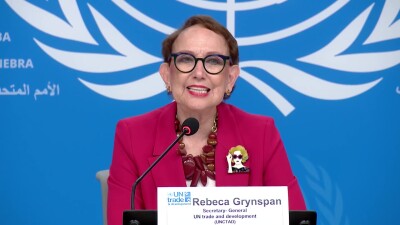
2. EXTRAIT SONORE (Anglais) Rebeca Grynspan, Secrétaire générale de la CNUCED : « L'investissement direct étranger mondial productif continue d'être faible, avec des perspectives encore négatives pour 2025 et des conséquences ressenties le plus fortement dans le monde en développement. »
3. Plan moyen, journalistes assistant à la salle de presse.
4. EXTRAIT SONORE (Anglais) Rebeca Grynspan, Secrétaire générale de la CNUCED : « En 2024, l'investissement direct étranger mondial a chuté de 11 %. »
5. Plan moyen, journaliste dans la salle de presse.
6. EXTRAIT SONORE (Anglais) Rebeca Grynspan, Secrétaire générale de la CNUCED : « Derrière ces chiffres se cachent des conséquences très réelles. Des emplois non créés. Des infrastructures non construites. Un développement durable retardé. Ce que nous voyons ici n'est pas seulement un ralentissement. C'est un schéma. »
7. Plan moyen, photographe prenant des photos.
8. EXTRAIT SONORE (Anglais) Rebeca Grynspan, Secrétaire générale de la CNUCED : « Cela se produit en raison de tensions géopolitiques croissantes, de barrières commerciales en hausse, de mesures de contrôle accrues sur les investissements étrangers, en particulier dans les pays développés. »
9. Plan large, orateurs au podium de la salle de presse.
10. EXTRAIT SONORE (Anglais) Rebeca Grynspan, Secrétaire générale de la CNUCED : « Nous devons intégrer la durabilité dans la prise de décision en matière d'investissement alignée sur les normes, combattre l'écoblanchiment et soutenir les pays pour la réforme des politiques. »
11. Plan moyen, photographe prenant des photos.
12. EXTRAIT SONORE (Anglais) Rebeca Grynspan, Secrétaire générale de la CNUCED : « Nous devons réformer les politiques d'investissement et diriger le capital vers l'économie réelle - énergie, industrie, technologie, infrastructures - afin que nous puissions orienter le capital vers ces secteurs très importants. Enfin, nous devons moderniser la gouvernance internationale de l'investissement, mettre à jour les règles internationales pour protéger l'intérêt public, assurer un traitement équitable pour les investisseurs et préserver l'espace politique national. »
13. Plan moyen, journaliste dans la salle de presse.
14. EXTRAIT SONORE (Anglais) Rebeca Grynspan, Secrétaire générale de la CNUCED : « Le moment d'agir est maintenant. L'investissement ne concerne pas seulement l'argent. Il s'agit de confiance. Il s'agit d'équité. Il s'agit d'un avenir qui inclut tout le monde. »
Similar Stories

1
1
1
Edited News | OCHA , UNICEF , WFP
Aid agencies warned on Friday of the fast-developing humanitarian emergency inside Taiz City in Yemen, which has been encircled by de facto Houthi forces fighting government troops along the country’s west coast.

2
17
1
2
Edited News , Press Conferences , Images | OCHA , WMO
Two UN agencies teamed up on Wednesday to issue an appeal for immediate assistance to help communities already being impacted by the strongest El Niño on record.

3
16
2
2
Edited News , B-roll , Conferences , Images | UNITED NATIONS , UNOG
Sixth Consultative Meeting on Enhancing Coordination of Peace Initiatives and Efforts for Sudan

1
1
1
Edited News | UNICEF , WHO , UNHCR
Yemen war continues to force families from homes amid hunger and disease
More than 250,000 people have now fled renewed fighting in Yemen, the UN said on Tuesday, citing particular concern for those sheltering in the southwestern city of Taiz and the wider governorate, where access is “essentially blocked”.

1
1
1
Edited News | UNICEF
A little over one year since a ceasefire agreement was announced between Hamas fighters and Israel, more than 340 children have been reported killed and hundreds more injured, the UN Children’s Fund, UNICEF, said on Friday.

1
1
1
Edited News | UNICEF , IFRC
Six weeks after Nepal’s deadly flooding disaster, communities are still struggling to rebuild their lives, but they will need sustained help as global warming increases the risk of another Himalayan catastrophe, the UN Children’s Fund (UNICEF) said on Friday.

1
1
1
Edited News | WHO
In suspected Russia plague death, testing and monitoring underway – WHO
The death of a lab worker in Russia’s Siberia region has sparked concerns about plague being the cause, the UN World Health Organization (WHO) said on Tuesday, adding that it was following the situation closely.

1
1
Edited News | OHCHR , UNOG
UN Human Rights Chief Volker Türk on Friday provided and oral update to the 63rd session of the Human rights Council on Ukraine.

1
1
1
Edited News | OHCHR , UNOG
UN Human Rights Chief Volker Türk on Friday provided and oral update to the 63rd session of the Human rights Council on the human rights situation in Haiti.

1
1
1
Edited News | WHO
Repeated delays in bringing lifesaving medicines, prosthetics and more from Israel into Gaza risk having devastating consequences on Palestinians who urgently need them in the wartorn enclave, the UN World Health Organization (WHO) said on Friday. “A truck full of non-priority supplies or the right supplies arriving too late, doesn't save lives. That's the question that actually matters," said Dr Reinhilde Van De Weerdt, WHO Representative in the OPT.

1
1
1
Edited News | WHO
DRC: Early access to care and oxygen decisive for Ebola patients’ survival – WHO
In the Democratic Republic of the Congo (DRC), health workers fighting the country’s largest-ever Ebola outbreak are struggling to overcome critical challenges to patient care, the UN World Health Organization (WHO) warned on Tuesday.

1
1
1
Edited News | OCHA , UN
Civilians in Iran are continuing to feel the consequences of months of conflict and military escalation, the UN’s top official in the country has said, as loss of life, damage to civilian infrastructure and mounting economic pressures leave many facing continued uncertainty.