

The United Nations Office at Geneva
Multimedia Newsroom
Hundreds of thousands of civilians at risk in Syria amid ongoing violence in northeast and northwest
Almost daily violence targeting built-up areas and health facilities in Syria continues to threaten civilians there, UN rights experts and humanitarians said on Friday.
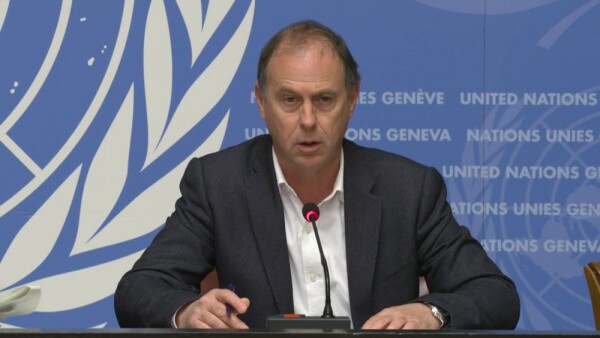
“Civilians continue to pay a very high price in the ongoing hostilities in Syria,” said UN human rights office (OHCHR) spokesperson Rupert Colville.
Dozens of people have been killed and injured in the largely separate situations “occurring simultaneously” in north-eastern and north-western Syria, he told journalists at the United Nations, noting that “at least 92” had been killed between 9 October and 5 November.
Their deaths were from a variety of causes including airstrikes and ground based strikes, “and increasingly as a result of what appears to be an indiscriminate use of improvised explosive devices (IEDs) in populated areas, including in local markets”, the OHCHR spokesperson added.
Those comments follow a warning from Najat Rochdi, Senior Humanitarian Adviser to the United Nations Special Envoy for Syria, that hundreds of thousands of people in northeast Syria are vulnerable following an incursion by the Turkish military on 9 October.
“Of the more than 200,000 people who fled the fighting in recent weeks, close to 100,000 people have not yet been able to return home and are dispersed across improvised camps and collective shelters,” she said on Thursday.
These recent displacements have compounded an already dire situation in which 710,000 people were already displaced and approximately 1.8 million people are in need of humanitarian assistance, Ms. Rochdi’s statement explained.
In a related warning, Mr. Colville said that people recently displaced during the military offensive have been “subsequently…subjected to arbitrary detention, in addition to enforced disappearances, after returning to their homes. This is occurring both in areas controlled by Turkish forces and Turkish-affiliated armed groups and in areas controlled by Kurdish armed groups.”
The OHCHR spokesperson added that attacks using improvised explosive devices in the formerly Kurdish-controlled north-east “have noticeably escalated in recent days, mainly in areas under the control of Turkish-affiliated armed groups, which suggests they have most likely been carried out by groups opposing the Turkish military offensive”.
In Syria’s northwest, meanwhile, medical professionals continue to be at grave risk.
Health facilities “continue to be directly hit or significantly damaged whenever there is a military escalation in Idlib”, OHCHR’s Mr. Colville said.
Just this week, “four separate facilities were damaged”, he noted, taking the total number of health facilities that OHCHR has recorded being hit since 29 April to 61.
“We can’t determine if every single attack is deliberate,” Mr. Colville added, “but the large scale of these attacks – as I say, 61 separate facilities, considerably more actual strikes hitting those facilities, given some of them were hit two, three, four times, and the fact that it’s happening every time there’s a military escalation strongly suggests that Government-affiliated forces are conducting these strikes are at least partly if not always deliberately striking health facilities. But I think we’ll have to…and of course, that would amount to a war crime.”
In a new development related to thousands of Syrians held by the Government, Mr. Colville explained that it was concerning that families have been receiving death notifications from the Government authorities. “Basically telling them that their relatives, or family members who were detained or forcibly disappeared have died in custody.”
The development comes as UN Special Envoy for Syria confirmed on Friday that talks between Syrians on a new foundational text for the country will resume in two weeks in Geneva.
Earlier, UN humanitarians warned that a serious funding crisis risks leaving hundreds of thousands of Syrians vulnerable to deteriorating weather conditions.
“Of the $295 million we required in 2019, we have received just $138 million,” said Marixie Mercado, spokesperson, UN Children’s Fund (UNICEF): “Despite the massive security, access and capacity challenges, this funding shortfall now represents the most serious obstacle we face in reaching children who need help urgently.”
Listing the many urgent interventions that would no longer be possible without that funding, Ms. Mercado explained that it would mean “not providing emergency water, sanitation and hygiene support to over 100,000 people, nor improving poor water supplies to 300,000 more. Not providing 55,000 children with routine immunization, and nearly 140,000 women and children with health and nutrition consultations.”
- Exterior shot, Palais des Nations flag alley.
- Medium shot, journalists, podium, Room III.
- Close up, hands typing on laptops in profile.
- SOUNDBITE (English) — Rupert Colville, spokesperson, Office of the High Commissioner for Human Rights (OHCHR): “Civilians continue to pay a very high price in the ongoing hostilities in Syria. Dozens have been killed and injured in the largely separate situations occurring simultaneously in northeastern and northwestern Syria, from a variety of causes, including airstrikes and ground-based strikes, and increasingly as a result of what appears to be an indiscriminate use of improvised explosive devices in populated areas, including in local markets .”
- Medium shot, journalists, Room III.
- SOUNDBITE (English) — Rupert Colville, spokesperson, Office of the High Commissioner for Human Rights (OHCHR): “Health facilities continue to be directly hit or significantly damaged whenever there is a military escalation in Idlib. Four separate facilities were damaged on 4 and 6 November, taking the total number of health facilities we have recorded being hit since 29 April to 61.”
- Medium shot, journalist peering at laptop screen, another journalist is seated next to him, Room III.
- SOUNDBITE (English) — Rupert Colville, spokesperson, Office of the High Commissioner for Human Rights (OHCHR): “We can’t determine if every single attack is deliberate, but the large scale of these attacks – as I say, 61 separate facilities, considerably more actual strikes hitting those facilities, given some of them were hit two, three, four times, and the fact that it’s happening every time there’s a military escalation strongly suggests that Government-affiliated forces are conducting these strikes are at least partly if not always deliberately striking health facilities. But I think we’ll have to…and of course, that would amount to a war crime.”
- Medium shot, journalist looks at laptop screen with hand covering mouth, a second journalist is seated next to her, Room III.
- SOUNDBITE (English)— Rupert Colville, spokesperson, Office of the High Commissioner for Human Rights (OHCHR): “Attacks with improvised explosive devices have noticeably escalated in recent days, mainly in areas under the control of Turkish-affiliated armed groups, which suggests they have most likely been carried out by groups opposing the Turkish military offensive.”
- Close up, journalist’s face in profile looking down, Room III.
- SOUNDBITE (English)— Rupert Colville, spokesperson, Office of the High Commissioner for Human Rights (OHCHR): “Another issue of concern in the north-east, relates to people recently displaced during the military offensive who have subsequently been subjected to arbitrary detention, in addition to enforced disappearances, after returning to their homes. This is occurring both in areas controlled by Turkish forces and Turkish-affiliated armed groups and in areas controlled by Kurdish armed groups.”
- Medium shot, journalists, Room III.
- SOUNDBITE (English)— Rupert Colville, spokesperson, Office of the High Commissioner for Human Rights (OHCHR): “A particular concern of ours is that, you know, among the thousands of Syrians who continue to be detained, or who have been forcibly disappeared inside Government-run detention facilities, we’re concerned that we are receiving reports of families receiving death notifications from the Government authorities, you know, basically telling them that their relatives, or family members who were detained or forcibly disappeared have died in custody.”
- Medium shot, journalists, Room III.
- SOUNDBITE (English)— Marixie Mercado, spokesperson, UN Children’s Fund (UNICEF): “Of the $295 million we required in 2019, we have received just $138 million. Despite the massive security, access and capacity challenges, this funding shortfall now represents the most serious obstacle we face in reaching children who need help urgently.”
- Medium shot, journalist with headphone, semi-profile, Room III.
- SOUNDBITE (English)— Marixie Mercado, spokesperson, UN Children’s Fund (UNICEF): “Not providing emergency water, sanitation and hygiene support to over 100,000 people, nor improving poor water supplies to 300,000 more. Not providing 55,000 children with routine immunization, and nearly 140,000 women and children with health and nutrition consultations.”
- Medium shot, journalist with hand on chin, profile, another journalist with ear microphone, Room III
- Medium shot, journalists, podium, Room III.
- Close up, journalist’s hands shown checking mobile, podium in background, Room III.
Similar Stories

2
17
1
2
Edited News , Press Conferences | OCHA , WMO
Two UN agencies teamed up on Wednesday to issue an appeal for immediate assistance to help communities already being impacted by the strongest El Niño on record.

3
16
2
2
B-roll , Conferences , Edited News | UNITED NATIONS , UNOG
Sixth Consultative Meeting on Enhancing Coordination of Peace Initiatives and Efforts for Sudan

1
1
1
Edited News | UNICEF , WHO , UNHCR
Yemen war continues to force families from homes amid hunger and disease
More than 250,000 people have now fled renewed fighting in Yemen, the UN said on Tuesday, citing particular concern for those sheltering in the southwestern city of Taiz and the wider governorate, where access is “essentially blocked”.

1
1
1
Edited News | UNICEF
A little over one year since a ceasefire agreement was announced between Hamas fighters and Israel, more than 340 children have been reported killed and hundreds more injured, the UN Children’s Fund, UNICEF, said on Friday.

1
1
1
Edited News | UNICEF , IFRC
Six weeks after Nepal’s deadly flooding disaster, communities are still struggling to rebuild their lives, but they will need sustained help as global warming increases the risk of another Himalayan catastrophe, the UN Children’s Fund (UNICEF) said on Friday.

1
1
1
Edited News | WHO
In suspected Russia plague death, testing and monitoring underway – WHO
The death of a lab worker in Russia’s Siberia region has sparked concerns about plague being the cause, the UN World Health Organization (WHO) said on Tuesday, adding that it was following the situation closely.

1
1
Edited News | OHCHR , UNOG
UN Human Rights Chief Volker Türk on Friday provided and oral update to the 63rd session of the Human rights Council on Ukraine.

1
1
1
Edited News | OHCHR , UNOG
UN Human Rights Chief Volker Türk on Friday provided and oral update to the 63rd session of the Human rights Council on the human rights situation in Haiti.

1
1
1
Edited News | WHO
Repeated delays in bringing lifesaving medicines, prosthetics and more from Israel into Gaza risk having devastating consequences on Palestinians who urgently need them in the wartorn enclave, the UN World Health Organization (WHO) said on Friday. “A truck full of non-priority supplies or the right supplies arriving too late, doesn't save lives. That's the question that actually matters," said Dr Reinhilde Van De Weerdt, WHO Representative in the OPT.

1
1
1
Edited News | WHO
DRC: Early access to care and oxygen decisive for Ebola patients’ survival – WHO
In the Democratic Republic of the Congo (DRC), health workers fighting the country’s largest-ever Ebola outbreak are struggling to overcome critical challenges to patient care, the UN World Health Organization (WHO) warned on Tuesday.

1
1
1
Edited News | OCHA , UN
Civilians in Iran are continuing to feel the consequences of months of conflict and military escalation, the UN’s top official in the country has said, as loss of life, damage to civilian infrastructure and mounting economic pressures leave many facing continued uncertainty.
1
1
1
Edited News | WHO , UNICEF
Aid agencies in Yemen highlighted the growing hunger emergency sparked by renewed fighting between Houthi opposition forces and Government troops, after mobile health clinics reported that hundreds of children displaced by the violence are suffering from the most deadly form of malnutrition.