

The United Nations Office at Geneva
Multimedia Newsroom
“A good day for Afghanistan” as donors pledge support, anticipating peace
International donors pledged financial and political backing for Afghanistan’s peace process at the 2020 Afghanistan Conference in Geneva on Tuesday, anticipating a sustainable ceasefire that will help the country rebuild and heal after decades of conflict.
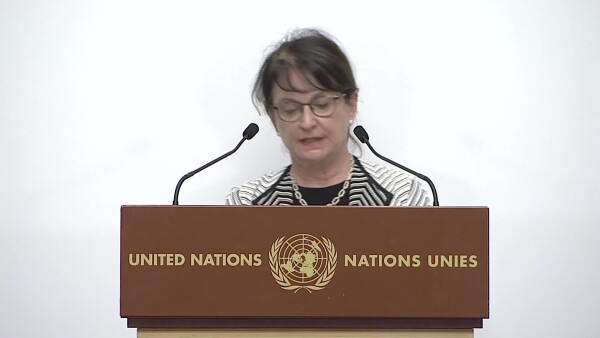
“Today, I believe, is a good day for Afghanistan, and for the people of Afghanistan. The world has come together today, both the international donors community, and a number of regional countries, and a large number of international organizations have come together to express emphatic support to the people of Afghanistan. What is the message? We stand with you”, Deborah Lyons, Special Representative of the Secretary-General and Head of the United Nations Assistance Mission for Afghanistan (UNAMA), told a news conference during a break from the pledging event.
“It's also important to note that in spite of the fact that we are seeing very strong pledging on the part of the many countries that have already spoken, this money does not come freely. It comes with conditions that the money will be well spent, and the government will be held accountable for the spending of the money.”
The conference was co-hosted by the government of Finland, whose Minister of Foreign Affairs Pekka Haavisto said the conference participants felt the youth of Afghanistan deserved better than what Afghan youth had suffered in the past. The conference had attracted dozens of donor governments, he said.
“We are doing it in a COVID-19 circumstance, most of the participants are online, or even recorded messages, but we have been able to gather 66 governments to this pledging conference and conference for Afghanistan and we have more than 30 international organizations at place here”, Mr. Haavisto said.
Afghan Deputy Minister of Finance Abdul Habib Zadran said donor governments had expressed strong backing for a sustainable peace, and their support was not going unnoticed.
“All eyes in Afghanistan are towards Geneva. They are expecting a lot from the international community. And there is millions of hopes from this conference today. But the good thing is that we are receiving very positive messages so far from the international community, our friends and our development partners”, he told the news conference.
Earlier, UN Secretary-General António Guterres addressed the conference in a video message.
“The Afghan people have suffered for far too long. I urge the redoubling of efforts towards an immediate, unconditional ceasefire, in order to save lives and prevent the further spread of COVID-19“, Mr Guterres said.
“Progress toward peace will contribute to the development of the entire region and is a vital step towards the safe, orderly and dignified return of millions of displaced Afghans. The United Nations stands with the people of Afghanistan on the path toward peace, development and self-reliance.”
Mr. Guterres’ remarks were followed by a keynote speech from Afghan President Ashraf Ghani, delivered via video link.
“What is the main priority of the Afghan people? A demand for peace. Today, we the Afghan people, government, and international community, share a vision of a sovereign unified democratic Afghanistan in peace with itself, the region and the world, capable of preserving and expanding the gains of the past two decades”, President Ghani said.
- Exterior wide shot, garden and UN flag flying, Palais des Nations.
- Wide shot, podium with speakers in a near-empty Room XIV in line with COVID-19 distancing measures, Palais des Nations.
- SOUNDBITE (English) — Deborah Lyons, Special Representative of the Secretary-General and Head of the United Nations Assistance Mission for Afghanistan (UNAMA): “Today, I believe, is a good day for Afghanistan, and for the people of Afghanistan. The world has come together today, both the international donors community, and a number of regional countries, and a large number of international organizations have come together to express emphatic support to the people of Afghanistan. What is the message? We stand with you.”
- Medium shot, cameras and UN staff members, Room XIV, Palais des Nations.
- SOUNDBITE (English) — Deborah Lyons, Special Representative of the Secretary-General and Head of the United Nations Assistance Mission for Afghanistan (UNAMA): “It's also important to note that in spite of the fact that we are seeing very strong pledging on the part of the many countries that have already spoken, this money does not come freely. It comes with conditions that the money will be well spent, and the Government will be held accountable for the spending of the money.”
- Wide shot, cameras and UN staff members in foreground and podium to rear, Room XIV, Palais des Nations.
- SOUNDBITE (English) — Pekka Haavisto, Minister of Foreign Affairs of Finland: “We are doing it in a COVID-19 circumstance, most of the participants are online, or even recorded messages, but we have been able to gather 66 governments to this pledging conference and conference for Afghanistan and we have more than 30 international organizations at place here.”
- Wide shot, cameras and UN staff members in foreground and podium to rear, Room XIV, Palais des Nations.
- SOUNDBITE (English) —Abdul Habib Zadran, Deputy Minister of Finance, Government of Afghanistan: “All eyes in Afghanistan are towards Geneva. They are expecting a lot from the international community. And there is millions of hopes from this conference today. But the good thing is that we are receiving very positive messages so far from the international community, our friends and our development partners.”
- Medium shot, cameras and UN staff members, Room XIV, Palais des Nations.
- SOUNDBITE (English) — António Guterres, Secretary-General of the United Nations: “The Afghan people have suffered for far too long. I urge the redoubling of efforts towards an immediate, unconditional ceasefire, in order to save lives and prevent the further spread of COVID-19.”
- Wide shot, Conference room with podium to rear, Palais des Nations.
- SOUNDBITE (English) — António Guterres, Secretary-General of the United Nations: “Progress toward peace will contribute to the development of the entire region and is a vital step towards the safe, orderly and dignified return of millions of displaced Afghans. The United Nations stands with the people of Afghanistan on the path toward peace, development and self-reliance.”
- Wide shot, Conference room with podium to rear, Palais des Nations.
- Ashraf Ghani, President of Afghanistan: “What is the main priority of the Afghan people? A demand for peace. Today, we the Afghan people, government, and international community, share a vision of a sovereign unified democratic Afghanistan in peace with itself, the region and the world, capable of preserving and expanding the gains of the past two decades.”
- Various shots, Participants to the conference stepping out of cars, Palais des Nations.
- Various shots, Participants to the conference being photographed, Palais des Nations.
- Medium shot, Participants to the conference walking in the Palais des Nations.
- Various shots, Participants in the conference room, Palais des Nations.
- Close-up, 2020 Afghanistan Conference poster, Palais des Nations.
Similar Stories

1
1
1
Edited News | OCHA , UNICEF , WFP
Aid agencies warned on Friday of the fast-developing humanitarian emergency inside Taiz City in Yemen, which has been encircled by de facto Houthi forces fighting government troops along the country’s west coast.

2
17
1
2
Edited News , Press Conferences , Images | OCHA , WMO
Two UN agencies teamed up on Wednesday to issue an appeal for immediate assistance to help communities already being impacted by the strongest El Niño on record.

3
16
2
2
Edited News , B-roll , Conferences , Images | UNITED NATIONS , UNOG
Sixth Consultative Meeting on Enhancing Coordination of Peace Initiatives and Efforts for Sudan

1
1
1
Edited News | UNICEF , WHO , UNHCR
Yemen war continues to force families from homes amid hunger and disease
More than 250,000 people have now fled renewed fighting in Yemen, the UN said on Tuesday, citing particular concern for those sheltering in the southwestern city of Taiz and the wider governorate, where access is “essentially blocked”.

1
1
1
Edited News | UNICEF
A little over one year since a ceasefire agreement was announced between Hamas fighters and Israel, more than 340 children have been reported killed and hundreds more injured, the UN Children’s Fund, UNICEF, said on Friday.

1
1
1
Edited News | UNICEF , IFRC
Six weeks after Nepal’s deadly flooding disaster, communities are still struggling to rebuild their lives, but they will need sustained help as global warming increases the risk of another Himalayan catastrophe, the UN Children’s Fund (UNICEF) said on Friday.

1
1
1
Edited News | WHO
In suspected Russia plague death, testing and monitoring underway – WHO
The death of a lab worker in Russia’s Siberia region has sparked concerns about plague being the cause, the UN World Health Organization (WHO) said on Tuesday, adding that it was following the situation closely.

1
1
Edited News | OHCHR , UNOG
UN Human Rights Chief Volker Türk on Friday provided and oral update to the 63rd session of the Human rights Council on Ukraine.

1
1
1
Edited News | OHCHR , UNOG
UN Human Rights Chief Volker Türk on Friday provided and oral update to the 63rd session of the Human rights Council on the human rights situation in Haiti.

1
1
1
Edited News | WHO
Repeated delays in bringing lifesaving medicines, prosthetics and more from Israel into Gaza risk having devastating consequences on Palestinians who urgently need them in the wartorn enclave, the UN World Health Organization (WHO) said on Friday. “A truck full of non-priority supplies or the right supplies arriving too late, doesn't save lives. That's the question that actually matters," said Dr Reinhilde Van De Weerdt, WHO Representative in the OPT.

1
1
1
Edited News | WHO
DRC: Early access to care and oxygen decisive for Ebola patients’ survival – WHO
In the Democratic Republic of the Congo (DRC), health workers fighting the country’s largest-ever Ebola outbreak are struggling to overcome critical challenges to patient care, the UN World Health Organization (WHO) warned on Tuesday.

1
1
1
Edited News | OCHA , UN
Civilians in Iran are continuing to feel the consequences of months of conflict and military escalation, the UN’s top official in the country has said, as loss of life, damage to civilian infrastructure and mounting economic pressures leave many facing continued uncertainty.