

The United Nations Office at Geneva
Multimedia Newsroom
Bitterness, sadness and pride for UNRWA staff, says departing chief
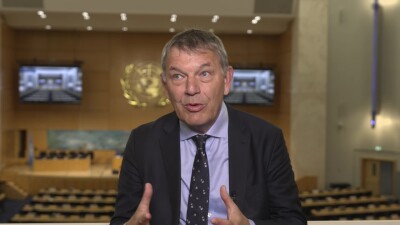
Asking the softly spoken, veteran humanitarian worker Philippe Lazzarini how he feels as he comes to the end of his second term as the head of the UN agency for Palestinians, UNRWA, is perhaps an unfair question.
“No doubt that I have mixed feelings today,” he says. “Bitterness, because I have been at the forefront over the last two years of extraordinary breaches of international law, witnessing atrocities, attacks against the United Nations; sadness, because many of our colleagues have been killed - nearly 400 in two years - that's never been seen in the entire United Nations history. But also some pride, because over the last two years, I have seen how our staff…have been extraordinarily committed to try to alleviate the suffering of a number of their own communities”.
In addition to being the face of an organization constantly berated and accused online of collaborating with Hamas fighters in Gaza, the 62-year-old Swiss national has watched the disastrous impact of the Israeli war on the enclave’s people and his agency, sparked by Hamas-led terror attacks in Israel, in October 2023.
(A high-level UN investigation into the accusations against UNRWA found that of 19 staff members accused of involvement in the terror attacks, one case was found to lack any supporting evidence and nine others lacked sufficient evidence to indicate involvement. In the remaining nine cases, evidence indicated that the UNRWA staff may have been involved in the 7 October attacks, at which point the agency announced they would be sacked.)
Today, the misery and death across the Gaza Strip continues, with one Gazan encounter from early in the conflict particularly hard to forget, despite Mr. Lazzarini’s many years working in conflict settings around the world, from Angola to Iraq and Somalia to South Sudan.
“It was a young girl I met in Rafah four weeks into the war and already I saw her with empty eyes begging in fact for a sip of water, a loaf of bread, in the school where she used to be a student. So, the school [that] should be a place of joy and education became a place of misery and shelter for these young girls. And I have to say, I have been haunted by this.”
And although there is a ceasefire in Gaza between Hamas fighters and Israel today, it is “in name only”, he insists, with people still being killed because they do not know where the shifting border is between them and the Israeli military.
“It’s nothing else than just misery,” he continues. “We might have reversed the tide of deepening hunger in Gaza but nothing else. People are still living in the rubble, are still waiting for hours to get some clean water. They are fighting and struggling against disease.”
Amid such suffering, Mr. Lazzarini dismisses suggestions that another body could take UNRWA’s place. “You do not have an existing alternative in Gaza,” he insists. “UNRWA is the only organization which has the manpower, the expertise, the community trust when it comes to public health, education services. There are no other NGOs or UN organizations. But we also know that the Palestinian Authority is not ready to take over these services.”
Beyond the attacks on UNRWA staff and on hundreds of the agency’s buildings in Gaza, its ability to provide key services in Gaza and beyond has been severely limited by a lack of financial support from the international community to match the three-year extension of its mandate passed by the UN General Assembly last December.
Despite austerity measures - including reduced services and a 20 per cent salary cut for most local staff – Mr. Lazzarini’s warning to the General Assembly President that UNRWA “may soon no longer be viable” without hard cash still stands. But political support is invaluable, too, and not just for his agency’s survival, he explains.
“The attacks on UNRWA are not an exception, cannot be dealt (with) in isolation. If we tolerate it for an agency like ours, others will follow. And that's exactly what happened in Gaza: the UN agencies have been finger-pointed at being infiltrated by Hamas to justify action against them…And now we hear exactly the same narrative, we see the same pattern being implemented in Lebanon.”
Away from Gaza, the dire situation for Palestinians in the occupied West Bank facing increasing attacks by Israeli settlers has also highlighted the “silent war” taking place there “in total impunity”, Mr. Lazzarini continues. In January, Israeli bulldozers moved into UNRWA headquarters in East Jerusalem and proceeded to demolish buildings there, as an Israeli flag was hoisted atop the UN complex – a move strongly condemned as a violation of international law by the global organization.
“When we talk about, you know, the respect of international law, we have seen that this blatant disdain and disregard - the fact that everything has been conducted without any respect of the rule of war - has also allowed now the spread of a conflict into Iran with no justification to initiate such a large-scale war impacting the entire region,” the UNRWA chief maintains.
Despite the global turmoil raging around the world, back in Geneva, Mr. Lazzarini appears relaxed as he prepares to move on to his next soon-to-be-last interview as head of UNRWA. He could easily be mistaken for a visitor in his wax coat, suede shoes, jacket and tie, but clothes are perhaps the last thing on his mind.
Readily conceding that he has faced “extreme pressure” from attacks against himself and UNRWA in the past two years, the top UN diplomat cites his family’s support as one of the principal reasons why he has been able to continue working.
“I haven't been present over the last two years,” he says, adding determinedly that once he leaves UNRWA, his plans include playing catch-up “to retrieve” his wife and children, as well as writing about his experiences at the helm of a UN agency whose future remains at the mercy of geopolitics.
ends
UNRWA final interview Philippe Lazzarini
TRT: 5’16”
SOURCE: UNTV CH
RESTRICTIONS: PLEASE CREDIT UNHCR, UNICEF, UNRWA and WHO when using their broll from Gaza, Lebanon and East Jerusalem.
LANGUAGE: ENGLISH / NATS
ASPECT RATIO: 16:9
DATELINE: 30 MARCH 2026 GENEVA, SWITZERLAND & various in East Jerusalem, Gaza, Lebanon (see details below):
Broll information:
- UNICEF Lebanon displacement images from 3 March 2026
- UNHCR images from Lebanon from 27 March 2026
- UNRWA images of East Jerusalem headquarters destruction from 20 January 2026
- WHO images of mass displacement in Gaza from 27 March 2026
Speakers:
- Philippe Lazzarini, UNRWA Commissioner-General
SHOTLIST
- Exterior wide, UN Geneva flag alley.
- Wide, Gaza footage of displaced on cart – please credit WHO.
- Wide, Gaza footage of tents for displaced - please credit WHO.
- SOUNDBITE (English) – Philippe Lazzarini, UNRWA Commissioner-General: “No doubt that I have a mixed feeling today. Feelings of, bitterness, but also sadness and also some pride. Bitterness, because I have been at the forefront over the last two years of extraordinary breaches of international law, witnessing atrocities, attacks against the United Nations. Sadness, because many of our colleagues have been killed - nearly 400 in two years - that's never been seen in the entire United Nations history.”
- Wide, Lebanon displaced, please credit UNICEF
- Medium-wide, Lebanon displaced, please credit UNICEF
- SOUNDBITE (English) – Philippe Lazzarini, UNRWA Commissioner-General: “Today, you do not have an existing alternative in Gaza. UNRWA is the only organization which has the manpower, the expertise, the community trust when it comes to public health, education services. There is no other NGOs or UN organization. But we also know that the Palestinian Authority is not ready to take over these services.”
- Medium-wide, makeshift shelter in Gaza, please credit WHO.
- Wide, Gazans on foot and in cars, please credit WHO.
- Medium-wide, makeshift tents, Gaza, please credit WHO.
- SOUNDBITE (English) – Philippe Lazzarini, UNRWA Commissioner-General: “It was a young girl I met in Rafah with four weeks into the war and already I saw her with empty eyes begging in fact for a sip of water, a loaf of bread, in the school where she used to be a student. So, the school should be a place of joy and education became a place of misery and shelter for these young girls. And I have to say, I have been haunted by this.”
- Medium-wide, Gazan man fixes a shelter, please credit WHO.
- Medium-wide, Gazan boy fixes a shelter, please credit WHO.
- Medium-wide, Gazan mother and baby, please credit WHO.
- SOUNDBITE (English) – Philippe Lazzarini, UNRWA Commissioner-General: “The attacks on UNRWA are not an exception, cannot be dealt in isolation. If we tolerate it for an agency like ours, others will follow. And that's exactly what happened in Gaza; the UN agencies have been finger pointed at being infiltrated by Hamas to justify action against them. The same happened with international NGOs, with local journalists, with aid workers. And now we hear exactly the same narrative, we see the same pattern being implemented in Lebanon.”
- Medium-wide, Lebanon displacement – please credit UNICEF.
- Wide, Lebanon displacement – please credit UNICEF.
- Wide, Lebanon displacement – please credit UNICEF.
- SOUNDBITE (English) – Philippe Lazzarini, UNRWA Commissioner-General: “When we talk about, you know, the respect of international law, we have seen that this blatant disdain and disregard - the fact that everything has been conducted without any respect of the rule of war - has also allowed now the spread of a conflict into Iran with no justification to initiate such a large-scale war impacting the entire region.”
- Wide, bulldozers at work in UNRWA compound, East Jerusalem, please credit UNRWA.
- Wide, bulldozers at work in UNRWA compound, East Jerusalem, please credit UNRWA.
- Wide, bulldozers at work in UNRWA compound, East Jerusalem, please credit UNRWA.
- Wide, Lebanon destruction from Israeli attack, please credit UNHCR.
- Wide, Lebanon destruction from Israeli attack , please credit UNHCR.
- Medium-wide, Lebanon destruction from Israeli bombardment, please credit UNHCR.
- SOUNDBITE (English) – Philippe Lazzarini, UNRWA Commissioner-General: “We might have reversed the tide of deepening hunger in Gaza but nothing else; people are still living in the rubble, are still waiting for hours to get some clean water. They are fighting and struggling against disease. Life in Gaza today is nothing else than misery.”
- Medium-wide, girl in tent, Gaza, please credit WHO.
- Medium-wide, clothes hanging on a line between tents.
- Wide, children on floor of tent under blankets, please credit WHO.
Similar Stories

2
17
1
2
Edited News , Press Conferences | OCHA , WMO
Two UN agencies teamed up on Wednesday to issue an appeal for immediate assistance to help communities already being impacted by the strongest El Niño on record.

3
16
2
2
B-roll , Conferences , Edited News | UNITED NATIONS , UNOG
Sixth Consultative Meeting on Enhancing Coordination of Peace Initiatives and Efforts for Sudan

1
1
1
Edited News | UNICEF , WHO , UNHCR
Yemen war continues to force families from homes amid hunger and disease
More than 250,000 people have now fled renewed fighting in Yemen, the UN said on Tuesday, citing particular concern for those sheltering in the southwestern city of Taiz and the wider governorate, where access is “essentially blocked”.

1
1
1
Edited News | UNICEF
A little over one year since a ceasefire agreement was announced between Hamas fighters and Israel, more than 340 children have been reported killed and hundreds more injured, the UN Children’s Fund, UNICEF, said on Friday.

1
1
1
Edited News | UNICEF , IFRC
Six weeks after Nepal’s deadly flooding disaster, communities are still struggling to rebuild their lives, but they will need sustained help as global warming increases the risk of another Himalayan catastrophe, the UN Children’s Fund (UNICEF) said on Friday.

1
1
1
Edited News | WHO
In suspected Russia plague death, testing and monitoring underway – WHO
The death of a lab worker in Russia’s Siberia region has sparked concerns about plague being the cause, the UN World Health Organization (WHO) said on Tuesday, adding that it was following the situation closely.

1
1
Edited News | OHCHR , UNOG
UN Human Rights Chief Volker Türk on Friday provided and oral update to the 63rd session of the Human rights Council on Ukraine.

1
1
1
Edited News | OHCHR , UNOG
UN Human Rights Chief Volker Türk on Friday provided and oral update to the 63rd session of the Human rights Council on the human rights situation in Haiti.

1
1
1
Edited News | WHO
Repeated delays in bringing lifesaving medicines, prosthetics and more from Israel into Gaza risk having devastating consequences on Palestinians who urgently need them in the wartorn enclave, the UN World Health Organization (WHO) said on Friday. “A truck full of non-priority supplies or the right supplies arriving too late, doesn't save lives. That's the question that actually matters," said Dr Reinhilde Van De Weerdt, WHO Representative in the OPT.

1
1
1
Edited News | WHO
DRC: Early access to care and oxygen decisive for Ebola patients’ survival – WHO
In the Democratic Republic of the Congo (DRC), health workers fighting the country’s largest-ever Ebola outbreak are struggling to overcome critical challenges to patient care, the UN World Health Organization (WHO) warned on Tuesday.

1
1
1
Edited News | OCHA , UN
Civilians in Iran are continuing to feel the consequences of months of conflict and military escalation, the UN’s top official in the country has said, as loss of life, damage to civilian infrastructure and mounting economic pressures leave many facing continued uncertainty.
1
1
1
Edited News | WHO , UNICEF
Aid agencies in Yemen highlighted the growing hunger emergency sparked by renewed fighting between Houthi opposition forces and Government troops, after mobile health clinics reported that hundreds of children displaced by the violence are suffering from the most deadly form of malnutrition.