

The United Nations Office at Geneva
Multimedia Newsroom
Syrians face ‘unprecedented’ hunger amid impending COVID crisis, warn UN humanitarians
Syrian communities devastated by years of civil war now face an “unprecedented” hunger crisis, just as urgent action is needed to prevent COVID-19 from spreading, UN humanitarians said on Friday.
The warning from multiple UN agencies comes ahead of a major donor pledging conference next Tuesday for the war-shattered country.
To date, most of the relatively few cases of confirmed new coronavirus infection have been identified, mainly in rural Damascus.
But there are serious concerns that Syrians – nine in 10 of whom live on $2 a day – are dangerously exposed to the disease should it reach them.
“We’ve only had 248 cases (of new coronavirus infection) in country thus far, but we can take no comfort in that,” said Dr Richard Brennan, Regional Emergency Director for the World Health Organization (WHO)'s Eastern Mediterranean Regional Office. “We have other countries in the region, the number of cases has got off to a slow start, and we’ve seen in more recent times a real acceleration, so we’ve seen this in Iraq, we’ve seen it in Turkey, we’ve seen it in Egypt and we can fully expect that we will have a similar development in Syria as well.”
The development coincides with an urgent World Food Programme (WFP) appeal for funding to sustain its massive nutrition programme.
“Syria today is facing an unprecedented hunger crisis as the prices of basic foods reach levels unseen even at the height of the nine-year conflict,” said spokesperson Elisabeth Byrs, noting a 200 per cent food price hike in under a year.
“We’ll continue our work, we’re on the ground…we’re helping 4.8 million people who need food assistance from WFP in Syria’s 14 governorates. We’re going to carry on, but to do that we need $200 million urgently.”
With more than half of Syria’s pre-war population - over 13 million people – now displaced across the country or refugees, UN humanitarian coordinating body OCHA echoed the need for international support at next Tuesday’s funding summit in Brussels.
“A generation of children has known nothing but hardship, destruction and deprivation,” said Jens Laerke, spokesperson for the Office for the Coordination of Humanitarian Affairs. “Now over 11 million people still inside Syria need aid and protection. The economy across the region is imploding, in Syria it is imploding, not least due to the impact of COVID-19.”
To date, the $3.8 billion Humanitarian Response Plan for Syria is only 30 per cent funded, Mr. Laerke added.
After more than nine years of war, more than half of Syria’s public hospitals and health centres are out of service, according to WHO.
From Damascus to Aleppo, facilities have been reduced to rubble, including a 400-bed national hospital in Homs and a 600-bed complex in Eastern Aleppo, which used to have a nursing school and specialist centres in ophthalmology, paediatrics and nephrology.
Amid such destruction in a country so reliant on international support, the UN is increasingly concerned that COVID-19 would be devastating for all those who live day-to-day, with no social welfare safety net and insufficient personal protective equipment (PPE).
This is despite efforts to boost public health measures to protect vulnerable populations, said WHO’s Dr Akjemal Magtymova, WHO Representative in Syria: “Even in healthcare settings, what I have witnessed crowds of patients in the facilities which are - there is - no use of masks, even among some of the health medical personnel, because of a lack of PPE.”
Insisting that there was still an “opportunity” to stop a widespread COVID-19 outbreak in Syria “that we know is coming”, WHO’s Dr Brennan said that scaling up tried and trusted prevention efforts was essential: “the disease surveillance, the testing, the isolation, the case management, the contact tracing and the community engagement and communications.”
- Wide shot, exterior, flag alley, Palais des Nations, United Nations Geneva.
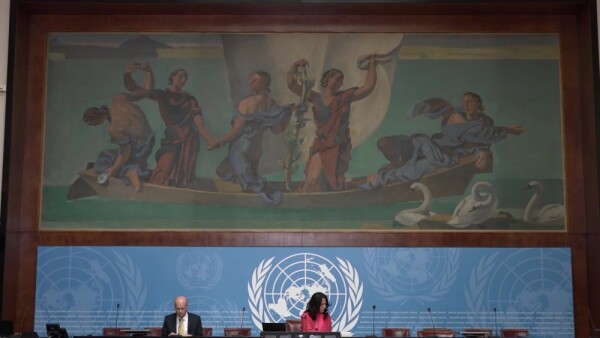
- Wide shot, Press Room III, UN Geneva, podium speakers.
- SOUNDBITE (EN) Dr Richard Brennan, Regional Emergency Director for WHO's Eastern Mediterranean Regional Office: “We’ve only had 248 cases in country thus far, but we can take no comfort in that. We have other countries in the region, the number of cases has got off to a slow start, and we’ve seen in more recent times a real acceleration, so we’ve seen this in Iraq, we’ve seen it in Turkey, we’ve seen it in Egypt and we can fully expect that we will have a similar development in Syria as well.”
- Close-up, journalist in Press Room III, UN Geneva, adjusting reading glasses.
- SOUNDBITE (EN) Dr Akjemal Magtymova, WHO Representative in Syria: “Even in healthcare settings, what I have witnessed crowds of patients in the facilities which are - there is - no use of masks, even among some of the health medical personnel, because of a lack of PPE.”
- Close-up, hands typing on laptop, Press Room III, UN Geneva.
- SOUNDBITE (EN) Dr Richard Brennan, Regional Emergency Director for WHO's Eastern Mediterranean Regional Office: “We still have an opportunity to mitigate the worst of the outbreak in Syria. And we really do need to collectively scale up our efforts with the local health authorities and local health workers to try and blunt the acceleration of the outbreak that we know is coming. We can do that most effectively by scaling up the effective public health measures that we know work: the disease surveillance, the testing, the isolation, the case management, the contact tracing and the community engagement and communications.”
- Medium shot, journalist reading from laptop, Press Room III, Palais des Nations.
- SOUNDBITE (EN) Elisabeth Byrs, spokesperson, WFP: “Syria today is facing an unprecedented hunger crisis as the prices of basic foods reach levels unseen even at the height of the nine-year conflict. Food prices are more than 200 per cent higher in less than a year.”
- Medium shot, journalists sitting in front of laptops, Press Room III, UN Geneva.
- SOUNDBITE (FR) Elisabeth Byrs, porte-parole, WFP/PAM : « Nous continuons notre travail, nous sommes présents, rien ne change pour nous. Nous rejoignons ces 4.800.000 personnes qui ont besoin d’assistance alimentaire du PAM dans les 14 gouvernorats de Syrie, nous continuons, et il faut pour cela que nous puissions avoir d’urgence ces 200 million dollars pour continuer à apporter une assistance alimentaire. »
- Medium shot, video journalist standing by TV camera, Press Room III, UN Geneva.
- SOUNDBITE (EN) Jens Laerke, spokesperson, OCHA: “A generation of children has known nothing but hardship, destruction and deprivation. Now over 11 million people still inside Syria need aid and protection. The economy across the region is imploding, in Syria it is imploding, not least due to the impact of COVID-19.”
- Medium shot, podium speaker, Press Room III, UN Geneva.
- Medium shot, journalist in foreground looking at podium (out of shot), while another journalist videos with his mobile phone, Press Room III, UN Geneva.
- Wide shot, podium speakers, Press Room III, UN Geneva.
Similar Stories

1
1
1
Edited News | OCHA , UNICEF , WFP
Aid agencies warned on Friday of the fast-developing humanitarian emergency inside Taiz City in Yemen, which has been encircled by de facto Houthi forces fighting government troops along the country’s west coast.

2
17
1
2
Edited News , Press Conferences , Images | OCHA , WMO
Two UN agencies teamed up on Wednesday to issue an appeal for immediate assistance to help communities already being impacted by the strongest El Niño on record.

3
16
2
2
Edited News , B-roll , Conferences , Images | UNITED NATIONS , UNOG
Sixth Consultative Meeting on Enhancing Coordination of Peace Initiatives and Efforts for Sudan

1
1
1
Edited News | UNICEF , WHO , UNHCR
Yemen war continues to force families from homes amid hunger and disease
More than 250,000 people have now fled renewed fighting in Yemen, the UN said on Tuesday, citing particular concern for those sheltering in the southwestern city of Taiz and the wider governorate, where access is “essentially blocked”.

1
1
1
Edited News | UNICEF
A little over one year since a ceasefire agreement was announced between Hamas fighters and Israel, more than 340 children have been reported killed and hundreds more injured, the UN Children’s Fund, UNICEF, said on Friday.

1
1
1
Edited News | UNICEF , IFRC
Six weeks after Nepal’s deadly flooding disaster, communities are still struggling to rebuild their lives, but they will need sustained help as global warming increases the risk of another Himalayan catastrophe, the UN Children’s Fund (UNICEF) said on Friday.

1
1
1
Edited News | WHO
In suspected Russia plague death, testing and monitoring underway – WHO
The death of a lab worker in Russia’s Siberia region has sparked concerns about plague being the cause, the UN World Health Organization (WHO) said on Tuesday, adding that it was following the situation closely.

1
1
Edited News | OHCHR , UNOG
UN Human Rights Chief Volker Türk on Friday provided and oral update to the 63rd session of the Human rights Council on Ukraine.

1
1
1
Edited News | OHCHR , UNOG
UN Human Rights Chief Volker Türk on Friday provided and oral update to the 63rd session of the Human rights Council on the human rights situation in Haiti.

1
1
1
Edited News | WHO
Repeated delays in bringing lifesaving medicines, prosthetics and more from Israel into Gaza risk having devastating consequences on Palestinians who urgently need them in the wartorn enclave, the UN World Health Organization (WHO) said on Friday. “A truck full of non-priority supplies or the right supplies arriving too late, doesn't save lives. That's the question that actually matters," said Dr Reinhilde Van De Weerdt, WHO Representative in the OPT.

1
1
1
Edited News | WHO
DRC: Early access to care and oxygen decisive for Ebola patients’ survival – WHO
In the Democratic Republic of the Congo (DRC), health workers fighting the country’s largest-ever Ebola outbreak are struggling to overcome critical challenges to patient care, the UN World Health Organization (WHO) warned on Tuesday.

1
1
1
Edited News | OCHA , UN
Civilians in Iran are continuing to feel the consequences of months of conflict and military escalation, the UN’s top official in the country has said, as loss of life, damage to civilian infrastructure and mounting economic pressures leave many facing continued uncertainty.