

The United Nations Office at Geneva
Multimedia Newsroom
Press Conferences | OCHA , OHCHR , UNHCR , WHO , WMO
UN Geneva briefing - 30 January 2024
UN GENEVA PRESS BRIEFING
30 January 2024
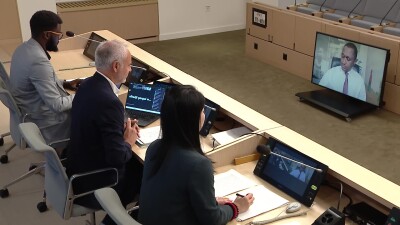
Alessandra Vellucci, Director of the United Nations Information Service in Geneva, chaired a hybrid briefing, which was attended by spokespersons and representatives of the Office of the High Commissioner for Human Rights, the Office for the Coordination of Humanitarian Affairs, the World Health Organization, the United Nations Refugee Agency, the United Nations Conference on Trade and Development, and the World Meteorological Organization.
Progress update on eliminating industrially produced trans fat
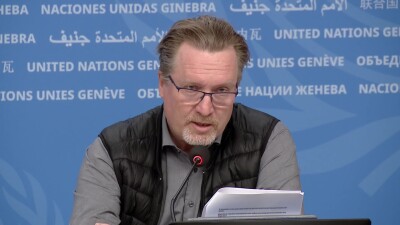
Dr. Francesco Branca, Director of the Department of Nutrition and Food Safety at the World Health Organization (WHO), explained that trans fat was produced industrially by the partial hydrogenation of any liquid oils which made them hard. Invented several decades earlier, those fats were known to be harmful and could lead to cardiovascular diseases. The good news was that only five year earlier, only six percent of people in the world had been protected through national policies on trans fats; today, as many as 46 percent of people in the world, across 53 countries, were covered. This way, an estimated 183,000 lives were being saved every year. Five countries had been awarded a WHO certificate for eliminating industrial trans fats from their food supply chains: Denmark, Lithuania, Poland, Saudi Arabia, and Thailand. Dr. Branca said that Cargill, one of the big manufacturers, had committed to eliminating trans fats from their production process. On the other side, the job was far from being finished, warned Dr. Branca. It was hoped that within next five years, at least 90 percent of the global population would be covered by policies on the elimination of industrially produced trans fat.
Responding to questions, Dr. Branca said that a report on this subject was being published shortly. The important news was to acknowledge the five countries which were leading the way, while the newly published data was encouraging and showing consistent progress towards eliminating trans fat. More information from the WHO on trans fat is available here.
Situation in Gaza
On questions related to the situation in the Gaza Strip, Dr. Francesco Branca, for the World Health Organization (WHO), said that a recent evaluation showed that close to 90 percent of the population were in a very precarious situation regarding food safety. The situation with food and water was very dire, reminded Christian Lindmeier, also for the World Health Organization; access to clean drinking water was affected by the desalination problems. The malnourished population was very prone to catching diseases, he warned, which came on the top of constant shelling. Mr. Lindmeier reminded that Dr. Tedros had already appealed to donors not to suspend the funding to UNRWA at this critical moment, which would only hurt the people of Gaza who now desperately needed this vital support.
Close to half of the people in Gaza were a refugee population for whom UNRWA had the primary responsibility, said Mr. Lindmeier. Before the war, UNRWA had run 22 health centers; only six were currently functioning. By 14 January, close to one million people were living in UNRWA shelters, almost half of the entire population of the Gaza Strip. Mr. Lindmeier emphasized that UNRWA provided vital services. He said that 70 percent of the almost 27,000 killed people in Gaza were women and children; the deliberate shelling of the civilians continued, which was acknowledged even by some of the closest allies of Israel. As important as the discussions were on the alleged participation of several UNRWA employees in the 7 October attacks, those discussions were also a distraction from the extremely dire conditions for the civilians in the enclave. Alessandra Vellucci, for the United Nations Information Service (UNIS), said that while the Secretary-General was horrified by the allegations against some UNRWA employees, he emphasized the need that the funding for UNRWA be continued at this critical point. Answering questions on what the humanitarian community would do, should UNWRA stop working for lack of funds, Ms. Vellucci said that the stopping had not happened yet, and the Secretary-General was working hard to solve the issue. Jens Laerke, for the Office for the Coordination of Humanitarian Affairs (OCHA), reiterated that UNRWA’s work was critical for humanitarian operations in Gaza.
Mr. Lindmeier, for the WHO, responding to other questions, said that scaling up of aid deliveries was possible; this was not a question for UN agencies, but for the Israeli forces as the occupying power. Why cut off an already existing lifeline, wondered Mr. Lindmeier. The situation around the Al Nasr hospital was getting worse, he said; it was a very important medical centre remaining in the south, which was under siege. The previous day, three missions to Al Nasr had been planned; only one convoy had been allowed through. Such denials and delays by the Israeli forces impeded the work of medical establishments.
Catherine Huissoud, for the United Nations Conference on Trade and Development (UNCTAD), informed that on 31 January, UNCTAD would release a rapid assessment of the social and economic deterioration in Gaza since the beginning of the military operation after 7 October 2023. The new report quantified GDP loss, recovery timelines, and described enduring effects on poverty and household expenditure; it painted a daunting picture of the development challenges ahead. Utilizing innovative satellite imagery and official data, UNCTAD estimated the current level of contraction of the economy.
Myanmar three years after the coup
Jeremy Laurence, for the Office of the High Commissioner for Human Rights (OHCHR), read a statement by the UN High Commissioner for Human Rights, Volker Türk, ahead of the third anniversary of the military coup in Myanmar. Three years after the coup, Myanmar’s ever deteriorating human rights crisis was now in freefall, with insufficient world attention paid to the misery and pain of its people. Since the end of October 2023, the situation had deteriorated even further. Pitched battles between the military and armed opposition groups had resulted in mass displacement and civilian casualties. Sources had verified that over 554 people had died since October. Overall for 2023, the number of civilians reportedly killed by the military had risen to over 1,600. As of 26 January, credible sources had documented the arrest of nearly 26,000 people on political grounds, of whom 19,973 remained in detention.
Rakhine State had been particularly hard hit since fighting restarted there in November. Many communities, especially the Rohingya, had already been suffering from the impacts of Cyclone Mocha and the military’s months-long limitation of humanitarian access and provision of assistance. There had now been several reports of Rohingya deaths and injuries amid the military’s shelling of Rohingya villages. OHCHR stressed that parties to armed conflicts had to take constant care to spare the civilians and civilian objects, in the conduct of military operations, which includes taking feasible measures to protect the civilian population under their control against the effects of attack. “This crisis will only be resolved by insisting on accountability for the military’s leadership, the release of political prisoners and the restoration of civilian rule,” High Commissioner Türk said, urging all Member States to take appropriate measures to address this crisis. The full statement is available here.
Replying to questions from the media, James Rodehaver, head of the Myanmar Team at the Office of the High Commissioner for Human Rights (OHCHR), speaking from Bangkok, said that the fighting, while significantly subsided following a China-brokered ceasefire, had continued with military attacks against the three armed groups in the so-called “Brotherhood Alliance.” Those armed groups were now very much in control of the areas they had captured; OHCHR was keen to see what kind of impact that had on the governance of those areas and how the civilian population was being cared for. Mr. Rodehaver said that the situation in the Rakhine State was dire, where both parties – the Myanmar Military and the Arakan Army – were establishing themselves in and around Rohingya villages, using schools and mosques for artillery attacks and mortar fire. Mr. Rodehaver stressed the importance of collecting comprehensive, detailed information for the sake of future accountability. It was very hard to get reliable data on weapons transfers, but some foreign assistance still seemed to be getting through to the Myanmar Military, including jet fuel and maintenance services. Organized crime and trafficking networks were still very active in the country. Many of the crossing points with neighbouring countries were now under the control of ethnic armed groups rather than the Myanmar Miliary. Rohingya had very limited options, which was why many amongst them opted for unseaworthy vessels. Mr. Rodehaver explained that almost all funding for his team came from extrabudgetary sources, and the fundraising was a labour-intensive process.
Shabia Mantoo, for the United Nations Refugee Agency (UNHCR), answering a question, said that there were still around one million Rohingya refugees hosted by Bangladesh. Continued support for them was or paramount importance. UNHCR was present and providing assistance in both Bangladesh and Myanmar.
OHCHR appeals for USD 500 million in extrabudgetary funding for 2024
Jeremy Laurence, for the Office of the High Commissioner for Human Rights (OHCHR), informed that UN High Commissioner for Human Rights Volker Türk today appealed for a significant increase in annual voluntary funding for his Office this year, warning it was still drastically short of funds needed to more effectively advance human rights globally.
In 2023, he reminded, the top five contributors of voluntary funds had been the European Union, the United States of America, Sweden, Germany, and Norway. More information is available here.
Record temperature in Europe
Clare Nullis, for the World Meteorological Organization (WMO), said that the WMO had officially confirmed the record temperature for continental Europe: 48.8 degrees Celsius, recorded in Sicily, Italy in August 2021. The procedures to confirm such records were painstaking and time-consuming, she explained. More details are available here. It was possible that a new global temperature record would be witnessed this year, she said.
Ms. Nullis also informed that the WMO had appointed Ko Barrett as Deputy Secretary-General and Thomas Asare as Assistant Secretary-General.
Announcements
Christian Lindmeier, for the World Health Organization (WHO), reminded that an embargoed press conference ahead of the World Cancer Day would be held at 2 pm today.
At 3 pm today, a press conference would be held ahead of the Tenth session of the Conference of the Parties (COP10) to the WHO Framework Convention on Tobacco Control, which would take place in Panama City from 5 to 10 February.
Alessandra Vellucci, for the United Nations Information Service, informed that the Committee on the Elimination of Discrimination against Women, was reviewing today the report of Niger.
The Committee on the Rights of the Child would hold on 1 February a meeting with State parties before closing its 95th session on 2 February.
The World Interfaith Harmony Week would be marked from 1 to 7 February, informed Ms. Vellucci.
***
The webcast for this briefing is available here: https://bit.ly/unog30012024
The audio for this briefing is available here: https://bit.ly/UNOG30012024
Similar Stories
1
1
1
Press Conferences | UNHCR
End of UNHCR's 77th Annual Executive Committee (ExCom) meeting week
1
1
1
Press Conferences | UNICEF , IOM , UNHCR
UN Special Assistant to the Personal Envoy Office (SUDAN): Peace Initiatives and Efforts in Sudan; UNICEF: Dire situation of children in Gaza; IOM: Damaged Homes and Energy Attacks Risk Displacing Ukrainians for this winter; UNHCR: update on EXCOM week
1
1
1
Press Conferences | IOM , UNDRR
UN stresses importance of household preparedness for disaster risk reduction.
1
1
1
Statements , Press Conferences | OHCHR
1
1
1
Press Conferences | UNHCR , UNICEF , IFRC , OHCHR , UN WOMEN , IOM , OCHA , WHO
UNHCR – ExCom Meeting, UNICEF – Nepal Recovery, IFRC – Flash Floods, WHO – Mental Health, IOM – South Sudan Floods, OCHA – DRC Humanitarian aid, UNHCR – Sahel Displacement, UNICEF – Yemen Update, IOM – Gaza Shelter, UN Women – Gaza Women, OHCHR – Arrests and detentions of Syrians by Israeli force
2
1
2
Press Conferences | UNCTAD
Presentation of the Trade and Developement Report 2026
Embargoed until 9 October 2026 at 11 a.m. (Geneva Time)
UNCTAD: UNCTAD’s flagship report finds that governments increasingly use industrial, trade, financial and technology policies to pursue economic and national security objectives. Market access and the ability to move into higher-value activities now depend more heavily on technology, finance and geopolitics.
1
1
1
Press Conferences | UPU
Release of the State of the Postal Sector Report 2026
1
1
1
Press Conferences | IOM , ITU , UNECE , UNICEF , WHO , WMO
UNICEF: Ebola, DRC - children orphans or separating them from parents and caregivers; IOM: Humanitarian needs in Djibouti amid arrivals from Yemen and increased migrant movements; WHO: Darfur, scale of health needs far exceeds available resources; WMO co-sponsored Global Heat Forum, Bangkok, monthly Global Seasonal Climate Update; UNECE: UN Forum of Mayors; ITU Plenipotentiary Conference 2026; WHO: child and adolescent obesity guidelines and new global roadmap to tackle pregnancy hypertension, a leading cause of maternal mortality
1
1
1
Press Conferences | OCHA , UN WOMEN , UNHCR , WFP , WHO , WTO , UNEP
OCHA – $160M CERF allocation to 12 underfunded crises; UNHCR – 5.8M refugee children remain out of school amid funding cuts; UN Women – Middle East escalation and food security among women/girls; WHO – Gaza supplies and overall situation; WFP – Yemen food insecurity and impact on global hunger ; UNEP - First International Conference of the Global Framework on Chemicals in Geneva | 16-20 November 2026
1
1
1
Press Conferences | UNHCR , WHO
Yemen's health system nears collapse amid conflict, causing rising casualties and medicine shortages.
1
1
1
Press Conferences | HRC
Update by the Expert Mechanism to Advance Racial Justice and Equality in Law Enforcement
1
1
1
Press Conferences | WIPO , WHO , UNICEF , UNHCR , IOM , WFP , FAO
WIPO Global Innovation Index 2026 launch and press conference, WHO Composition of influenza vaccines for the 2027 Southern Hemisphere flu season, UNICEF Yemen hunger and malnutrition; UNHCR Sudan displacement into Chad; IOM Ebola and population movements in DRC; WFP emergency food assistance in Nepal; and FAO food loss and waste.