

The United Nations Office at Geneva
Multimedia Newsroom
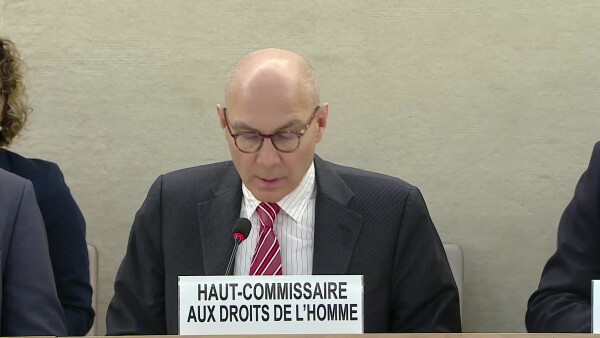
“The Russian Federation's invasion of Ukraine has thrown us back to an archaic era. An era when a neighboring country’s territory could be attacked and taken, at will, as one’s own. When the identity and history of communities could be denied, and reality rewritten,” Türk said.
“The UN Charter was supposed to put an end to such atavistic thinking. But today, a nation is struggling to survive. After 13 months of the Russian Federation's war against Ukraine, severe violations of human rights and international humanitarian law have become shockingly routine,” the High Commissioner said.
“Using the rigorous methodology of my Office, our staff have verified more than 8,400 civilian deaths, and over 14,000 civilians wounded, since 24 February 2022. These figures are just the tip of the iceberg. Most of the casualties resulted from Russian forces' use of wide-impact explosive weaponry in residential neighborhoods,” he said.
“In occupied areas of Ukraine, we have documented numerous summary executions and targeted attacks on civilians since February 2022 by Russia’s military forces, including affiliated armed groups, such as the Wagner Group. We have also documented 621 cases of enforced disappearances and arbitrary detention,” the High Commissioner said.
During the same period, the UN Human Rights Office documented 91 cases of enforced disappearances and arbitrary detention by Ukrainian security forces. Of the 73 victims interviewed, 53 per cent had been tortured or ill-treated. The Office also documented 24 cases of sexual violence by Ukrainian personnel; most of these consisted of threats of sexual violence during initial stages of detention, as well as forced public stripping.
Türk also spoke about the transfers of Ukrainian civilians, noting that they may constitute violations of Article 49 of the Fourth Geneva Convention, which prohibits forcible transfers to occupied territory, or deportations to any other country, regardless of their motive.
“Ukrainian civilians have been transferred to occupied territory or to the Russian Federation. They include children and adults who had been housed in social care institutions, as well as unaccompanied children living in areas of Ukraine occupied or temporarily controlled by Russian forces,” the High Commissioner said.
The UN Human Rights Office has interviewed more than 400 prisoners of war, on both sides. Ukraine, to its credit, the High Commissioner said, had provided unfettered and confidential access to places of internment.
“The Russian Federation, however, gave us no access, despite multiple requests, meaning that interviews with Ukrainian POWs could take place only after they had been released,” Türk said, stressing that this lack of access meant that numbers of cases ought not to be compared against each other.
“More than 90 per cent of Ukrainian POWs that my Office interviewed said that they were tortured or ill-treated, notably in penitentiary facilities, including through so-called ‘welcoming beatings’ on their arrival, as well as frequent acts of torture throughout detention” Türk said.
“Almost half of the Russian POWs who were interviewed indicated that they had been tortured or ill-treated. Most of these acts of torture reportedly occurred soon after capture. We did not find a sustained pattern of severe ill-treatment in more permanent places of internment,” the High Commissioner said.
The UN Human Rights Office documented the summary execution by Russian personnel of Ukrainian prisoners of war shortly after their capture, with one victim severely mutilated before he was killed. The Office continues to gather and analyse information about the devastating incident in Olenivka, in July 2022, in which at least 50 Ukrainian POWs were killed.
The Office also documented the summary execution by Ukrainian armed forces of Russian POWs and personnel hors de combat, immediately following their capture.
International humanitarian law encapsulates minimum core values that, in the most distressing circumstances, preserve our humanity, the High Commissioner said.
“Even amid the bloodshed of war, the rules of international humanitarian law especially protect the lives and dignity of civilians, wounded and sick soldiers, and prisoners of war. Nobody is above these laws,” Türk stated.
And yet for the woman with disabilities who is unable to leave her house under heavy shelling; for the tens of thousands whose lives and bodies are being torn apart; for prisoners of war who are tortured and deprived of medical care; for children growing up in terror – these laws are violated daily.
“I speak for many when I say that I will never forget the photographs of a dying, heavily pregnant woman being carried on a stretcher from the bombed-out ruins of a Mariupol maternity hospital in March 2022. All these victims have a right to justice – and to a just peace,” the High Commissioner said.
“At a time when humanity faces overwhelming existential challenges, this destructive war is tugging us away from the work of building solutions – the work of ensuring our survival.
This war defies any reason. This madness must end, and peace be found, in line with the UN Charter and international law,” Türk stated.
ENDS
For more information and media requests, please contact:
Ravina Shamdasani - + 41 22 917 9169 / ravina.shamdasani@un.org or
Liz Throssell + 41 22 917 9296 / elizabeth.throssell@un.org or
Jeremy Laurence + +41 22 917 9383 / jeremy.laurence@un.org or
Marta Hurtado - + 41 22 917 9466 / marta.hurtadogomez@un.org
Tag and share
Twitter @UNHumanRights
Facebook unitednationshumanrights
Instagram @unitednationshumanrights
Tag and share - Twitter: @UNHumanRights and Facebook: unitednationshumanrights
- Exterior shot: Wide shot Alley of Flags Palais des Nations
- Wide shot: Room 20
- SOUNDBITE (English) – Volker Türk, UN High Commissioner for Human Rights (OHCHR): “The Russian Federation's invasion of Ukraine has thrown us back to an archaic era. An era when a neighboring country’s territory could be attacked and taken, at will, as one’s own. When the identity and history of communities could be denied, and reality rewritten,”
- Cut Away: Room 20
- SOUNDBITE (English) – Volker Türk, UN High Commissioner for Human Rights (OHCHR): “The UN Charter was supposed to put an end to such atavistic thinking. But today, a nation is struggling to survive. After 13 months of the Russian Federation's war against Ukraine, severe violations of human rights and international humanitarian law have become shockingly routine,”
- Cut Away: Room 20
- SOUNDBITE (English) – Volker Türk, UN High Commissioner for Human Rights (OHCHR): “Using the rigorous methodology of my Office, our staff have verified more than 8,400 civilian deaths, and over 14,000 civilians wounded, since 24 February 2022. These figures are just the tip of the iceberg. Most of the casualties resulted from Russian forces' use of wide-impact explosive weaponry in residential neighborhoods,”
- Cut Away: Room 20
- SOUNDBITE (English) – Volker Türk, UN High Commissioner for Human Rights (OHCHR): “In occupied areas of Ukraine, we have documented numerous summary executions and targeted attacks on civilians since February 2022 by Russia’s military forces, including affiliated armed groups, such as the Wagner Group. We have also documented 621 cases of enforced disappearances and arbitrary detention,”
- Cut Away: Room 20
- SOUNDBITE (English) – Volker Türk, UN High Commissioner for Human Rights (OHCHR): “Ukrainian civilians have been transferred to occupied territory or to the Russian Federation. Theyinclude children and adults who had been housed in social care institutions, as well as unaccompanied children living in areas of Ukraine occupied or temporarily controlled by Russian forces,”
- Cut Away: Room 20
- SOUNDBITE (English) – Volker Türk, UN High Commissioner for Human Rights (OHCHR): “The Russian Federation, however, gave us no access, despite multiple requests, meaning that interviews with Ukrainian POWs could take place only after they had been released,”
- Cut Away: Room 20
- SOUNDBITE (English) – Volker Türk, UN High Commissioner for Human Rights (OHCHR): “More than 90 per cent of Ukrainian POWs that my Office interviewed said that they were tortured or ill-treated, notably in penitentiary facilities, including through so-called ‘welcoming beatings’ on their arrival, as well as frequent acts of torture throughout detention”
- Cut Away: Room 20
- SOUNDBITE (English) – Volker Türk, UN High Commissioner for Human Rights (OHCHR): “Almost half of the Russian POWs who were interviewed indicated that they had been tortured or ill-treated. Most of these acts of torture reportedly occurred soon after capture. We did not find a sustained pattern of severe ill-treatment in more permanent places of internment,”
- Cut Away: Room 20
- SOUNDBITE (English) – Volker Türk, UN High Commissioner for Human Rights (OHCHR): “Even amid the bloodshed of war, the rules of international humanitarian law especially protect the lives and dignity of civilians, wounded and sick soldiers, and prisoners of war. Nobody is above these laws,”
- Cut Away: Room 20
- SOUNDBITE (English) – Volker Türk, UN High Commissioner for Human Rights (OHCHR): “I speak for many when I say that I will never forget the photographs of a dying, heavily pregnant woman being carried on a stretcher from the bombed-out ruins of a Mariupol maternity hospital in March 2022. All these victims have a right to justice – and to a just peace,”
- Cut Away: Room 20
- SOUNDBITE (English) – Volker Türk, UN High Commissioner for Human Rights (OHCHR): “At a time when humanity faces overwhelming existential challenges, this destructive war is tugging us away from the work of building solutions – the work of ensuring our survival. This war defies any reason. This madness must end, and peace be found, in line with the UN Charter and international law,”
Similar Stories

1
1
1
Edited News | OCHA , UNICEF , WFP
Aid agencies warned on Friday of the fast-developing humanitarian emergency inside Taiz City in Yemen, which has been encircled by de facto Houthi forces fighting government troops along the country’s west coast.

2
17
1
2
Edited News , Press Conferences , Images | OCHA , WMO
Two UN agencies teamed up on Wednesday to issue an appeal for immediate assistance to help communities already being impacted by the strongest El Niño on record.

3
16
2
2
Edited News , B-roll , Conferences , Images | UNITED NATIONS , UNOG
Sixth Consultative Meeting on Enhancing Coordination of Peace Initiatives and Efforts for Sudan

1
1
1
Edited News | UNICEF , WHO , UNHCR
Yemen war continues to force families from homes amid hunger and disease
More than 250,000 people have now fled renewed fighting in Yemen, the UN said on Tuesday, citing particular concern for those sheltering in the southwestern city of Taiz and the wider governorate, where access is “essentially blocked”.

1
1
1
Edited News | UNICEF
A little over one year since a ceasefire agreement was announced between Hamas fighters and Israel, more than 340 children have been reported killed and hundreds more injured, the UN Children’s Fund, UNICEF, said on Friday.

1
1
1
Edited News | UNICEF , IFRC
Six weeks after Nepal’s deadly flooding disaster, communities are still struggling to rebuild their lives, but they will need sustained help as global warming increases the risk of another Himalayan catastrophe, the UN Children’s Fund (UNICEF) said on Friday.

1
1
1
Edited News | WHO
In suspected Russia plague death, testing and monitoring underway – WHO
The death of a lab worker in Russia’s Siberia region has sparked concerns about plague being the cause, the UN World Health Organization (WHO) said on Tuesday, adding that it was following the situation closely.

1
1
Edited News | OHCHR , UNOG
UN Human Rights Chief Volker Türk on Friday provided and oral update to the 63rd session of the Human rights Council on Ukraine.

1
1
1
Edited News | OHCHR , UNOG
UN Human Rights Chief Volker Türk on Friday provided and oral update to the 63rd session of the Human rights Council on the human rights situation in Haiti.

1
1
1
Edited News | WHO
Repeated delays in bringing lifesaving medicines, prosthetics and more from Israel into Gaza risk having devastating consequences on Palestinians who urgently need them in the wartorn enclave, the UN World Health Organization (WHO) said on Friday. “A truck full of non-priority supplies or the right supplies arriving too late, doesn't save lives. That's the question that actually matters," said Dr Reinhilde Van De Weerdt, WHO Representative in the OPT.

1
1
1
Edited News | WHO
DRC: Early access to care and oxygen decisive for Ebola patients’ survival – WHO
In the Democratic Republic of the Congo (DRC), health workers fighting the country’s largest-ever Ebola outbreak are struggling to overcome critical challenges to patient care, the UN World Health Organization (WHO) warned on Tuesday.

1
1
1
Edited News | OCHA , UN
Civilians in Iran are continuing to feel the consequences of months of conflict and military escalation, the UN’s top official in the country has said, as loss of life, damage to civilian infrastructure and mounting economic pressures leave many facing continued uncertainty.