

The United Nations Office at Geneva
Multimedia Newsroom
Hunger in Latin America: whole continent is on the move, warns WFP
Ever greater numbers of vulnerable people are risking their lives on dangerous migration routes in Latin America, forced to move by the global food security crisis that’s been made worse by spiralling inflation linked to the war in Ukraine, the UN World Food Programme (WFP) said on Tuesday.
“We are having countries like Haiti with 26 per cent food inflation and we have other countries that really are off the charts even with food inflation,” said Lola Castro, WFP Regional Director in Latin America and the Caribbean (LAC).
Negative trend
Latest data indicates that 9.7 million people in the 13 LAC countries where WFP works are already extremely food insecure, up from 8.3 million in late 2021. “We are looking at around 14 million people as forecast if the crisis continues,” said Ms. Castro. “This is not good and we are going back almost to the high levels that we had during COVID-19”, when 17.2 million people were severely food insecure, at the peak of the pandemic.
Fuel and energy prices were also “a huge issue” for those least able to feed themselves, Ms. Castro told journalists in Geneva. “We have seen how in last two years the cost of moving a tonne of food in our region is seven times more expensive.”
Desperate migrants
The dramatic deterioration in people’s daily lives has given them little option but to leave their communities and head north, even if it means risking their lives, the WFP official explained. Communities of particular concern include Haitian migrants who travelled during the COVID-19 pandemic in search of work and shelter in Brazil and Chile.
“All of you are watching caravans, caravans of migrants moving, and before we used to talk about migration happening from the north of Central America, but now, unfortunately, we talk about migration being hemispheric. We have the whole continent on the move.”
Darien Gap danger
One of the clearest signs of people’s desperation is the fact that they are willing to risk their lives crossing the Darien Gap, a particularly arduous and dangerous forest route in Central America that allows access from the south of the continent to the north.
“In 2020, 5,000 people passed by the Darien Gap, migrating from South America into Central America, and you know what, in 2021 151,000 people passed, and this is 10 days walking through a forest, 10 days through rivers, crossing mountains and people die because this one of most dangerous jungles in the world.”
For these migrants the reason why they are on the move is simple, the WFP official explained: “They are leaving communities where they have lost everything to climate crisis, they have no food security, they have no ability to feed their people and their families.”
UN data indicates that of the 69 economies now experiencing food, energy and financial shocks, 19 are in the Latin America and the Caribbean region.
This has meant that governments which were already doing their utmost to sustain social welfare safety nets during the coronavirus pandemic are now struggling to maintain this level of support to populations.
ends
STORY: Latin America & Caribbean Food Alert - WFP
TRT: 1 min 59s
SOURCE: UNTV CH
RESTRICTIONS: NONE
LANGUAGE: ENGLISH / NATS
ASPECT RATIO: 16:9
DATELINE: 14 June 2022 GENEVA, SWITZERLAND
SHOTLIST
- Exterior medium shot, Palais des Nations flag alley, nations’ flags moving gently in the wind, a lovely day.
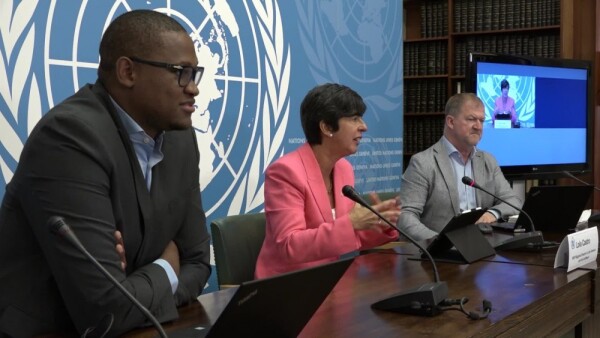
- Wide shot, podium showing speakers in Press room.
- SOUNDBITE (English) — Lola Castro, WFP Regional Director in Latin America and the Caribbean: “We are having countries like Haiti with 26 per cent food inflation and we have other countries that really are off the charts even with food inflation.”
- Medium shot, journalist sitting in front of laptop, hand hovering over keyboard.
- SOUNDBITE (English) — Lola Castro, WFP Regional Director in Latin America and the Caribbean: “The fuel and energy are also a huge issue. We have seen how in last two years the cost of moving a tonne of food in our region is seven times more expensive.”
- Medium shot, photographer preparing to take a picture.
- SOUNDBITE (English) — Lola Castro, WFP Regional Director in Latin America and the Caribbean: “What we are looking now is we’re looking at 9.7 million people extremely food insecure, severely food insecure in the countries where WFP works, but we are looking at around 14 million people as forecast if the crisis continues. And this is not good and we are going back almost to the high levels that we had during COVID-19.”
- Medium-wide shot, podium speakers temporarily obscured by participant passing in front of TV camera.
- SOUNDBITE (English) — Lola Castro, WFP Regional Director in Latin America and the Caribbean: “All of you are watching caravans, caravans of migrants moving, and before we used to talk about migration happening from the north of Central America, but now, unfortunately, we talk about migration being hemispheric. We have the whole continent on the move.”
- Close-up, podium speakers, side shot.
- SOUNDBITE (English) — Lola Castro, WFP Regional Director in Latin America and the Caribbean: “In 2020, 5,000 people passed by the Darien Gap, migrating from South America into Central America, and you know what, in 2021 151,000 people passed, and this is 10 days walking through a forest, 10 days through rivers, crossing mountains and people die because this is one of most dangerous jungles in the world.”
- Medium shot, journalists, side shot.
- SOUNDBITE (English) — Lola Castro, WFP Regional Director in Latin America and the Caribbean: “They are leaving communities where they have lost everything to climate crisis, they have no food security, they have no ability to feed their people and their families.”
- Medium shot: podium speakers, side shot.
- Close-up, hand holding pen and writing in notepad.
- Close-up, speaker shown in TV camera viewfinder and to rear.
Similar Stories

1
1
1
Edited News | OCHA , UNICEF , WFP
Aid agencies warned on Friday of the fast-developing humanitarian emergency inside Taiz City in Yemen, which has been encircled by de facto Houthi forces fighting government troops along the country’s west coast.

2
17
1
2
Edited News , Press Conferences , Images | OCHA , WMO
Two UN agencies teamed up on Wednesday to issue an appeal for immediate assistance to help communities already being impacted by the strongest El Niño on record.

3
16
2
2
Edited News , B-roll , Conferences , Images | UNITED NATIONS , UNOG
Sixth Consultative Meeting on Enhancing Coordination of Peace Initiatives and Efforts for Sudan

1
1
1
Edited News | UNICEF , WHO , UNHCR
Yemen war continues to force families from homes amid hunger and disease
More than 250,000 people have now fled renewed fighting in Yemen, the UN said on Tuesday, citing particular concern for those sheltering in the southwestern city of Taiz and the wider governorate, where access is “essentially blocked”.

1
1
1
Edited News | UNICEF
A little over one year since a ceasefire agreement was announced between Hamas fighters and Israel, more than 340 children have been reported killed and hundreds more injured, the UN Children’s Fund, UNICEF, said on Friday.

1
1
1
Edited News | UNICEF , IFRC
Six weeks after Nepal’s deadly flooding disaster, communities are still struggling to rebuild their lives, but they will need sustained help as global warming increases the risk of another Himalayan catastrophe, the UN Children’s Fund (UNICEF) said on Friday.

1
1
1
Edited News | WHO
In suspected Russia plague death, testing and monitoring underway – WHO
The death of a lab worker in Russia’s Siberia region has sparked concerns about plague being the cause, the UN World Health Organization (WHO) said on Tuesday, adding that it was following the situation closely.

1
1
Edited News | OHCHR , UNOG
UN Human Rights Chief Volker Türk on Friday provided and oral update to the 63rd session of the Human rights Council on Ukraine.

1
1
1
Edited News | OHCHR , UNOG
UN Human Rights Chief Volker Türk on Friday provided and oral update to the 63rd session of the Human rights Council on the human rights situation in Haiti.

1
1
1
Edited News | WHO
Repeated delays in bringing lifesaving medicines, prosthetics and more from Israel into Gaza risk having devastating consequences on Palestinians who urgently need them in the wartorn enclave, the UN World Health Organization (WHO) said on Friday. “A truck full of non-priority supplies or the right supplies arriving too late, doesn't save lives. That's the question that actually matters," said Dr Reinhilde Van De Weerdt, WHO Representative in the OPT.

1
1
1
Edited News | WHO
DRC: Early access to care and oxygen decisive for Ebola patients’ survival – WHO
In the Democratic Republic of the Congo (DRC), health workers fighting the country’s largest-ever Ebola outbreak are struggling to overcome critical challenges to patient care, the UN World Health Organization (WHO) warned on Tuesday.

1
1
1
Edited News | OCHA , UN
Civilians in Iran are continuing to feel the consequences of months of conflict and military escalation, the UN’s top official in the country has said, as loss of life, damage to civilian infrastructure and mounting economic pressures leave many facing continued uncertainty.