

The United Nations Office at Geneva
Multimedia Newsroom
Mali Press shutdowns reflect growing regional intolerance: UN rights office
Mali’s ban on two major international broadcasters operating inside the country is a worrying development and reflects growing regional intolerance towards freedom of expression, the UN rights office, OHCHR, said on Friday.
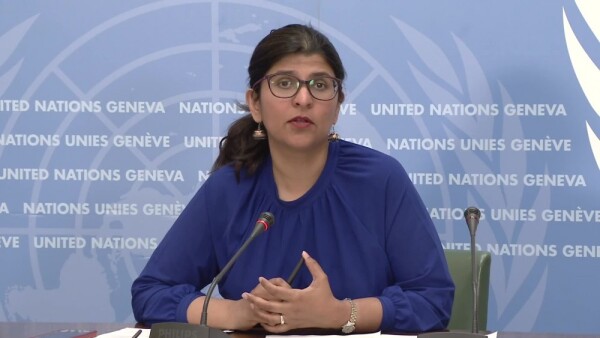
Highlighting the “pervasive chilling effect on journalists and bloggers” of the situation in the west African nation, OHCHR spokesperson Ravina Shamdasani said that the move against Radio France International (RFI) and France24 was just “the latest in a string of actions” by the military authorities.
“We are deeply dismayed by the Malian media regulator’s decision to definitively suspend Radio France International (RFI) and France24,” Ms. Shamdasani said. “We call on Mali’s transitional military authorities to reverse this ban and allow independent media to work freely in the country.”
Mali has seen two armed ousters in the last two years, the first in August 2020, the second in May last year.
According to OHCHR, the suspensions against RFI and France 24 were first imposed by the Government on 16 March.
Both broadcasters had been accused of airing “false allegations” about reports of human rights violations by the Malian army, Ms. Shamdasani explained, adding that “on 27 April, the High Authority for Communication announced that those provisional suspensions would be ‘definitive’”.
The use of digital surveillance tools has made it increasingly difficult for journalists, bloggers and rights activists to operate safely inside Mali and protect their sources, the OHCHR official said, pointing to the prevailing “climate of self-censorship” among reporters and rights defenders.
“More, not less, scrutiny is needed” of the actions of the authorities, Ms. Shamdasani insisted, her comments coming after some 500 people were allegedly summarily executed in Moura, a village in central Mali, earlier this month.
To date, UN investigators have yet to be granted access to Moura, where Malian Armed Forces accompanied by foreign military personnel reportedly carried out killings and other grave violations. Since the atrocity, OHCHR has continued to document other serious allegations of violations of international human rights law and international humanitarian law in many parts of the country.
Amid ongoing regional insecurity outside Mali and across the Sahel caused by climate shocks, violence linked to competition for dwindling resources and mass displacement, Ms. Shamdasani warned that there was “a worrying trend in some of the other countries in West Africa as well, and this applies not only to freedom of expression and then the work of journalists, but also civic space and civil society as a whole; there appears to be a growing intolerance for dissent, unfortunately.”
The problem extends well beyond Africa and is particularly relevant ahead of World Press Freedom Day on May 2, the OHCHR official insisted.
“We’re seeing journalists going through tremendous risks to try to get the information out there. We’ve spoken quite often about all the misinformation during the conflict, during the current conflict in Ukraine coming from both sides, really, and the important role of journalists and the tremendous risks that they take to be able to get objective, independent information to us.”
ends
STORY: Mali Press Shutdowns – OHCHR
TRT: 1 mins 43s
SOURCE: UNTV CH
RESTRICTIONS: NONE
LANGUAGE: ENGLISH
ASPECT RATIO: 16:9
DATELINE: 29 April 2022 GENEVA, SWITZERLAND
SHOTLIST
- Exterior wide shot, flag alley, UN Geneva.
- Wide shot, UN Geneva Press room, podium speaker and large-screen TV showing speakers in room and remotely.
- SOUNDBITE (ENGLISH): Ravina Shamdasani, spokesperson, OHCHR: “We are deeply dismayed by the Malian media regulator’s decision to definitively suspend Radio France International (RFI) and France24. We call on Mali’s transitional military authorities to reverse this ban and allow independent media to work freely in the country.”
- Close-up, journalist’s hands typing on laptop, other participants to rear.
- SOUNDBITE (ENGLISH): Ravina Shamdasani, spokesperson, OHCHR: “The suspensions were first imposed by the Government until further notice on 16 March, accusing the two broadcasters of airing ‘false allegations’ about reports of human rights violations by the Malian army. On 27 April, the High Authority for Communication announced that those provisional suspensions would be ‘definitive’.”
- Close-up, journalist’s hands seen typing on laptop.
- SOUNDBITE (ENGLISH): Ravina Shamdasani, spokesperson, OHCHR: “We are seeing a worrying trend in some of the other countries in West Africa as well and this applies not only to freedom of expression and then the work of journalists, but also civic space and civil society as a whole; there appears to be a growing intolerance for dissent, unfortunately.”
- Medium shot, participants working on laptops.
- SOUNDBITE (ENGLISH): Ravina Shamdasani, spokesperson, OHCHR: “And we’re seeing journalists going through tremendous risks to try to get the information out there. We’ve spoken quite often about all the misinformation during the conflict, during the current conflict in Ukraine coming from both sides, really, and the important role of journalists and the tremendous risks that they take to be able to get objective, independent information to us.”
- Medium-wide shot, participants seated in foreground, podium speakers and large-screen TVs to rear.
- Medium close-up, masked participant typing on laptop, two other masked participants to her side, and large-screen TV showing podium speaker to rear.
- Close-up, side shot of large-screen TV showing podium speaker in room.
Similar Stories

2
17
1
2
Edited News , Press Conferences | OCHA , WMO
Two UN agencies teamed up on Wednesday to issue an appeal for immediate assistance to help communities already being impacted by the strongest El Niño on record.

3
16
2
2
B-roll , Conferences , Edited News | UNITED NATIONS , UNOG
Sixth Consultative Meeting on Enhancing Coordination of Peace Initiatives and Efforts for Sudan

1
1
1
Edited News | UNICEF , WHO , UNHCR
Yemen war continues to force families from homes amid hunger and disease
More than 250,000 people have now fled renewed fighting in Yemen, the UN said on Tuesday, citing particular concern for those sheltering in the southwestern city of Taiz and the wider governorate, where access is “essentially blocked”.

1
1
1
Edited News | UNICEF
A little over one year since a ceasefire agreement was announced between Hamas fighters and Israel, more than 340 children have been reported killed and hundreds more injured, the UN Children’s Fund, UNICEF, said on Friday.

1
1
1
Edited News | UNICEF , IFRC
Six weeks after Nepal’s deadly flooding disaster, communities are still struggling to rebuild their lives, but they will need sustained help as global warming increases the risk of another Himalayan catastrophe, the UN Children’s Fund (UNICEF) said on Friday.

1
1
1
Edited News | WHO
In suspected Russia plague death, testing and monitoring underway – WHO
The death of a lab worker in Russia’s Siberia region has sparked concerns about plague being the cause, the UN World Health Organization (WHO) said on Tuesday, adding that it was following the situation closely.

1
1
Edited News | OHCHR , UNOG
UN Human Rights Chief Volker Türk on Friday provided and oral update to the 63rd session of the Human rights Council on Ukraine.

1
1
1
Edited News | OHCHR , UNOG
UN Human Rights Chief Volker Türk on Friday provided and oral update to the 63rd session of the Human rights Council on the human rights situation in Haiti.

1
1
1
Edited News | WHO
Repeated delays in bringing lifesaving medicines, prosthetics and more from Israel into Gaza risk having devastating consequences on Palestinians who urgently need them in the wartorn enclave, the UN World Health Organization (WHO) said on Friday. “A truck full of non-priority supplies or the right supplies arriving too late, doesn't save lives. That's the question that actually matters," said Dr Reinhilde Van De Weerdt, WHO Representative in the OPT.

1
1
1
Edited News | WHO
DRC: Early access to care and oxygen decisive for Ebola patients’ survival – WHO
In the Democratic Republic of the Congo (DRC), health workers fighting the country’s largest-ever Ebola outbreak are struggling to overcome critical challenges to patient care, the UN World Health Organization (WHO) warned on Tuesday.

1
1
1
Edited News | OCHA , UN
Civilians in Iran are continuing to feel the consequences of months of conflict and military escalation, the UN’s top official in the country has said, as loss of life, damage to civilian infrastructure and mounting economic pressures leave many facing continued uncertainty.
1
1
1
Edited News | WHO , UNICEF
Aid agencies in Yemen highlighted the growing hunger emergency sparked by renewed fighting between Houthi opposition forces and Government troops, after mobile health clinics reported that hundreds of children displaced by the violence are suffering from the most deadly form of malnutrition.