

The United Nations Office at Geneva
Multimedia Newsroom
Edited News | OHCHR
UNOG Bi-Weekly Press Briefing: Bosnia and Herzegovina / Serbia - Hate Speech - OHCHR
The UN Human Rights Office (OHCHR) is alarmed by recent incidents which took place in Bosnia and Herzegovina as well as in Serbia fuelled by the continued inflammatory, nationalistic rhetoric and hate speech by individuals and, in some cases, by politicians.
“We are deeply concerned by recent incidents in Bosnia and Herzegovina and in Serbia that saw individuals glorify atrocity crimes and convicted war criminals, target certain communities with hate speech, and, in some cases, directly incite violence”, said Liz Throssell, an OHCHR’s spokesperson at a news briefing today at the United Nations in Geneva.
The incidents took place in several locations in the Republika Srpska entity of Bosnia and Herzegovina, including Bijeljina, Prijedor, Foča, Gacko, Višegrad, as well as in the Brčko District, and in Priboj and Novi Pazar in Serbia.
The fear, and the risk, is that these acts will continue increasing in 2022 when elections are due to take place in Serbia in April, and in October in Bosnia and Herzegovina.
“These acts, which happened amid religious holidays last weekend, included large groups of people chanting the name of convicted war criminal Ratko Mladić during torchlight processions or singing nationalistic songs calling for the takeover of various locations in the former Yugoslavia”, said Ms Throssell. “In one incident, individuals fired shots into the air as they drove past a mosque”.
Some of the incidents occurred in places where atrocity crimes were committed during the war in Bosnia and Herzegovina.
“These incidents - some in locations that saw large-scale atrocity crimes during the war in Bosnia and Herzegovina, such as Prijedor and Foca - are an affront to survivors, including those who returned to their homes after the conflict”, Ms. Throssel said. “The failure to prevent and sanction such acts, which fuel a climate of extreme anxiety, fear and insecurity in some communities, is a major obstacle to trust-building and reconciliation”.
According to OHCHR, the rise in hate speech, the denial of genocide and other atrocity crimes as well as the glorification of war criminals in the Western Balkans highlight the failure to comprehensively address the past.
“We stress once again the need for the authorities in Serbia and in Bosnia and Herzegovina to abide by their international human rights obligations to ensure the rights to truth, justice and reparation”, said Ms Throssell, adding that “they should also adopt measures to prevent recurrence and to promote further reconciliation efforts. We call on them to condemn and refrain from any advocacy of national, racial or religious hatred”.
OHCHR highlighted the important role that political and religious leaders must play in speaking out firmly against intolerance, discriminatory stereotyping, and instances of hate speech.
“We are encouraged to see that, following some of the recent incidents, officials - including senior politicians, as well as religious leaders - moved quickly to condemn the acts, and police have begun investigations”, Liz Throssell said.
As Serbia and Bosnia Herzegovina are both states to the International Covenant on Civil and Political Rights, they are - according to OHCHR - obliged to ensure that incitement to discrimination, hostility and violence is prohibited in law and in practice. All perpetrators and instigators of such acts must be held accountable.
Ms. Throssell said that “people who live in areas that were the scene of mass atrocity crimes during the conflict, people who may have returned to their homes but are living in a climate of fear and insecurity and that is why we, and also other parts of the UN, are repeating and putting our focus on the importance of hate speech and other related incidents, the glorification of war criminals, convicted war criminals”.
-ends-
- Exterior shot, United Nations in Geneva, flag alley
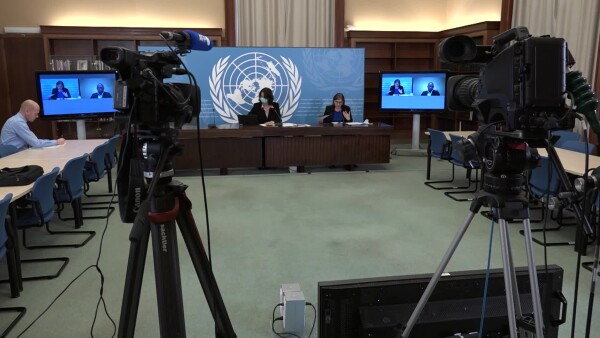
- Wide shot, press briefing room at the United Nations in Geneva
- SOUNDBITE (English) – Liz Throssell, OHCHR spokesperson: “We are deeply concerned by recent incidents in Bosnia and Herzegovina and in Serbia that saw individuals glorify atrocity crimes and convicted war criminals, target certain communities with hate speech, and, in some cases, directly incite violence”.
- Close up, hands typing
- SOUNDBITE (English) – Liz Throssell, OHCHR spokesperson: “These acts, which happened amid religious holidays last weekend, included large groups of people chanting the name of convicted war criminal Ratko Mladić during torchlight processions or singing nationalistic songs calling for the takeover of various locations in the former Yugoslavia. In one incident, individuals fired shots into the air as they drove past a mosque”.
- Medium shot, cameraman and journalist in press briefing room
- SOUNDBITE (English) – Liz Throssell, OHCHR spokesperson: “These incidents - some in locations that saw large-scale atrocity crimes during the war in Bosnia and Herzegovina, such as Prijedor and Foca - are an affront to survivors, including those who returned to their homes after the conflict. The failure to prevent and sanction such acts, which fuel a climate of extreme anxiety, fear and insecurity in some communities, is a major obstacle to trust-building and reconciliation”.
- Medium shot, journalist listening
- SOUNDBITE (English) – Liz Throssell, OHCHR spokesperson: “We stress once again the need for the authorities in Serbia and in Bosnia and Herzegovina to abide by their international human rights obligations to ensure the rights to truth, justice and reparation. They should also adopt measures to prevent recurrence and to promote further reconciliation efforts. We call on them to condemn and refrain from any advocacy of national, racial or religious hatred”.
- Medium shot, journalists listening in the press briefing room
- SOUNDBITE (English) – Liz Throssell, OHCHR spokesperson: “We are encouraged to see that, following some of the recent incidents, officials - including senior politicians, as well as religious leaders - moved quickly to condemn the acts, and police have begun investigations”.
- Close up screen with UN spokesperson in the background
- SOUNDBITE (English) – Liz Throssell, OHCHR spokesperson: “People who live in areas that were the scene of mass atrocity crimes during the conflict, people who may have returned to their homes but are living in a climate of fear and insecurity and that is why we, and also other parts of the UN, are repeating and putting our focus on the importance of hate speech and other related incidents, the glorification of war criminals, convicted war criminals”.
- Close up, camera with screen and big screens in the press briefing room in the background
- Wide shot, press briefing room with journalists and speaker at the podium
- Medium shot, journalists
Similar Stories

1
1
1
Edited News | OCHA , UNICEF , WFP
Aid agencies warned on Friday of the fast-developing humanitarian emergency inside Taiz City in Yemen, which has been encircled by de facto Houthi forces fighting government troops along the country’s west coast.

2
17
1
2
Edited News , Press Conferences , Images | OCHA , WMO
Two UN agencies teamed up on Wednesday to issue an appeal for immediate assistance to help communities already being impacted by the strongest El Niño on record.

3
16
2
2
Edited News , B-roll , Conferences , Images | UNITED NATIONS , UNOG
Sixth Consultative Meeting on Enhancing Coordination of Peace Initiatives and Efforts for Sudan

1
1
1
Edited News | UNICEF , WHO , UNHCR
Yemen war continues to force families from homes amid hunger and disease
More than 250,000 people have now fled renewed fighting in Yemen, the UN said on Tuesday, citing particular concern for those sheltering in the southwestern city of Taiz and the wider governorate, where access is “essentially blocked”.

1
1
1
Edited News | UNICEF
A little over one year since a ceasefire agreement was announced between Hamas fighters and Israel, more than 340 children have been reported killed and hundreds more injured, the UN Children’s Fund, UNICEF, said on Friday.

1
1
1
Edited News | UNICEF , IFRC
Six weeks after Nepal’s deadly flooding disaster, communities are still struggling to rebuild their lives, but they will need sustained help as global warming increases the risk of another Himalayan catastrophe, the UN Children’s Fund (UNICEF) said on Friday.

1
1
1
Edited News | WHO
In suspected Russia plague death, testing and monitoring underway – WHO
The death of a lab worker in Russia’s Siberia region has sparked concerns about plague being the cause, the UN World Health Organization (WHO) said on Tuesday, adding that it was following the situation closely.

1
1
Edited News | OHCHR , UNOG
UN Human Rights Chief Volker Türk on Friday provided and oral update to the 63rd session of the Human rights Council on Ukraine.

1
1
1
Edited News | OHCHR , UNOG
UN Human Rights Chief Volker Türk on Friday provided and oral update to the 63rd session of the Human rights Council on the human rights situation in Haiti.

1
1
1
Edited News | WHO
Repeated delays in bringing lifesaving medicines, prosthetics and more from Israel into Gaza risk having devastating consequences on Palestinians who urgently need them in the wartorn enclave, the UN World Health Organization (WHO) said on Friday. “A truck full of non-priority supplies or the right supplies arriving too late, doesn't save lives. That's the question that actually matters," said Dr Reinhilde Van De Weerdt, WHO Representative in the OPT.

1
1
1
Edited News | WHO
DRC: Early access to care and oxygen decisive for Ebola patients’ survival – WHO
In the Democratic Republic of the Congo (DRC), health workers fighting the country’s largest-ever Ebola outbreak are struggling to overcome critical challenges to patient care, the UN World Health Organization (WHO) warned on Tuesday.

1
1
1
Edited News | OCHA , UN
Civilians in Iran are continuing to feel the consequences of months of conflict and military escalation, the UN’s top official in the country has said, as loss of life, damage to civilian infrastructure and mounting economic pressures leave many facing continued uncertainty.