

The United Nations Office at Geneva
Multimedia Newsroom
Thousands suffer extreme rights abuses journeying to Africa’s Mediterranean coast: UNHCR, IOM
Thousands of refugees and migrants in eastern and western Africa are dying while others face harrowing abuse in their attempts to reach the continent’s Mediterranean coast in search of a better life, a joint UN/Danish Refugee Council (DRC) report said on Wednesday.
Testimonies published by the UN refugee agency, UNHCR, with the DRC’s Mixed Migration Centre (MMC), reveal random killings, torture, forced labour and beatings.
Other people on the move said they had been burnt with hot oil and melted plastic, while others faced electrocution and being tied in stress positions.
Smugglers and traffickers were key abusers, but so too were State officials, to a surprising extent, Vincent Cochetel, UNHCR Special Envoy for the Central Mediterranean, told journalists at the UN in Geneva.
“In 47 per cent of the case(s), the victims reported the perpetrators of violence are law enforcement authorities, whereas in the past we believed that it was mainly smugglers and traffickers,” he said. “Yes, they are key perpetrators of violence, but the primary perpetrators of violence are people who are supposed to protect.”
Although accurate data is extremely difficult to gather, data suggests that at least 1,750 people died leaving western or eastern African nations en route to countries including Libya, Egypt or Algeria in 2018 and 2019.
This represents more than 70 deaths a month, “making it one of the most deadly routes for refugees and migrants in the world”, UNHCR said in a statement.
Almost three in 10 people died as people attempted to cross the Sahara Desert, according to the UN agency. Other lethal hotspots included locations in southern Libya such as Sabha, Kufra and Qatrun, in addition to the “smuggling hub” of Bani Walid southeast of Tripoli and several places along the west African section of the migrant route including Bamako in Mali and Agadez in Niger.
To date this year, at least 70 people are known to have died, including 30 killed in June by traffickers in Mizdah, southern Libya, whose victims came from Bangladesh and African countries.
In a note accompanying the report, UNHCR noted that overland deaths are in addition to the “thousands who have died or gone missing” in recent years trying to cross the Mediterranean Sea to Europe, usually in vessels unfit to make the crossing.
“We can consider that an estimate of 72 per cent minimum died overland even before reaching Libya or Morocco or Egypt, their place of initial destination on their journey,” Mr. Cochetel said. “That’s a low estimate in our view, in the sense that the number of deaths on land is more or less the same than the number of deaths at sea for 2018/2019.”
Among the report’s findings is clear evidence that Libya is by no means the only place where migrants and refugees face life-threatening dangers.
“Abuse actually is along the route and even sometimes it starts within the country of origin and follows people as they move,” said Othman Belbeisi, IOM Senior Regional Advisor to the Director General on Middle East and North Africa.
“Especially as they are moving at the hands of those smugglers and traffickers. People do not know their locations and they do not have communications, so even if people die or go missing, it’s very difficult to verify or to know where those people get missed.”
Describing the report’s findings as “unacceptable” and calling for action to help vulnerable people on the move, Mr. Cochetel noted that internationally agreed measures to target business and individuals involved in people smuggling had shown limited success.
“We have had no new names of traffickers listed for the last two years, we have not had one single arrest of a UN-sanctioned trafficker over the last two years,” he said. “So why can’t States do like they do with trafficking of weapons, terrorism or drug trafficking; why don’t we follow the money-flows, why don’t we seriously go after those people and try to combat impunity.”
Around 85 per cent of refugees usually stay in the first country where they arrive, the UNHCR Special Envoy insisted, before underscoring the need for investment in countries of origin to provide desperate people with an alternative to having to put their lives in the hands of traffickers.
“Access to education is difficult, socio-economic inclusion is inexistent in many countries,” Mr. Cochetel said. “Access to medical care is not available, we’ve seen it during COVID-19 in many of those transit countries for migrants or for refugees, so there is a lot to be done under this umbrella of inclusion.”
Highlighting the fact that Libya is not safe for refugees and migrants returned from dangerous sea crossing attempts by the Libyan coast guard, IOM’s Othman Belbeisi called for solutions beyond the war-ravaged nation.
“The situation is not only in one country, (the) other side of the Mediterranean has also a big responsibility; you have to understand that countries like Libya which is in conflict, (in) civil war, people are dying, there is huge displacement, is not a safe port, so if we call to return people or to have an idea to bring people back to a country that is not safe, I believe there is a big question about how serious we are to reach a solution.”
- Exterior shot, Palais des Nations flag alley, nations’ flags flying, a blue sky day.
- Wide shot, podium with speakers sitting wide apart in Press Room III, which is relatively empty, in line with COVID-19 distancing measures, Palais des Nations.
- Medium shot, TV camera crews, journalist, Press Room III, Palais des Nations.
- SOUNDBITE (English) — Othman Belbeisi, IOM Senior Regional Advisor to the Director General on Middle East and North Africa: “Abuse actually is along the route and even sometimes it starts within the country of origin and follows people as they move. Especially as they are moving at the hands of those smugglers and traffickers. People do not know their locations and they do not have communications, so even if people die or go missing, it’s very difficult to verify or to know where those people get missed.”
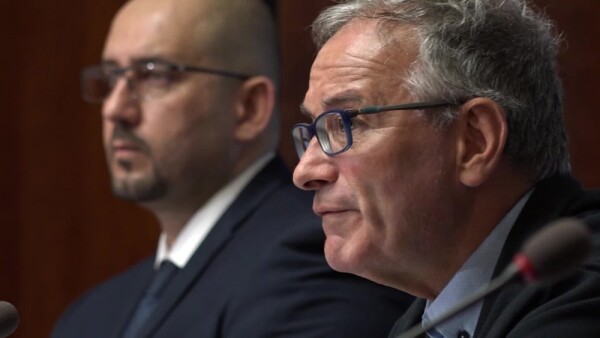
- Close-up, two podium speakers in profile, one is talking, Press Room III, Palais des Nations.
- SOUNDBITE (English) — Vincent Cochetel, UNHCR Special Envoy for the Central Mediterranean: “The perpetrators of physical violence, in 47 per cent of the case, the victims reported the perpetrators of violence are law enforcement authorities, whereas in the past we believed that it was mainly smugglers and traffickers; yes, they are key perpetrators of violence, but the primary perpetrators of violence are people who are supposed to protect.”
- Medium shot, chairs propped up against table, journalist to rear, seated, Press Room III, Palais des Nations.
- SOUNDBITE (English) — Vincent Cochetel, UNHCR Special Envoy for the Central Mediterranean: “We can consider that an estimate of 72 per cent minimum died overland even before reaching Libya or Morocco or Egypt, their place of initial destination on their journey. That’s a low estimate in our view, in the sense that the number of deaths on land is more or less the same than the number of deaths at sea for 2018/2019.”
- Medium shot, speakers in profile, Press Room III, Palais des Nations.
- SOUNDBITE (English) — Vincent Cochetel, UNHCR Special Envoy for the Central Mediterranean: “We have had no new names of traffickers listed for the last two years, we have not had one single arrest of a UN-sanctioned trafficker over the last two years. So why can’t States do like they do with trafficking of weapons, terrorism or drug trafficking; why don’t we follow the money-flows, why don’t we seriously go after those people and try to combat impunity.”
- Medium shot, journalist in centre of shot, sitting back in chair, holding pen in hand, Press Room III, Palais des Nations.
- SOUNDBITE (English) — Othman Belbeisi, IOM Senior Regional Advisor to the Director General on Middle East and North Africa: “The situation is not only in one country, (the) other side of the Mediterranean has also a big responsibility; you have to understand that countries like Libya which is in conflict, (in) civil war, people are dying, there is huge displacement, is not a safe port, so if we call to return people or to have an idea to bring people back to a country that is not safe, I believe there is a big question about how serious we are to reach a solution.”
- Medium shot, journalist reading report (out of shot) behind a sea of seats, holds pen to mouth, Press Room III, Palais des Nations.
- SOUNDBITE (English) — Vincent Cochetel, UNHCR Special Envoy for the Central Mediterranean: “Access to education is difficult, socio-economic inclusion is inexistent in many countries; access to medical care is not available, we’ve seen it during COVID-19 in many of those transit countries for migrants or for refugees, so there is a lot to be done under this umbrella of inclusion.”
- Wide shot, podium speakers sitting wide apart in Press Room III, Palais des Nations.
- Medium shot, journalists, one typing with one hand on laptop, Press Room III, Palais des Nations.
- Close-up, photographer taking picture, Press Room III, Palais des Nations.
Similar Stories

1
1
1
Edited News | UNICEF , IFRC
Six weeks after Nepal’s deadly flooding disaster, communities are still struggling to rebuild their lives, but they will need sustained help as global warming increases the risk of another Himalayan catastrophe, the UN Children’s Fund (UNICEF) said on Friday.
1
1
1
Statements , Press Conferences | OHCHR
1
1
1
Press Conferences | UNHCR , UNICEF , IFRC , OHCHR , UN WOMEN , IOM , OCHA , WHO
UNHCR – ExCom Meeting, UNICEF – Nepal Recovery, IFRC – Flash Floods, WHO – Mental Health, IOM – South Sudan Floods, OCHA – DRC Humanitarian aid, UNHCR – Sahel Displacement, UNICEF – Yemen Update, IOM – Gaza Shelter, UN Women – Gaza Women, OHCHR – Arrests and detentions of Syrians by Israeli force
2
1
2
Press Conferences | UNCTAD
Presentation of the Trade and Developement Report 2026
Embargoed until 9 October 2026 at 11 a.m. (Geneva Time)
UNCTAD: UNCTAD’s flagship report finds that governments increasingly use industrial, trade, financial and technology policies to pursue economic and national security objectives. Market access and the ability to move into higher-value activities now depend more heavily on technology, finance and geopolitics.
1
1
1
Press Conferences | UPU
Release of the State of the Postal Sector Report 2026

1
1
1
Edited News | WHO
In suspected Russia plague death, testing and monitoring underway – WHO
The death of a lab worker in Russia’s Siberia region has sparked concerns about plague being the cause, the UN World Health Organization (WHO) said on Tuesday, adding that it was following the situation closely.
1
1
1
Press Conferences | IOM , ITU , UNECE , UNICEF , WHO , WMO
UNICEF: Ebola, DRC - children orphans or separating them from parents and caregivers; IOM: Humanitarian needs in Djibouti amid arrivals from Yemen and increased migrant movements; WHO: Darfur, scale of health needs far exceeds available resources; WMO co-sponsored Global Heat Forum, Bangkok, monthly Global Seasonal Climate Update; UNECE: UN Forum of Mayors; ITU Plenipotentiary Conference 2026; WHO: child and adolescent obesity guidelines and new global roadmap to tackle pregnancy hypertension, a leading cause of maternal mortality

1
1
Edited News | OHCHR , UNOG
UN Human Rights Chief Volker Türk on Friday provided and oral update to the 63rd session of the Human rights Council on Ukraine.

1
1
1
Edited News | OHCHR , UNOG
UN Human Rights Chief Volker Türk on Friday provided and oral update to the 63rd session of the Human rights Council on the human rights situation in Haiti.

1
1
1
Edited News | WHO
Repeated delays in bringing lifesaving medicines, prosthetics and more from Israel into Gaza risk having devastating consequences on Palestinians who urgently need them in the wartorn enclave, the UN World Health Organization (WHO) said on Friday. “A truck full of non-priority supplies or the right supplies arriving too late, doesn't save lives. That's the question that actually matters," said Dr Reinhilde Van De Weerdt, WHO Representative in the OPT.
1
1
1
Press Conferences | OCHA , UN WOMEN , UNHCR , WFP , WHO , WTO , UNEP
OCHA – $160M CERF allocation to 12 underfunded crises; UNHCR – 5.8M refugee children remain out of school amid funding cuts; UN Women – Middle East escalation and food security among women/girls; WHO – Gaza supplies and overall situation; WFP – Yemen food insecurity and impact on global hunger ; UNEP - First International Conference of the Global Framework on Chemicals in Geneva | 16-20 November 2026

1
1
1
Edited News | WHO
DRC: Early access to care and oxygen decisive for Ebola patients’ survival – WHO
In the Democratic Republic of the Congo (DRC), health workers fighting the country’s largest-ever Ebola outbreak are struggling to overcome critical challenges to patient care, the UN World Health Organization (WHO) warned on Tuesday.