

The United Nations Office at Geneva
Multimedia Newsroom
Press Conferences | HRC , UNAIDS , UNICEF , IFRC , OHCHR , UNHCR , WHO
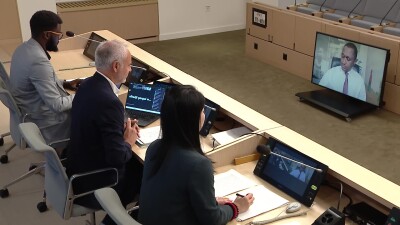
Geneva Press Briefing - 23 February 2024
UN GENEVA PRESS BRIEFING
23 February 2024
Two years of full-scale war in Ukraine
James Elder, for the United Nations Children’s Fund (UNICEF), speaking from Kharkiv in Ukraine, estimated that over the past two years, children in war-ravaged Ukraine had had to spend 3,000-5,000 hours underground, which translated to some 200 days. From dozens of conversations with families and child psychologists, Mr. Elder concluded that psychological scars of children were deep. Some three quarters of young people reported needing psychological support, and only a fraction of them were getting it. Parents across Ukraine reported that their children were suffering from excessive anxiety and sleeplessness. Parents and children alike were worn down. While parental care was critical to addressing the prolonged stress experienced by children, parents themselves were chronically under stress and unable to provide adequate support to their children.
In Kharkiv, informed Mr. Elder, only two out of 700 schools offered in-class learning, which, among other consequences, led to stunted socialization. UNICEF had mobile medical teams going door-to-door providing medical and psychological care, and training psychologists and counselors. However, the attacks continued, living in bunkers continued, and each day was sapping more of the remaining strength and hope. The often-praised resilience of Ukrainians came at a cost, he concluded.
David Fisher, Head of the Delegation of the International Federation of Red Cross and Red Crescent Societies (IFRC) in Ukraine, speaking from Kyiv, said that two years on, people in Ukraine were still pushing forward, people were carrying on, but all under the uncertainty of bombardment and lack of access to essential services in the hardest hit areas. Air alerts were constant even far away from the frontlines. IFRC had visited Kharkiv earlier this week, where local Red Cross staff and volunteers admitted to being tired but added that they had no right to be tired, so they carried on. Ukrainian Red Cross chapters had child-friendly spaces across the country and did their best to give children some sense of normality. Older people in rural areas were among the most vulnerable categories, having lost their homes and seen their health deteriorate. Ukrainian Red Cross had tripled the number of their volunteers and staff and revived numerous branches. In Mykolaiv, for example, Red Cross was providing one third of all drinkable water, and in many places they were the ones to provide first aid. They were also playing a part in reconstruction and recovery, said Mr. Fisher. Thanks to the donors, IFRC’s presence in the country had made a big difference; dozens of sister Red Cross societies were in Ukraine supporting the local society activities. Continued support was needed to ensure that early recovery efforts could go ahead.
Charlotte Sector, for UNAIDS, informed that UNAIDS had published a sitrep on the occasion of the second anniversary of the war. Despite the initial disruption to the national AIDS response at the onset of the war, the national AIDS program had gradually resumed routine operations.
Responding to questions, Mr. Fisher, for the IFRC, said that the highest needs and the most difficult access were in the east, in the vicinity of the contact line. There were constant aid raids and power outages in Kyiv as well, he explained. The biggest needs were in rural areas, where access to basic services was most difficult. Mr. Elder, for UNICEF, explained that UNICEF did not have access to Russian-controlled areas of Ukraine. Ms. Vellucci, for UNIS, said that the Secretary-General would address the Security Council meeting on Ukraine today.
Human rights violations in Sudan
Seif Magango, for the Office of the High Commissioner for Human Rights (OHCHR), speaking from Nairobi, stated that the armed conflict in Sudan had resulted in thousands of civilians killed, millions displaced, property looted, and children conscripted, as fighting had spread to more regions of the country. New OHCHR report detailed multiple indiscriminate attacks by both the Sudanese Armed Forces (SAF) and the Rapid Support Forces (RSF) in densely populated areas, including sites sheltering internally displaced people - particularly in the capital Khartoum, as well as in Kordorfan and Darfur - during fighting between April and December 2023.
Just this week, credible video evidence reviewed by the OHCHR showed that several students travelling by road in North Kordofan State might have been beheaded by men in SAF uniform in El-Obeid City – the victims seen as being RSF supporters based on their perceived ethnicity. The video footage posted on social media on 15 February showed troops parading with decapitated heads in the street while chanting ethnic slurs. In Darfur, thousands had been killed in RSF attacks, some of which had been ethnically motivated. The report found that between May and November 2023, the RSF and its allied Arab militia had carried out at least ten attacks against civilians in El-Geneina, the capital of West Darfur, killing thousands of people, most of them from the African Masalit ethnic community. Ms. Magango explained that by mid-December, more than 6.7 million people had been displaced by the conflict. This number had since increased to more than eight million, both in Sudan and abroad.
Human Rights High Commissioner Volker Türk stressed that “there must be prompt, thorough, effective, transparent, independent and impartial investigations into all allegations of violations and abuses of international human rights and violations of international humanitarian law and those responsible must be brought to justice.”
OHCHR report can be accessed here.
Answering questions from the media, Mr. Magango stated that the conflict in Sudan was becoming a forgotten one. Violations of human rights were continuing, and there were over 14,600 confirmed fatalities. More than eight million people were currently displaced. Some of the received allegations could amount to war crimes, stressed Mr. Magango. Independent, transparent, and prompt investigations were needed. OHCHR had shared the draft of its report and the press briefing note with the Sudanese authorities; the High Commissioner would present the report at the upcoming Human Rights Council session. Mr. Magango reiterated that the rules of war applied to both state and non-state actors, in other words to both SAF and RSF.
Tarik Jašarević, for the World Health Organization (WHO), replying to another question, said that the ten months of the conflict had indeed had a terrible impact on the lives and health of people in Sudan, where the health system had been already struggling even before the war. He said that 70 to 80 percent of hospitals in conflict-affected states of Sudan were not working; people were dying because of the lack of access to basic health care. The situation in Sudan was getting worse and was not getting the global attention it deserved.
Escalating humanitarian crisis in eastern Democratic Republic of the Congo
Eujin Byun, for the United Nations Refugee Agency (UNHCR), stated that UNHCR was gravely concerned by the worsening humanitarian situation civilians face in the eastern Democratic Republic of the Congo (DRC). Intensifying violence and conflict were exacting a heavy toll on innocent civilians, hundreds of thousands of whom were attempting to seek safety on the peripheries of conflict zones. Since the resurgence of fighting around the town of Sake in the North Kivu Province on 7 February, 144,000 individuals had been forced to flee the outskirts of Goma. They had fled indiscriminate bombings that had impacted displacement sites and other civilian areas over the past few weeks, and which had resulted in the deaths of more than 20 civilians and injured more than 60.
The plight of the newly displaced in eastern DRC was compounded by the pre-existing, pressing humanitarian situation. More than seven million people remained displaced across the country, including half a million refugees. Those displaced contended with already high risks associated with inadequate shelters, poor sanitation facilities and limited income-generating opportunities. UNHCR had successfully advocated with local authorities for the extension of two displacement sites on the periphery of Goma and, with other humanitarian agencies, plans to deliver 900,000 shelters in 2024, nearly double the 500,000 built last year. To address these and many other humanitarian needs in the DRC, the 2024 Humanitarian Response Plan had been launched on 20 February, appealing for USD 2.6 billion to help some 8.7 million people in need across the country.
There were 252 known armed groups operating in eastern DRC at the moment, so it was difficult to assign responsibility to any particular militia. UNHCR was calling on all actors to respect international humanitarian law, said Ms. Byun in a response to a question. Constrained humanitarian access to people in need was one of the major concerns for UNHCR, she stressed.
UNHCR statement is available here.
Health situation in Gaza
Christopher Black, for the World Health Organization (WHO), speaking from near Rafah in Gaza, said that this week he had taken part in three missions to the Nasser Hospital. Because of the active fighting around the hospital, and in spite of the close proximity, access to the hospital was very challenging. WHO and OCHA teams had evacuated 51 patients in critical condition; even the process of taking the patients out was extremely difficult. Hospital corridors were full of patients and barely lit; patients had to be carried on stretchers down multiple sets of stairs. Mr. Black recounted the bravery of the doctors and medical staff who had remained with the patients, and the Palestinian Red Cross which had worked with WHO and OCHA to get the patients out. Of the 51 transferred patients, there had been ten children and 21 women, specified Mr. Black in a response to a question.
Human Rights Council
Pascal Sim, for the Human Rights Council (HRC), informed that the Human Rights Council would open on 26 February at 9 am its 55th regular session, which would last from 26 February to 5 April 2024, under the presidency of Ambassador Omar Zniber of Morocco. Delivering statements at the opening would also be the Secretary-General of the United Nations, António Guterres; the President of the United Nations General Assembly, Dennis Francis; the United Nations High Commissioner for Human Rights, Volker Türk. The Council would then start its high-level segment, hearing from Ignazio Cassis, Swiss Foreign Minister. Dignitaries representing more than 110 Member States would address the Council. At 4 pm, there would be a high-level discussion on the realization of rights of persons with disabilities. Room XIX would serve as a spillover room in case Room XX was full. More information about the 55th session can be found at the HRC extranet page.
Alessandra Vellucci, for the United Nations Information Service, stated that the information about the Secretary-General’s participation and press encounter was expected soon. She said that the President of the General Assembly would be in Geneva from 25 to 27 February, after which he would continue to Nairobi. UN PGA would speak at the opening of the Council and participate in the high-level panel on the realization of rights of persons with disabilities.
Responding to a question regarding coverage of the Council, Ms. Vellucci explained that due to the liquidity crisis, UNIS was not able to recruit additional temporary assistance needed for full, usual coverage of the session. Automated webcast of all meeting would be ensured, said Ms. Vellucci; in addition, high-quality broadcast would be provided for the first morning of the 55th session and possibly for the end of the session – voting on draft resolutions. Press coverage would be provided for the first day and the voting, and possibly for other days, human resources permitting. She reiterated that UNIS was still providing full broadcast quality and press coverage of all UN human rights treaty bodies.
Zero Discrimination Day
Charlotte Sector, for UNAIDS, informed that 1 March would mark the tenth anniversary of Zero Discrimination Day. UNAIDS’s call to action was in order to protect everyone’s health, everyone’s rights had to be protected. The world had made great progress towards the goal of ending AIDS as a public health threat by 2030. That progress had been powered by progress in protecting human rights. However, laws, policies and practices that punished, discriminated against, and stigmatize women and girls, LGBT and other marginalized communities violated human rights and obstruct access to HIV prevention, testing, treatment, and care. There was an urgent need to remove laws which harm people’s rights and to bring in laws which uphold the rights of every person.
More information is available here.
Announcements
Alessandra Vellucci, for the United Nations Information Service, informed that on 28 February at 1:30 pm, there would be a launch of a new report by the Group of Human Rights Experts on Nicaragua on the human rights situation in Nicaragua.
Committee on Enforced Disappearances would hold on 26 February a dialogue with Honduras under article 29(4) of the Convention, by which States parties may be requested to provide additional information on the implementation of the Convention.
Committee on Economic, Social and Cultural Rights would close on 1 March its 75th session and issue its concluding observations on the six country reports reviewed during this session: Romania, Mauritania, Ireland, Iraq, Indonesia, and Sweden.
Ms. Vellucci also informed that the UN Secretary-General would address the Conference on Disarmament on 26 February at 2:30 pm.
Similar Stories
1
1
1
Press Conferences | UNHCR
End of UNHCR's 77th Annual Executive Committee (ExCom) meeting week
1
1
1
Press Conferences | UNICEF , IOM , UNHCR
UN Special Assistant to the Personal Envoy Office (SUDAN): Peace Initiatives and Efforts in Sudan; UNICEF: Dire situation of children in Gaza; IOM: Damaged Homes and Energy Attacks Risk Displacing Ukrainians for this winter; UNHCR: update on EXCOM week
1
1
1
Press Conferences | IOM , UNDRR
UN stresses importance of household preparedness for disaster risk reduction.
1
1
1
Statements , Press Conferences | OHCHR
1
1
1
Press Conferences | UNHCR , UNICEF , IFRC , OHCHR , UN WOMEN , IOM , OCHA , WHO
UNHCR – ExCom Meeting, UNICEF – Nepal Recovery, IFRC – Flash Floods, WHO – Mental Health, IOM – South Sudan Floods, OCHA – DRC Humanitarian aid, UNHCR – Sahel Displacement, UNICEF – Yemen Update, IOM – Gaza Shelter, UN Women – Gaza Women, OHCHR – Arrests and detentions of Syrians by Israeli force
2
1
2
Press Conferences | UNCTAD
Presentation of the Trade and Developement Report 2026
Embargoed until 9 October 2026 at 11 a.m. (Geneva Time)
UNCTAD: UNCTAD’s flagship report finds that governments increasingly use industrial, trade, financial and technology policies to pursue economic and national security objectives. Market access and the ability to move into higher-value activities now depend more heavily on technology, finance and geopolitics.
1
1
1
Press Conferences | UPU
Release of the State of the Postal Sector Report 2026
1
1
1
Press Conferences | IOM , ITU , UNECE , UNICEF , WHO , WMO
UNICEF: Ebola, DRC - children orphans or separating them from parents and caregivers; IOM: Humanitarian needs in Djibouti amid arrivals from Yemen and increased migrant movements; WHO: Darfur, scale of health needs far exceeds available resources; WMO co-sponsored Global Heat Forum, Bangkok, monthly Global Seasonal Climate Update; UNECE: UN Forum of Mayors; ITU Plenipotentiary Conference 2026; WHO: child and adolescent obesity guidelines and new global roadmap to tackle pregnancy hypertension, a leading cause of maternal mortality
1
1
1
Press Conferences | OCHA , UN WOMEN , UNHCR , WFP , WHO , WTO , UNEP
OCHA – $160M CERF allocation to 12 underfunded crises; UNHCR – 5.8M refugee children remain out of school amid funding cuts; UN Women – Middle East escalation and food security among women/girls; WHO – Gaza supplies and overall situation; WFP – Yemen food insecurity and impact on global hunger ; UNEP - First International Conference of the Global Framework on Chemicals in Geneva | 16-20 November 2026
1
1
1
Press Conferences | UNHCR , WHO
Yemen's health system nears collapse amid conflict, causing rising casualties and medicine shortages.
1
1
1
Press Conferences | HRC
Update by the Expert Mechanism to Advance Racial Justice and Equality in Law Enforcement
1
1
1
Press Conferences | WIPO , WHO , UNICEF , UNHCR , IOM , WFP , FAO
WIPO Global Innovation Index 2026 launch and press conference, WHO Composition of influenza vaccines for the 2027 Southern Hemisphere flu season, UNICEF Yemen hunger and malnutrition; UNHCR Sudan displacement into Chad; IOM Ebola and population movements in DRC; WFP emergency food assistance in Nepal; and FAO food loss and waste.