

The United Nations Office at Geneva
Multimedia Newsroom
Myanmar: International community failed Rohingyas, UN Special Rapporteur
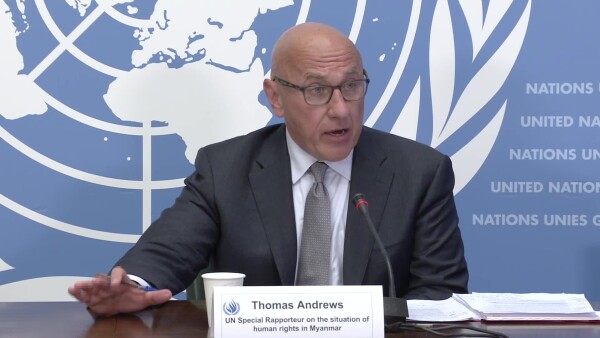
More than 800 children have been killed or maimed since the coup began in February 2021 and end of last year and most were victims of indiscriminate attacks by junta forces, the UN Special Rapporteur on Myanmar, Thomas Andrews, said on Thursday.
Speaking at a press conference in Geneva, the UN-appointed independent expert said that in addition to those killed, "387 children are behind bars in Myanmar as political prisoners...660,000 children are now displaced in Myanmar and 5.8 million children require humanitarian assistance. This is a disaster on top of a disaster, and it has the most profound impact on those that are most vulnerable and that is the children of Myanmar.”
In a recently report, the Special Rapporteur detailed how the junta had imported more than $1 billion in weapons and weapons-related materials since the military coup, with the full knowledge that these weapons could be used to kill thousands of innocent people, to commit probable war crimes and crimes against humanity.
“I published just a few weeks ago a comprehensive report called ‘The Billion Dollar Death Trade’ in which we identify very specifically where those weapons are coming from, the jurisdictions of those weapons,” Mr. Andrews said. “We identified manufacturers of those weapons and there was some very detailed information that we forwarded to some countries, who have expressed an interest in enforcement action, so that we can try to stop the flow of these weapons to the junta.”
If the shipment of these materials is stopped, the junta’s capacity to commit war crimes and crimes against humanity would be significantly disrupted, said Mr. Andrews.
Earlier, the Special Rapporteur told the Human Rights Council’s 47 UN Member States that they must step up and stop so that the junta cannot continue “Myanmar's nightmare”. He called on the international community to act in a coordinated manner to deprive the junta, stressing that there needs to be coordination and strategy behind sanctions and coordinated enforcement of these sanctions.
“The United States has put sanctions on the Myanmar foreign trade bank and the Myanmar investment commercial bank. Those are huge steps forward,” Mr. Andrews said. “If the United States would follow the EU’s lead in imposing sanctions on the single largest source of revenue for the junta, Myanma Oil and Gas Enterprise (MOGE), and then if the EU followed the United States in imposing sanctions on financial institutions, we would have really something going here.”
Giving a sobering update on the deteriorating conditions in Myanmar, Mr. Andrews reported that “kids, Rohingya children, cannot eat resolutions and they are starving and we need more than rhetoric and words. We need action. And I was very concerned when I learned that last year only one of the 57 OIC countries had contributed any money to the Rohingya emergency joint response plan.”
Mr. Andrews asked the Council whether the international community was meeting its fundamental obligation to help the victims of these human rights violations and atrocities.
“The victims of these atrocities, and there is no group that has been more victimized by the horror of the Myanmar military than the Rohingya ethnic muslim minority,” the Special Rapporteur said. “Over 700,000 literally had to run for their lives over the border into Bangladesh, in 2016 and 2017, because of the genocidal attacks of the military.”
Today, Rohingya people who fled Myanmar continue to live in refugee camps in Bangladesh. But, because of a lack of support from the international community, Rohingya children are being denied the food and nutrition that they need. A full 41 per cent of Rohingya children suffer from stunted growth and more than half are anaemic. In addition, the UN World Food Programme was forced to cut already meager food rations by 17 per cent in April and an additional 20 per cent in June.
“More than one million Rohingyas are in Bangladesh now and they are living under extremely difficult conditions,” Mr. Andrews concluded. “Now the tragedy here is that the international community has failed to provide the level of support that is necessary to sustain these Rohingya.”
UN Special Rapporteurs are not UN staff and do not receive a salary for their work. They are independent from any government or organisation and serve in their individual capacity.
-ends-
- Continuity: Statement of Thomas Andrews, United Nations Special Rapporteur on the situation of human rights in Myanmar.
See PDF Attachement. Pls, check against delivery. - Exterior wide shot: UN Palais with flags
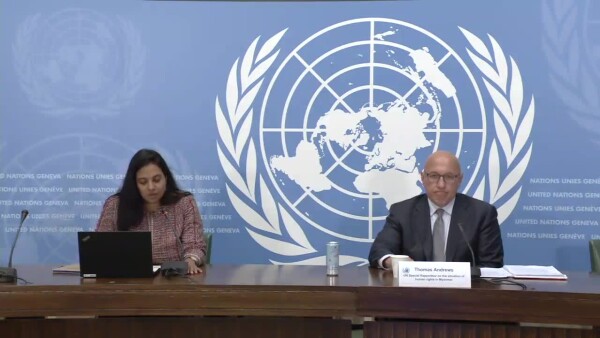
- Wide shot: speaker, moderator, photographer and attendees at the press conference, screen with speaker
- SOUNDBITE (English) – Thomas Andrews, Special Rapporteur on the situation of human rights in Myanmar: “At least 800 children have been killed, 387 children are behind bars in Myanmar as political prisoners.”
- Medium shot: attendees taking notes at the press conference
- SOUNDBITE (English) – Thomas Andrews, Special Rapporteur on the situation of human rights in Myanmar: “660’000 children are now displaced in Myanmar and 5.8 million children require humanitarian assistance. This is a disaster on top of a disaster and it has the most profound impact on those that are most vulnerable and that is the children of Myanmar.”
- Medium shot: attendees and moderator at the press conference
- SOUNDBITE (English) – Thomas Andrews, Special Rapporteur on the situation of human rights in Myanmar: “I published just a few weeks ago a comprehensive report called “The Billion Dollar Death Trade” in which we identify very specifically where those weapons are coming from, the jurisdictions of those weapons. We identified manufacturers of those weapons. And there was some very detailed information that we forwarded to some countries, who have expressed an interest in enforcement action, so that we can try to stop the flow of these weapons to the junta”.
- Medium shot: speaker behind podium, moderator’s laptop in the foreground
- SOUNDBITE (English) – Thomas Andrews, Special Rapporteur on the situation of human rights in Myanmar: “The United States has put sanctions on the Myanmar foreign trade bank and the Myanmar investment commercial bank. Those are huge steps forward. And if the United States would follow the EU’s lead in imposing sanctions on the single largest source of revenue for the junta, Myanmar oil and gas. And then if the EU followed the United States in imposing sanctions on financial institutions, we would have really something going here. There needs to be coordination and strategy behind these sanctions and sanctions policies. And there needs to be enforcement, coordinated enforcement of these sanctions.”
- Close shot: Photographer at the press conference
- SOUNDBITE (English) – Thomas Andrews, Special Rapporteur on the situation of human rights in Myanmar: “Kids, Rohingya children, cannot eat resolutions and they are starving and we need more than rhetoric and words. We need action. And I was very concerned when I learned that last year only one of the 57 OIC countries had contributed any money to the Rohingya emergency joint response plan.”
- Medium shot: moderator and speaker behind podium, photographer in the foreground
- SOUNDBITE (English) – Thomas Andrews, Special Rapporteur on the situation of human rights in Myanmar: “The victims of these atrocities, and there is no group that has been more victimized by the horror of the Myanmar military than the Rohingya ethnic muslim minority. Over 700'000 literally had to run for their lives over the border into Bangladesh, in 2016 and 2017, because of the genocidal attacks of the military. More than 1 million Rohingyas are in Bangladesh now and they are living under extremely difficult conditions. Now the tragedy here is that the international community has failed to provide the level of support that is necessary to sustain these Rohingya.”
- Medium shot: moderator and speaker behind podium, screen with speaker
- Medium shot: moderator and speaker behind podium, screen with speaker
DURATION - TRT:
SOURCE: UNTV CH
LANGUAGE: ENGLISH, NATS
ASPECT RATIO: 16:9
DATE SHOT: 6 July 2023
FORMAT: HYBRID PRESS BRIEFING
LOCATION: GENEVA, SWITZERLAND
SHOTLIST
Similar Stories

1
1
1
Edited News | UNICEF , IFRC
Six weeks after Nepal’s deadly flooding disaster, communities are still struggling to rebuild their lives, but they will need sustained help as global warming increases the risk of another Himalayan catastrophe, the UN Children’s Fund (UNICEF) said on Friday.
1
1
1
Statements , Press Conferences | OHCHR
1
1
1
Press Conferences | UNHCR , UNICEF , IFRC , OHCHR , UN WOMEN , IOM , OCHA , WHO
UNHCR – ExCom Meeting, UNICEF – Nepal Recovery, IFRC – Flash Floods, WHO – Mental Health, IOM – South Sudan Floods, OCHA – DRC Humanitarian aid, UNHCR – Sahel Displacement, UNICEF – Yemen Update, IOM – Gaza Shelter, UN Women – Gaza Women, OHCHR – Arrests and detentions of Syrians by Israeli force
2
1
2
Press Conferences | UNCTAD
Presentation of the Trade and Developement Report 2026
Embargoed until 9 October 2026 at 11 a.m. (Geneva Time)
UNCTAD: UNCTAD’s flagship report finds that governments increasingly use industrial, trade, financial and technology policies to pursue economic and national security objectives. Market access and the ability to move into higher-value activities now depend more heavily on technology, finance and geopolitics.
1
1
1
Press Conferences | UPU
Release of the State of the Postal Sector Report 2026

1
1
1
Edited News | WHO
In suspected Russia plague death, testing and monitoring underway – WHO
The death of a lab worker in Russia’s Siberia region has sparked concerns about plague being the cause, the UN World Health Organization (WHO) said on Tuesday, adding that it was following the situation closely.
1
1
1
Press Conferences | IOM , ITU , UNECE , UNICEF , WHO , WMO
UNICEF: Ebola, DRC - children orphans or separating them from parents and caregivers; IOM: Humanitarian needs in Djibouti amid arrivals from Yemen and increased migrant movements; WHO: Darfur, scale of health needs far exceeds available resources; WMO co-sponsored Global Heat Forum, Bangkok, monthly Global Seasonal Climate Update; UNECE: UN Forum of Mayors; ITU Plenipotentiary Conference 2026; WHO: child and adolescent obesity guidelines and new global roadmap to tackle pregnancy hypertension, a leading cause of maternal mortality

1
1
Edited News | OHCHR , UNOG
UN Human Rights Chief Volker Türk on Friday provided and oral update to the 63rd session of the Human rights Council on Ukraine.

1
1
1
Edited News | OHCHR , UNOG
UN Human Rights Chief Volker Türk on Friday provided and oral update to the 63rd session of the Human rights Council on the human rights situation in Haiti.

1
1
1
Edited News | WHO
Repeated delays in bringing lifesaving medicines, prosthetics and more from Israel into Gaza risk having devastating consequences on Palestinians who urgently need them in the wartorn enclave, the UN World Health Organization (WHO) said on Friday. “A truck full of non-priority supplies or the right supplies arriving too late, doesn't save lives. That's the question that actually matters," said Dr Reinhilde Van De Weerdt, WHO Representative in the OPT.
1
1
1
Press Conferences | OCHA , UN WOMEN , UNHCR , WFP , WHO , WTO , UNEP
OCHA – $160M CERF allocation to 12 underfunded crises; UNHCR – 5.8M refugee children remain out of school amid funding cuts; UN Women – Middle East escalation and food security among women/girls; WHO – Gaza supplies and overall situation; WFP – Yemen food insecurity and impact on global hunger ; UNEP - First International Conference of the Global Framework on Chemicals in Geneva | 16-20 November 2026

1
1
1
Edited News | WHO
DRC: Early access to care and oxygen decisive for Ebola patients’ survival – WHO
In the Democratic Republic of the Congo (DRC), health workers fighting the country’s largest-ever Ebola outbreak are struggling to overcome critical challenges to patient care, the UN World Health Organization (WHO) warned on Tuesday.