

The United Nations Office at Geneva
Multimedia Newsroom
Edited News , Press Conferences | OHCHR , UNOG
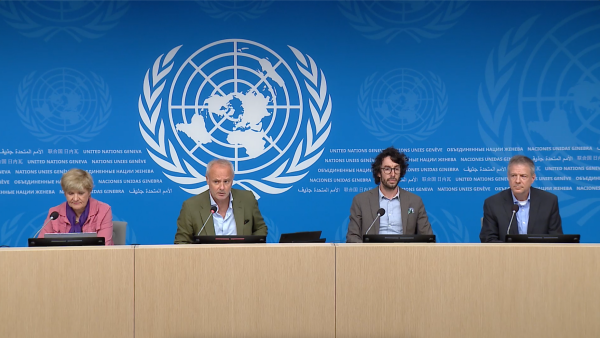
United Nations Human Rights briefing on Ukraine by Matilda Bogner_1
Matilda Bogner, Head of the UN Human Rights Monitoring Mission in Ukraine remarks on Detentions of Civilians in the Context of the Armed Attack by the Russian Federation against Ukraine.
The report that is released today focuses on arbitrary detention of civilians in the context of the Russian Federation’s large-scale attack on Ukraine. It covers 15 months from February 2022 to May 2023.
The findings in our report are based on 1,136 interviews with victims, witnesses and others, 274 site visits and 70 visits to official places of detention run by Ukrainian authorities. The United Nations joint Human Rights office in Ukraine documented over 900 cases of arbitrary detention of civilians, including children, and elderly people. The vast majority of these cases were perpetrated by the Russian Federation.
Ukraine gave unimpeded confidential access to official places of detention and detainees, with one exception. The Russian Federation did not grant us such access, despite the office requests.
“I will start with the detention of civilians by the Russian Federation. From the beginning of its armed attack, Russia began to detain civilians in areas that it occupied. It carried out what appeared in some cases to be security detentions, but in a manner that did not protect civilians or comply with international law. We documented 864 individual cases of arbitrary detention by the Russian Federation, many of which also amounted to enforced disappearances,” she said.
“Civilians were often detained during so-called ‘filtration’ in occupied territory for their perceived support of Ukraine, their status as former Ukrainian servicepersons, or their perceived political opinion or affiliation. They included local public officials, humanitarian volunteers, members of civil society, priests and teachers,” Bogner stated.
“Many civilian detainees were held incommunicado, in unofficial places of detention, often in deplorable conditions. In about a quarter of the documented cases, civilian detainees were transferred to other locations within occupied territory or deported to the Russian Federation. Often, no information was disclosed to their families for prolonged periods of time,” she said.
“We documented the summary execution of 77 civilians while they were arbitrarily detained by the Russian Federation. Some of these cases were included in our report on killings published in December,” Bogner stated.
“Russian armed forces, law enforcement and penitentiary authorities engaged in widespread torture and ill-treatment of civilian detainees. Most of those we interviewed said they had been tortured and ill-treated, and in some cases subjected to sexual violence. Torture was used to force victims to confess to helping Ukrainian armed forces, compel them to cooperate with the occupying authorities, or intimidate those with pro-Ukrainian views,” she stated.
Legislative amendments passed last year, and practices by Ukrainian security forces, resulted in an environment conducive to arbitrary detention. “We documented 75 cases of arbitrary detention by Ukrainian security forces, mostly of people suspected of conflict-related offences. A significant proportion of these cases also amounted to enforced disappearance, perpetrated mainly by the Security Service of Ukraine,” she said.
Under martial law, legislative amendments have given Ukrainian authorities wider discretion to detain people in relation to national security. Given their excessive scope, the amended provisions appear to go beyond what is permissible under international law, even during a public emergency, and have facilitated arbitrary detention.
The law on collaboration, adopted in March 2022, is not in line, according to the report, with international law and criminalizes a wide range of conduct, including that permitted or required under International Humanitarian Law. It has led to cases of arbitrary detention. The misuse of legislative provisions to detain civilians without a warrant, resulted in further cases of arbitrary detention.
“We documented that over half of those arbitrarily detained were subjected to torture or ill-treatment by Ukrainian security forces. This happened while people were being interrogated, usually immediately after arrest,” she said.
“We are not aware of any investigations by Russian authorities into arbitrary detention, enforced disappearance, torture or ill-treatment perpetrated by its own forces in Ukraine,” she said. The United Nations Human rights office is deeply concerned that the Russian Parliament approved in its first reading a draft federal law that would potentially exempt from criminal liability perpetrators of international crimes committed in occupied regions of Ukraine, if they are committed to protect “the interests of the Russian Federation”.
“This would violate the State’s obligation to investigate and prosecute serious violations of international humanitarian law and gross violations of international human rights law,” she stated.
“The Government of Ukraine says that it launches criminal investigations into each allegation of detention of civilians by the Russian Federation. To date, 23 people have been convicted, including 19 in absentia. We are not aware of any completed criminal investigations by Ukrainian authorities into its own security forces for such violations,” Bogner said.
The violations described in the report affect not only the victims, but also their families and communities. Many relatives still have no information on the whereabouts and fate of their loved ones.
“I conclude by reiterating our request to the Russian Federation to grant United Nations human rights monitors full and unfettered access to all areas of Ukraine which it occupies,” Bogner said.
For more information and media requests, please contact:
Ravina Shamdasani - + 41 22 917 9169 / ravina.shamdasani@un.org or
Liz Throssell + 41 22 917 9296 / elizabeth.throssell@un.org or
Jeremy Laurence + +41 22 917 9383 / jeremy.laurence@un.org or
Marta Hurtado - + 41 22 917 9466 / marta.hurtadogomez@un.org
In Nairobi
Seif Magango - +254 788 343 897 / seif.magango@un.org
Tag and share
Twitter @UNHumanRights
Facebook unitednationshumanrights
Instagram @unitednationshumanrights
Tag and share - Twitter: @UNHumanRights and Facebook: unitednationshumanrights
- Exterior shots : Palais de Nations
- Cut away : briefing room
- SOUNDBITE (English)— Matilda Bogner Head of the UN Human Rights Monitoring Mission in Ukraine: “I will start with the detention of civilians by the Russian Federation. From the beginning of its armed attack, Russia began to detain civilians in areas that it occupied. It carried out what appeared in some cases to be security detentions, but in a manner that did not protect civilians or comply with international law. We documented 864 individual cases of arbitrary detention by the Russian Federation, many of which also amounted to enforced disappearances.”
- Cut away: briefing room
- SOUNDBITE (English)— Matilda Bogner Head of the UN Human Rights Monitoring Mission in Ukraine: “Civilians were often detained during so-called ‘filtration’ in occupied territory for their perceived support of Ukraine, their status as former Ukrainian servicepersons, or their perceived political opinion or affiliation. They included local public officials, humanitarian volunteers, members of civil society, priests and teachers.”
- Cut away: briefing room
- SOUNDBITE (English)— Matilda Bogner Head of the UN Human Rights Monitoring Mission in Ukraine: “Many civilian detainees were held incommunicado, in unofficial places of detention, often in deplorable conditions. In about a quarter of the documented cases, civilian detainees were transferred to other locations within occupied territory or deported to the Russian Federation. Often, no information was disclosed to their families for prolonged periods of time.”
- Cut away: briefing room
- SOUNDBITE (English)— Matilda Bogner Head of the UN Human Rights Monitoring Mission in Ukraine: “We documented the summary execution of 77 civilians while they were arbitrarily detained by the Russian Federation. Some of these cases were included in our report on killings published in December.”
- Cut away: briefing room
- SOUNDBITE (English)— Matilda Bogner Head of the UN Human Rights Monitoring Mission in Ukraine: “Russian armed forces, law enforcement and penitentiary authorities engaged in widespread torture and ill-treatment of civilian detainees. Most of those we interviewed said they had been tortured and ill-treated, and in some cases subjected to sexual violence. Torture was used to force victims to confess to helping Ukrainian armed forces, compel them to cooperate with the occupying authorities, or intimidate those with pro-Ukrainian views.”
- Cut away: briefing room
- SOUNDBITE (English)— Matilda Bogner Head of the UN Human Rights Monitoring Mission in Ukraine: “We documented 75 cases of arbitrary detention by Ukrainian security forces, mostly of people suspected of conflict-related offences. A significant proportion of these cases also amounted to enforced disappearance, perpetrated mainly by the Security Service of Ukraine.”
- Photos: Makeshift detention place in a residential building in Hostomel, Kyiv region ©OHCHR
- SOUNDBITE (English)— Matilda Bogner Head of the UN Human Rights Monitoring Mission in Ukraine: “We documented that over half of those arbitrarily detained were subjected to torture or ill-treatment by Ukrainian security forces. This happened while people were being interrogated, usually immediately after arrest.”
- Photos: Makeshift place of detention used by the Russian armed forces in Kharkiv region. ©OHCHR
- SOUNDBITE (English)— Matilda Bogner Head of the UN Human Rights Monitoring Mission in Ukraine: “We are not aware of any investigations by Russian authorities into arbitrary detention, enforced disappearance, torture or ill-treatment perpetrated by its own forces in Ukraine.”
- Photos: Inscriptions made by detained civilians on a wall of makeshift detention place in Dymer, Kyiv region. © OHCHR
- SOUNDBITE (English)— Matilda Bogner Head of the UN Human Rights Monitoring Mission in Ukraine: “This would violate the State’s obligation to investigate and prosecute serious violations of international humanitarian law and gross violations of international human rights law.”
- Cut away: briefing room
- SOUNDBITE (English)— Matilda Bogner Head of the UN Human Rights Monitoring Mission in Ukraine: “The Government of Ukraine says that it launches criminal investigations into each allegation of detention of civilians by the Russian Federation. To date, 23 people have been convicted, including 19 in absentia. We are not aware of any completed criminal investigations by Ukrainian authorities into its own security forces for such violations.”
- Cut away: briefing room
- SOUNDBITE (English)— Matilda Bogner Head of the UN Human Rights Monitoring Mission in Ukraine: “I conclude by reiterating our request to the Russian Federation to grant United Nations human rights monitors full and unfettered access to all areas of Ukraine which it occupies.”
Similar Stories
1
1
1
Press Conferences | UNHCR
End of UNHCR's 77th Annual Executive Committee (ExCom) meeting week

1
1
1
Edited News | UNICEF
A little over one year since a ceasefire agreement was announced between Hamas fighters and Israel, more than 340 children have been reported killed and hundreds more injured, the UN Children’s Fund, UNICEF, said on Friday.
1
1
1
Press Conferences | UNICEF , IOM , UNHCR
UN Special Assistant to the Personal Envoy Office (SUDAN): Peace Initiatives and Efforts in Sudan; UNICEF: Dire situation of children in Gaza; IOM: Damaged Homes and Energy Attacks Risk Displacing Ukrainians for this winter; UNHCR: update on EXCOM week
1
1
1
Press Conferences | IOM , UNDRR
UN stresses importance of household preparedness for disaster risk reduction.

1
1
1
Edited News | UNICEF , IFRC
Six weeks after Nepal’s deadly flooding disaster, communities are still struggling to rebuild their lives, but they will need sustained help as global warming increases the risk of another Himalayan catastrophe, the UN Children’s Fund (UNICEF) said on Friday.
1
1
1
Statements , Press Conferences | OHCHR
1
1
1
Press Conferences | UNHCR , UNICEF , IFRC , OHCHR , UN WOMEN , IOM , OCHA , WHO
UNHCR – ExCom Meeting, UNICEF – Nepal Recovery, IFRC – Flash Floods, WHO – Mental Health, IOM – South Sudan Floods, OCHA – DRC Humanitarian aid, UNHCR – Sahel Displacement, UNICEF – Yemen Update, IOM – Gaza Shelter, UN Women – Gaza Women, OHCHR – Arrests and detentions of Syrians by Israeli force
2
1
2
Press Conferences | UNCTAD
Presentation of the Trade and Developement Report 2026
Embargoed until 9 October 2026 at 11 a.m. (Geneva Time)
UNCTAD: UNCTAD’s flagship report finds that governments increasingly use industrial, trade, financial and technology policies to pursue economic and national security objectives. Market access and the ability to move into higher-value activities now depend more heavily on technology, finance and geopolitics.
1
1
1
Press Conferences | UPU
Release of the State of the Postal Sector Report 2026

1
1
1
Edited News | WHO
In suspected Russia plague death, testing and monitoring underway – WHO
The death of a lab worker in Russia’s Siberia region has sparked concerns about plague being the cause, the UN World Health Organization (WHO) said on Tuesday, adding that it was following the situation closely.
1
1
1
Press Conferences | IOM , ITU , UNECE , UNICEF , WHO , WMO
UNICEF: Ebola, DRC - children orphans or separating them from parents and caregivers; IOM: Humanitarian needs in Djibouti amid arrivals from Yemen and increased migrant movements; WHO: Darfur, scale of health needs far exceeds available resources; WMO co-sponsored Global Heat Forum, Bangkok, monthly Global Seasonal Climate Update; UNECE: UN Forum of Mayors; ITU Plenipotentiary Conference 2026; WHO: child and adolescent obesity guidelines and new global roadmap to tackle pregnancy hypertension, a leading cause of maternal mortality

1
1
Edited News | OHCHR , UNOG
UN Human Rights Chief Volker Türk on Friday provided and oral update to the 63rd session of the Human rights Council on Ukraine.