

The United Nations Office at Geneva
Multimedia Newsroom
Press Conferences | IFRC , OCHA , UNCTAD , UNHCR , WHO
UN Geneva Press Briefing - 19 May 2026
UN GENEVA PRESS BRIEFING
19 May 2026
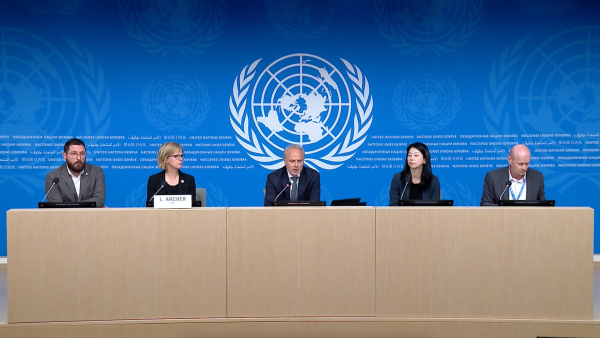
Rolando Gómez, Chief of the Press and External Relations Section at the United Nations Information Service (UNIS) in Geneva, chaired the hybrid briefing, which was attended by spokespersons and representatives from the World Health Organization, the United Nations High Commissioner for Refugees, the United Nations Office for the Coordination of Humanitarian Affairs, and the International Federation of the Red Cross and Red Crescent Societies.
Outbreak of Ebola disease in the Democratic Republic of the Congo and Uganda
Dr Anne Ancia, World Health Organization (WHO) Representative in the Democratic Republic of the Congo, speaking from Bunia in the Ituri province, provided an update on the Ebola outbreak caused by the Bundibugyo virus in the Democratic Republic of the Congo (DRC) and in Uganda.
The Government of the DRC had declared the outbreak on 15 May, following confirmation of eight cases in Ituri. The situation was deeply concerning, there being no licensed vaccine or treatment for this species of Ebola; supportive care was lifesaving, however.
There was significant uncertainty about the number of infections and how far the virus had spread. As of 19 May, more than 500 suspected cases, including 130 suspected deaths, had been reported by the Ministry of Health. So far, 30 cases had been confirmed in the DRC. The outbreak now affected ten health zones in Ituri province and had reached North Kivu. Uganda had confirmed two imported cases.
Community engagement would be key to bring the outbreak under control. WHO was working closely with the government, local leaders and other partners to map and address gaps, and to scale up surveillance, contact tracing, testing, clinical care, and cross-border preparedness. WHO had deployed experts to the field alongside national responders, and sent 12 tons of supplies, including personal protective equipment for frontline health workers. WHO was also working with non-governmental organizations, such as ALIMA and Médecins Sans Frontières, to set up treatment centres and expand care in affected areas.
Eujin Byun, for the United Nations High Commissioner for Refugees (UNHCR), highlighted the ongoing outbreak’s severe impact on displaced populations, especially those in the two provinces of Ituri and North Kivu, who were already most affected by continuous conflict and displacement.
More than 2 million internally displaced people (IDP) and returnees lived in the Ituri and North Kivu provinces, where humanitarian needs were already severe and access to basic services remained severely constrained. UNHCR was particularly concerned that capacity for health care in these provinces had been significantly weakened, including during last year’s conflict. This had left displaced communities with limited access to medical care, disease surveillance, isolation capacity and referral systems, at a time when rapid detection and response were critical.
In Ituri, approximately 11,000 South Sudanese refugees required preventive assistance; in Goma, more than 2,000 urban Rwandan and Burundian refugees needed support for prevention measures, including soap and hand-sanitizer. Community outreach activities and risk awareness campaigns were being reinforced to ensure refugees, internally displaced people, returnees and host communities had access to accurate information on prevention measures and early detection.
In North Kivu, UNHCR was closely following the closure of the Goma–Gisenyi and Bukavu borders: it was assessing implications for cross-border movements, voluntary repatriation and humanitarian access, while strengthening prevention measures at the Goma transit centre. UNHCR and its partners were coordinating with health authorities to support community outreach and prevention efforts in the coming days.
Laura Archer, Lead on Clinical Care and Public Health in Emergencies at the International Federation of the Red Cross and Red Crescent Societies (IFRC), stressed that early detection, community engagement, as well as local public health actors and actions, were critical to contain this outbreak.
IFRC was deploying specialized public health teams and experts to the affected areas in the coming days. Coordination mechanisms had been activated between IFRC teams in Kinshasa, Kampala, Nairobi, and Geneva, to support the response. Safe and dignified burial kits were currently being dispatched to the impacted areas from both Kinshasa and warehouses in Dubai.
The Red Cross Society of the Democratic Republic of Congo, supported by IFRC, was at the heart of this response. IFRC was working alongside health authorities and partners in all areas impacted by this outbreak. Red Cross staff and volunteers in DRC had extensive experience in Ebola outbreak response: they were directly supporting their communities through public health activities, including safe and dignified burials and risk communication and community engagement.
Previous experiences had taught that outbreak response had a greater likelihood of success when communities were actively engaged. People needed reliable, evidence-based information on how to protect themselves and on when and where to seek care. Local Red Cross volunteers played a vital role in sharing trusted information, countering misinformation, and supporting public health efforts within communities.
Ebola outbreaks could escalate quickly if cases were not identified early, if communities lacked reliable information, or health systems were overwhelmed. Unfortunately, all of these were coming together in this outbreak.
Responding to questions from journalists, Dr Ancia explained that the situation in Ituri – the epicenter of the current Ebola virus disease outbreak – was being complicated by the activities of armed groups and by mining operations and, as a result, by large-scale population movements. In Goma, where cases had also been confirmed, the outbreak was taking place against the backdrop of a humanitarian crisis that has been ongoing since 1994 and the activities of the M23 group. Health facilities had been attacked, and the Federation itself was facing logistical difficulties, including a shortage of lorries.
International experts said that vaccines for the previous strain of the virus could not be used in the present response. Two potential molecules were under investigation. Awaiting a vaccine, communities must be made to understand how to protect themselves, as well as how to identify contacts and isolate them, with the aim of breaking the chain of transmission. An important aspect in this regard was the organization of safe burials, in a context where burials are often a source of infection.
WHO would be bringing in anthropologists to ensure it fully understood how best to engage with communities and to build partnerships with them: if coercive measures were used and the public did not agree, suspected cases would refuse to go to hospitals and healthcare facilities.
WHO’s mandate covered health and public health issues, including health conditions during conflicts, it was clarified in response to another question. Thus, under the terms of a resolution adopted in 2022, the Director-General submits separate reports on the health situation in Ukraine. Yesterday, the Russian Federation requested that the issue of the health situation in Ukraine be dealt with within the framework of health emergencies in general, which the World Health Assembly rejected following a vote.
The health community had learnt a great deal from previous Ebola outbreaks, particularly regarding how to collaborate with communities – including churches, schools and traditional leaders – to curb the epidemic.
WHO needed to have clarity on the actual situation. There was a well-supported laboratory in Goma, and a brand-new laboratory was functioning in Bunia. WHO would bring in other mobile labs.
Regarding survival rates, WHO was looking into previous outbreaks in Uganda, which had had a lethality of between 40 and 50 percent (because many cases were suspected but never confirmed); and in the DRC, which had had a lethality of 30 percent. This subtype of Ebola virus, Bundibugyo, was a little bit less virulent.
MONUSCO (the United Nations Organization Stabilization Mission in the Democratic Republic of the Congo) was also helping; it had given WHO three ambulances and a cargo to transport supplies, as well as protective cars so that staff could go in unsafe area.
Research and development studies were ongoing in the DRC for Ebola, Mpox and African trypanosomiasis. A vaccine would not be available before two months. This did not mean this outbreak would be over in two months: it took two years to solve the previous one, Dr Ancia reminded.
Ms Archer said in the DRC, the IFRC was specifically supporting the Congolese Red Cross, which had activated 300 volunteers to the areas impacted, with more to come as needed. One team would be deployed as a “safe and dignified burial support team” for local responders. IFRC also had infection prevention control teams on standby, waiting for a request from the Ministry of Health.
Tarik Jašarević, also for the World Health Organization, said a WHO scientific Advisory Group would meet today to look into recommendations on which candidate vaccines should be prioritized for clinical trial. The committee would provide further recommendations on that.
The decrease in funding had had a marked detrimental effect on humanitarian actors, Dr Ancia said in response to other questions. The financing for water and sanitation, which was also extremely important, had decreased by 73 percent over a year.
Ms Byun indicated that the situation in DRC had always been severely underfunded. Ms Archer warned against a “very scary” trend of decreased funding for humanitarian health, not just from one government, but overall.
Jens Laerke, for the United Nations Office for the Coordination of Humanitarian Affairs (OCHA), said the global [funding] appeal for the DRC in 2026 had asked for USD 1.4 billion, of which OCHA had received USD 478 million, that is 34 percent. Health represented 105 million of that appeal: OCHA had received about USD 32 to 33 million of that. The United States was funding 61 percent of the funded amount.
Rolando Gómez, Chief of the Press and External Relations Section at the United Nations Information Service (UNIS) in Geneva, reminded that MONUSCO was deployed in the affected area and as part of its mandate, among other things, was coordinating with the Congolese authorities and with partners to help with the protection of civilians, and to provide health security in affected areas.
Announcements
Marcelo Risi, for UN Trade and Development (UNCTAD), said UNCTAD would issue today a report on the global economic outlook entitled Trade and Development Foresights 2026, as an update to its flagship Trade and Development Report 2025, released in December.
The new report showed that global growth was slowing, that recent trade resilience was narrower than expected, and that developing economies faced rising exposure to energy, food and financial pressures. It looked at what the conflict in the Middle East, energy prices, bond market volatility, and renewed concerns about inflation may mean for the global economy. The report showed that countries could reduce exposure to shocks by investing in affordable clean energy, stronger financial safeguards, and more predictable trade.
Sigrid Kranawetter, Director of Governing Bodies at the World Health Organization, gave an update on the proceedings of the 79th World Health Assembly (WHA). The general debate was expected to finish tomorrow around 2 p.m. Committee A – covering WHO's work on emergencies and current priorities, among others – had started yesterday.
The Assembly hoped to finish its committee work by Friday evening, Saturday being reserved for the adoption of their reports and any draft resolutions and decisions on the table, including resolutions on the situation and the health conditions in the Middle East; on Lebanon; on Ukraine; and on Palestine and the occupied Syrian Golan. Committee A would also take up a supplementary agenda item submitted by Gulf Cooperation Council Member States, and would consider resolutions submitted by Iran and Bahrain, respectively.
WHO’s mandate covered health and public health issues, including health conditions during conflicts, it was also explained. Accordingly, under the terms of a resolution adopted in 2022, the Director-General submitted a separate report on the health situation in Ukraine. Yesterday, the Russian Federation had requested that this item be dealt with within the framework of WHO’s work in health emergencies in general, a request which the World Health Assembly had rejected following a vote.
Journalists raised questions on individual cases of Ebola in Germany and the United States. Mr Jašarević said WHO did not have details on individual cases. Ebola was transmitted through close contact: people who had been identified as contacts of those infected should be monitored for 21 days, i.e. the duration of the incubation period.
In other announcements, Rolando Gómez, Chief of the Press and External Relations Section at the United Nations Information Service (UNIS) in Geneva, said the United Nations Secretary-General was now in Japan. Mr Guterres had met with the Prime Minister of Japan and had made remarks during an event on the future of multilateralism. While in Tokyo, the Secretary-General will take part in the UN Chief Executives Board for Coordination (CEB) meeting.
The Working Group on the Right to Development was holding its 27th session from 18 to 21 May 2026 in the Tempus Building.
In New York, the Security Council would hold public meetings on Ukraine (4 p.m. Geneva time) and on the situation in the Middle East (late in the evening).
The UN Department of Economic and Social Affairs (DESA) would issue today its 2026 mid-year update on the global economy, entitled World Economic Situation and Prospects 2026.
The reopening of the Celestial Sphere – an Art Deco work installed in 1939 for the twentieth anniversary of the League of Nations – would be officially celebrated during an event this Thursday, 21 May, at 4 p.m. The Director General would give remarks.
***
ANNOUNCEMENTS
UN Trade & Development
Marcelo Risi
• Trade and Development Foresights 2026 on the global economic outlook, an update to the flagship Trade and Development Report 2025 released in December.
WHO Tarik Jašarević with Sigrid Kranawetter, Director, Governing Bodies
• Update on the work of WHA
EBOLA
WHO Tarik Jašarević with Dr Anne Ancia, WHO Representative in the Democratic Republic of the Congo DRC, from Bunia, Ituri
• Update on the outbreak of Ebola disease caused by Bundibugyo virus in the Democratic Republic of the Congo and Uganda
UNHCR Eujin Byun
• Ebola outbreak in eastern DRC raises concerns for displaced people and humanitarian operations
IFRC Paolo Cravero with Laura Archer, IFRC Lead on Clinical Care and Public Health in Emergencies
• The Red Cross response to the Ebola outbreak in DRC
Similar Stories

1
1
1
Press Conferences | UPU
Release of the State of the Postal Sector Report 2026
1
1
1
Press Conferences | IOM , ITU , UNECE , UNICEF , WHO , WMO
UNICEF: Ebola, DRC - children orphans or separating them from parents and caregivers; IOM: Humanitarian needs in Djibouti amid arrivals from Yemen and increased migrant movements; WHO: Darfur, scale of health needs far exceeds available resources; WMO co-sponsored Global Heat Forum, Bangkok, monthly Global Seasonal Climate Update; UNECE: UN Forum of Mayors; ITU Plenipotentiary Conference 2026; WHO: child and adolescent obesity guidelines and new global roadmap to tackle pregnancy hypertension, a leading cause of maternal mortality
1
1
1
Press Conferences | OCHA , UN WOMEN , UNHCR , WFP , WHO , WTO , UNEP
OCHA – $160M CERF allocation to 12 underfunded crises; UNHCR – 5.8M refugee children remain out of school amid funding cuts; UN Women – Middle East escalation and food security among women/girls; WHO – Gaza supplies and overall situation; WFP – Yemen food insecurity and impact on global hunger ; UNEP - First International Conference of the Global Framework on Chemicals in Geneva | 16-20 November 2026
1
1
1
Press Conferences | UNHCR , WHO
Yemen's health system nears collapse amid conflict, causing rising casualties and medicine shortages.
1
1
1
Press Conferences | HRC
Update by the Expert Mechanism to Advance Racial Justice and Equality in Law Enforcement
1
1
1
Press Conferences | WIPO , WHO , UNICEF , UNHCR , IOM , WFP , FAO
WIPO Global Innovation Index 2026 launch and press conference, WHO Composition of influenza vaccines for the 2027 Southern Hemisphere flu season, UNICEF Yemen hunger and malnutrition; UNHCR Sudan displacement into Chad; IOM Ebola and population movements in DRC; WFP emergency food assistance in Nepal; and FAO food loss and waste.
2
1
2
Press Conferences | UNCTAD
Gaza reconstruction needs reach $71.5 billion as Palestinian economy and public finances face severe strain. Latest UNCTAD report documents the loss of decades of development gains, economic collapse in Gaza and tightening economic constraints in the West Bank.
The report identifies three immediate priorities: transferring withheld Palestinian revenues, safeguarding the banking system and aligning reconstruction support with the documented scale of damage and economic losses.
1
1
1
Press Conferences | HRC
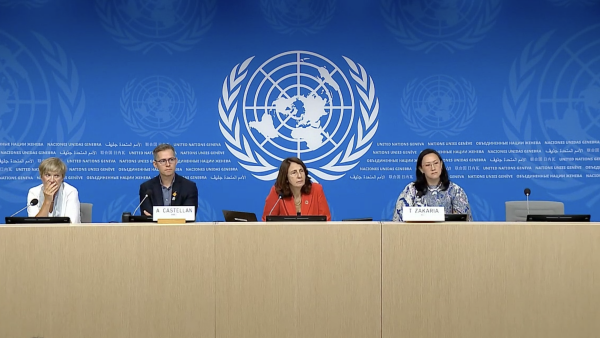
Press conference on the situation of human rights in Nicaragua by the UN Group of Human Rights Experts
1
1
1
Press Conferences | ITU , UNHCR , WHO , WMO
YEMEN - UNHCR: Escalating conflict in Yemen could fuel more displacement, refugee movement
CLIMATE - WHO / WMO: Health and Climate impact of El Niño
1
1
1
Press Conferences | HRC , OHCHR
Mariana Katzarova discusses human rights in Russia as a UN Special Rapporteur.
1
1
1
Press Conferences | IOM , OHCHR , UN WOMEN , UNFPA , UNHCR , UNOPS , WHO
UN Geneva briefing: Yemen crisis worsens, urgent aid needed across multiple sectors.
1
1
1
Press Conferences | HRC
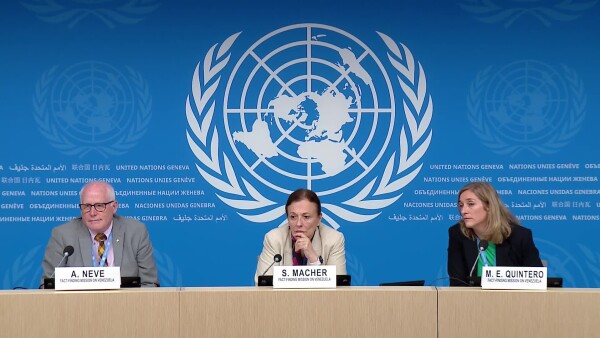
Press conference on the latest report of the Independent International Fact-Finding Mission on the Bolivarian Republic of Venezuela to the UN Human Rights Council